Leaves on a StreamEmotional Fitness · ~3 min
About this template · Updated September 2026
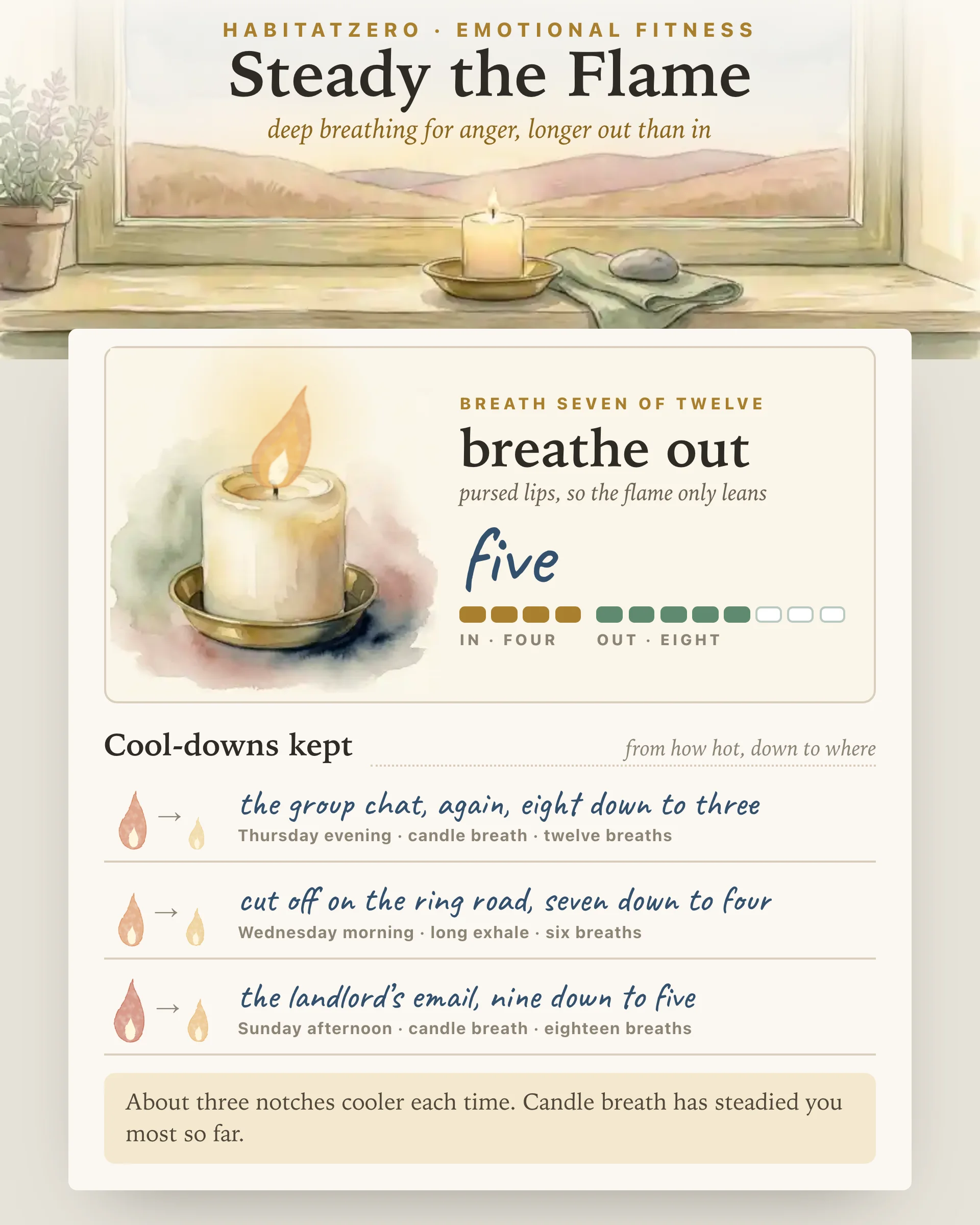
Anger is fast. The pulse is already up and the reply is already half typed before the thinking part of you has been consulted. Deep breathing exercises for anger do not argue with the feeling, and they do not ask you to pretend it away. They do one narrow job: they slow the body for a minute or two, so that whatever you do next is something you chose.
This page treats that minute as a candle. The flame is the heat you are carrying. You are not trying to blow it out, because anger is often information worth keeping. You are trying to get it to stand still.
Every pattern here is longer on the way out than on the way in, and that is deliberate. In a small laboratory study, people who breathed with a longer exhale than inhale reported more relaxation and less stress than when the same breath was weighted the other way round. A month-long randomized trial found that five minutes a day of exhale-focused cyclic sighing lifted mood more than mindfulness meditation did. Neither study was about anger in particular and both were modest in size, so read them as a reason to try the long exhale, not as a promise.
The anger evidence is broader. A 2024 meta-analysis pooled more than a hundred and fifty studies of anger management activities and found that the ones which lower arousal, deep breathing among them, reduced anger and aggression, while the ones which raise it did not. Hitting a bag, going for a hard run, venting at full volume: on average these left people about as angry as they started. Settling the body worked across ages, settings and ways of teaching it.
You can do all three with no screen at all. Sit or stand with both feet on the floor and let the breath drop as low into the belly as is comfortable, without forcing it, which is how the NHS describes its own calming breath.
First you read the heat. Ten small flames run from a flicker to a blaze. Tap the one that matches, and the candle beside them is redrawn at that size and color. Then pick a breath, pick six, twelve or eighteen rounds, and begin.
While you breathe, the flame stands tall for the in-breath and leans over for the whole of the out-breath, so your eyes can pace you when counting is too much to ask. A row of counts fills in underneath, and the stretch for breathing out is always the longer one. You can stop early; the whole breaths you finished still count.
Afterwards you read the flame a second time. If you like, tap what lit it (a message, traffic, being talked over) or write a few words of your own. Keep the cool-down and it lands in a ledger as two flames, the before and the after, with the numbers spelled out between them. The ledger holds twelve. Once it has a few lines it starts to answer a question no article can: how many notches does this usually take you down, and which of the three breaths does that best for you.
Breathing will not settle the thing you are angry about. It gets you steady enough to deal with that thing well, whether that means saying something hard in a level voice or deciding it was not worth your evening. If the number does not move, that is worth writing down too.
Go gently. Stop and breathe normally if you feel dizzy, tingly or short of air, and ask a doctor first if you live with a heart or lung condition. And if anger has begun to come out as violence, or you are frightened of what you might do, a candle on a screen is the wrong tool. Talk to a doctor or a licensed therapist, and call your local emergency number if anyone is in danger now.
Use it in the gap: after the email lands and before you answer it, in the parked car, in the hallway outside the room. If holding the breath suits you better than stretching it, 4-7-8 Breathing and Box Breathing both add a pause between in and out. And once the flame is steady and you want to decide what to do with the heat that is left, Steadying Practices picks up from there.
There is no single winner. What the better-studied patterns share is a slow pace and an out-breath that lasts longer than the in-breath. Four counts in and six counts out is a sound place to start, and the ledger on this page will show which of the three patterns moves your own number furthest.
Anger speeds the body up: quick pulse, tight chest, shallow breath. Slow breathing with a long exhale is linked in studies to a calmer body, and a large 2024 review of anger management found that activities which settle the body reduce anger while venting does not. The breathing buys a gap between the spark and whatever you do next.
Six slow breaths, about a minute, is the shortest session on this page and a fair first try. Two or three minutes gives the body longer to settle when the heat is high. Stop and breathe normally if you feel dizzy or tingly, which can happen when you breathe more deeply than you need to.
The research leans clearly toward calming down. Pooled studies found that hitting a bag, a hard run and similar ways of letting it out left people about as angry as before, while breathing and relaxation brought anger down. Breathing is not swallowing the anger. It gets you level enough to say what needs saying.
Anyone can look over the filled-in candle and its ledger on this page, and the three patterns are written out in full so you can breathe them unaided. Running the timer on your own anger and holding on to your cool-downs happens inside HabitatZero, which costs nothing to join.
By the team behind Fabulous, the science-based self-care app used by over 30 million people.