
The Overwhelm Recovery ProtocolWellness & Routines · ~5 min
About this template · Updated November 2026
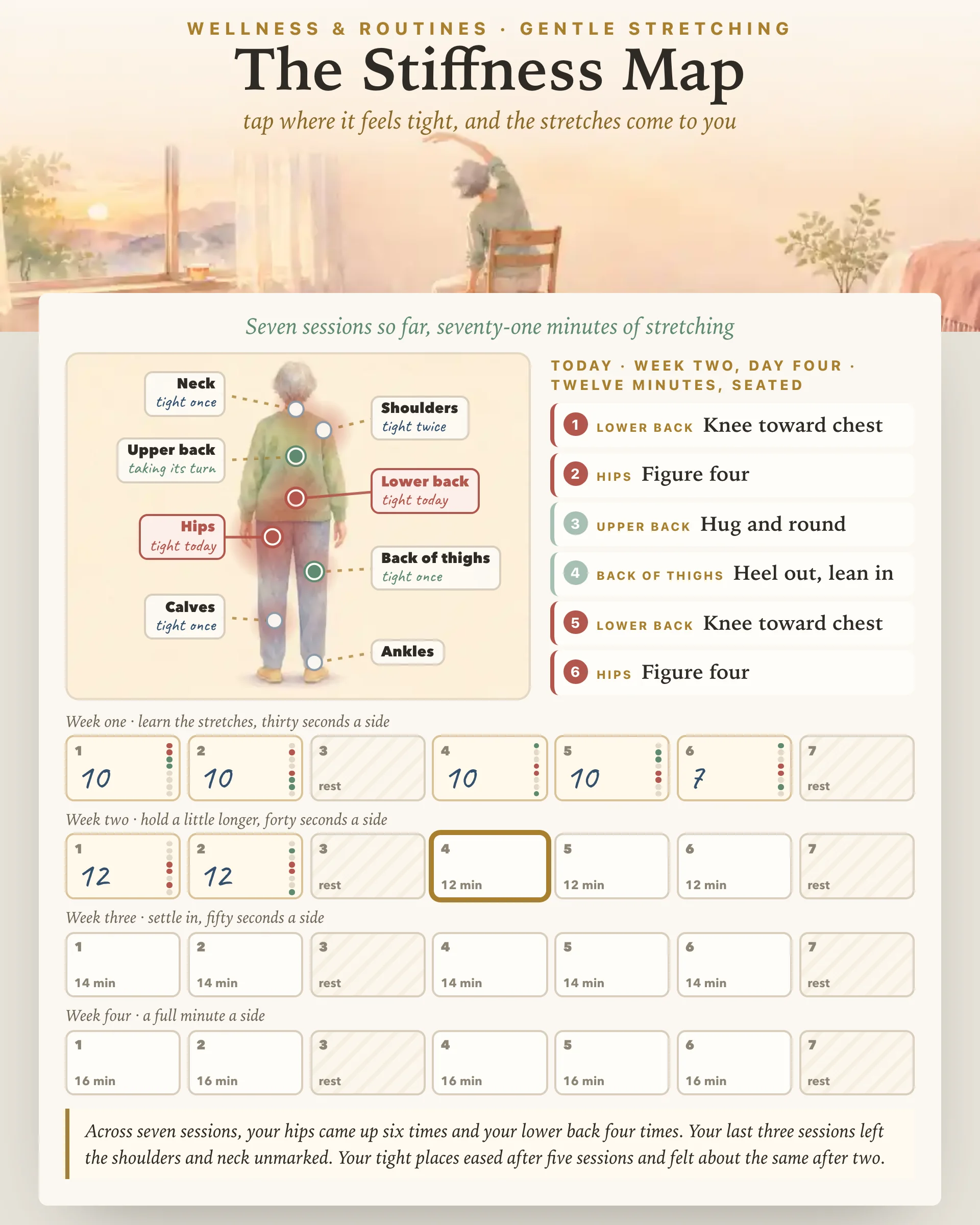
Stiffness rarely spreads evenly. One morning it sits at the back of your neck after a night on the wrong pillow; another week it is your hips after a long drive, or calves that grumble on the stairs. A fixed list of stretching exercises for seniors treats every body and every day the same. This page starts from where you feel it.
The painted figure has eight places: neck, shoulders, upper back, lower back, hips, back of the thighs, calves and ankles. Tap the ones that feel tight right now, up to six. The sheet then builds a session of six stretches:
Every stretch comes in two versions: seated in a sturdy chair without wheels, or standing with a hand on a kitchen counter, so your balance is never what is being tested. The morning version opens with two minutes of marching in place and shoulder rolls; the evening one warms up for a minute and closes with a minute of slow breathing.
Press begin and the timer walks you through it: ten seconds to settle into position, a hold on the first side, ten seconds to switch, a hold on the second. A ring counts down every hold, and pause freezes everything if the doorbell rings. If a stretch feels wrong today, skip it; skipped time is left out of your minutes.
The holds grow across the plan:
Each week has five stretching days and two rest days. A finished session lands on the calendar as a column of eight beads, neck at the top and ankles at the bottom, red where it felt tight and green where a place took its turn. After a couple of weeks the calendar becomes a record of where your stiffness lives, and the reading under it says which places come up most, which have gone quiet, and whether the tight places tended to ease.
The American College of Sports Medicine's position stand on exercise for adults recommends flexibility exercises for each major muscle group on two or more days a week, adding up to about sixty seconds per stretch. Your tight places reach that total from the first week, with two rounds of thirty seconds, and every place gets there in a single hold by week four.
Longer holds may matter more as the years go by. In a trial with people aged sixty-five to ninety-seven, those who stretched their hamstrings for sixty seconds, five days a week for six weeks, gained range of motion faster than those who held for fifteen or thirty seconds, and kept more of it a month after stopping. It covered one muscle group in sixty-two people, so read it as a reason to build toward the minute, not as a promise.
A systematic review of flexibility training in adults over sixty-five found that stretching programs may improve range of motion, but the evidence that this carries over into everyday tasks such as reaching, dressing or climbing stairs was conflicting. Stretching is not a falls program either. A large Cochrane review of exercise for preventing falls found strong evidence that balance and functional exercise lowers the rate of falls, and no trials at all comparing stretching alone with no exercise. If steadiness worries you, add The Balance Ladder rather than leaning on stretches alone.
What a short stretch most days can give you is a regular check-in with your body, joints moved through their range on purpose, and a few quiet minutes that belong to you.
Talk with a doctor or physical therapist before you start if you have had a fall, dizzy spells, a joint replacement, a heart or blood pressure condition, osteoporosis, or pain that will not settle. After a hip replacement, leave out any crossed-leg position until your surgeon or therapist clears it, and with osteoporosis, ask which bends and twists suit you. Ease into each stretch only until you feel a mild pull, breathe slowly, and never bounce. Stop anything that hurts. Whenever you stand for a stretch, keep a sturdy chair or a counter within arm's reach. Mark a session sore, and the sheet will tell you to ease the holds back.
For the same set every day, The Daily Stretch Mat keeps a morning set and a desk set on a painted mat. To stay seated and move with your breath, The Chair by the Window is a seated yoga sequence over the same four weeks. For poses that go a little further, with a chair, a counter or a mat at every step, The Woven Mat is a gentle yoga practice in three levels. The Stiffness Map is for the days when you would rather ask your body first.
Simple, still holds for the places that stiffen most: an ear drifting toward the shoulder for the neck, an arm drawn across the chest, a hug that rounds the upper back, a knee drawn toward the chest, figure four for the hips, a heel-out lean for the back of the thighs, a towel around the foot for the calves, and slow ankle circles. Each has a seated version and a standing one with a hand on a counter.
The American College of Sports Medicine suggests about sixty seconds in total for each stretch, on two or more days a week. This plan starts at thirty seconds a side, with your tightest places done twice, and reaches a full minute a side by week four. Hold still rather than bouncing, and stop at a mild pull.
Plenty of people feel stiffest soon after waking, so a short session before breakfast can make the day start easier. Move before you hold: the morning version opens with two minutes of marching in place and shoulder rolls, because a warm muscle takes a stretch more comfortably.
For most people, yes, with a few precautions. Use a sturdy chair without wheels, keep a counter within reach for every standing stretch, and back off at any pain. Talk with a doctor or physical therapist first if you have had a fall, dizziness, a joint replacement, osteoporosis, a heart or blood pressure condition, or ongoing pain, since some bends and crossed-leg positions may need swapping out.
Not on its own, as far as the evidence shows. A large Cochrane review of exercise for falls in older people found that balance and functional exercise lowers the rate of falls, but it found no trials comparing stretching alone with no exercise. If falls worry you, pair this plan with balance and strength work.
By the team behind Fabulous, the science-based self-care app used by over 30 million people.


