
The Overwhelm Recovery ProtocolWellness & Routines · ~5 min
About this template · Updated November 2026
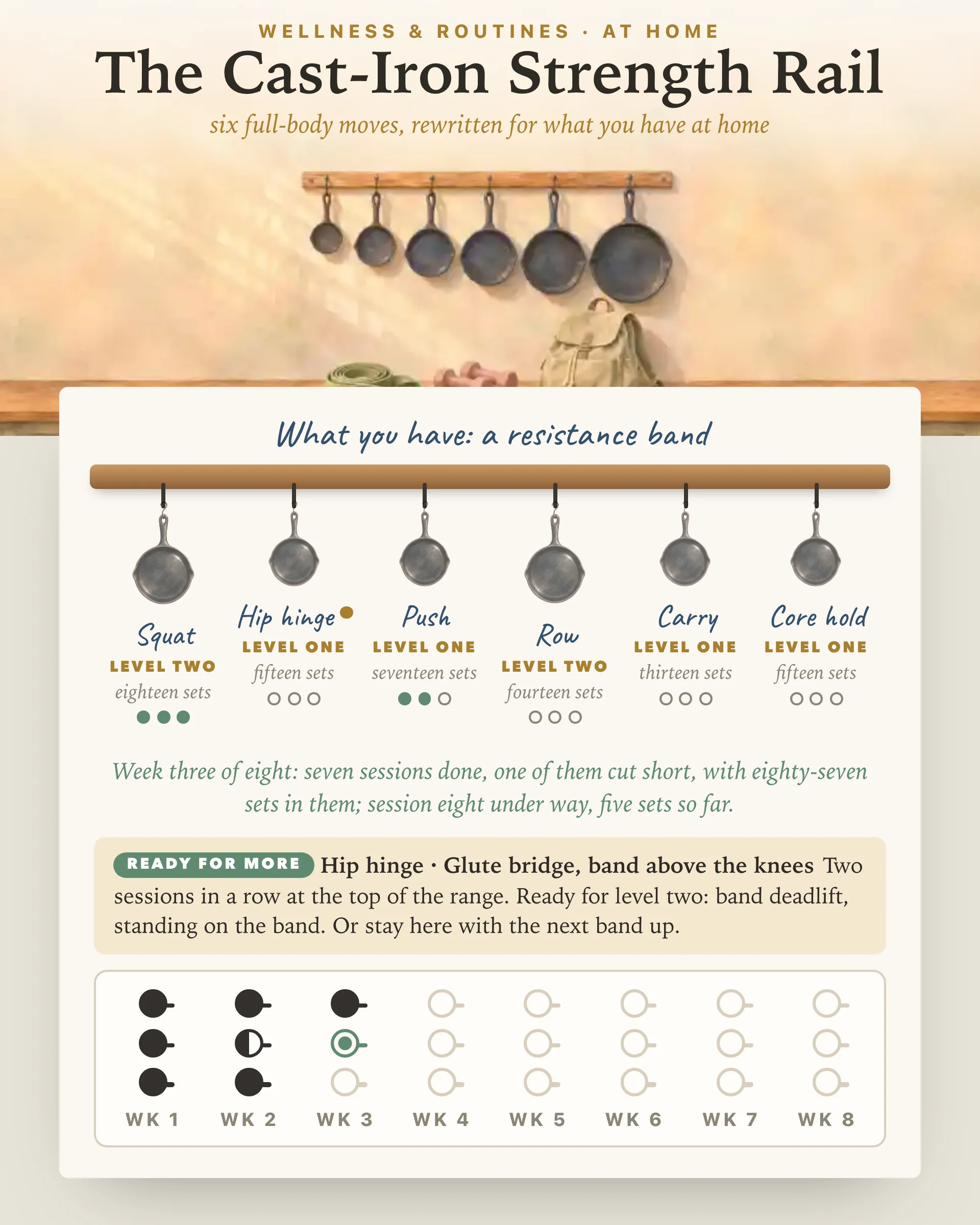
Strength training at home tends to stall on one question: what counts as enough when there is no rack of weights to climb through? This page answers with what you already own. Pick bodyweight only, a resistance band, a pair of dumbbells or a backpack full of books, and six moves rewrite themselves around that choice. Three days a week for eight weeks, you log each set, rest on a clock that keeps real time, and let a plain rule tell you when a move is ready for more.
Most of what a body does at home comes down to a few shapes. You sit and stand back up, bend at the hips for a basket on the floor, push away from a counter, pull a stuck drawer, carry bags in from the car, and keep your middle steady while the rest moves. The rail hangs one pan for each: squat to a chair, hip hinge, push, row, carry and a core hold.
Each pattern has three levels, and your gear decides what they look like. With only furniture, the push climbs from the wall to the kitchen counter to the floor, and the row leans back from a sturdy door frame. With a band, you stand on it to squat and shut it in a door to row. With dumbbells, the hinge becomes a Romanian deadlift. With a backpack, the load rides on your shoulders for squats and rests on your hips for bridges. Switch the gear and every card changes, while sets already logged keep the gear they were done with.
Tap a pan to open its card. The card names the move for your gear and level, this week's dose, and one line on form. Reps go in with plus and minus, the band or weight with a tap, and a set you had to cut short is marked stopped early. The carry and the core hold time themselves, and one stopped partway keeps only its whole seconds.
After each set a rest timer starts. It reads the clock itself, so a phone that locks in your pocket still ends the rest on time. Rests are never logged.
Every whole set seasons its pan a shade darker, the way a skillet builds its finish one use at a time, and a strip of twenty-four small pans below fills in session by session.
A move is ready for more when its two latest sessions both reached the top of the range on every planned set (twelve reps, forty seconds of carrying, or thirty seconds of holding) at the same level, with the same gear and nothing stopped early. The two must be in a row, so a session at another level or one cut short starts the count over. When the rule fires, the card offers the next level, or with a band, dumbbells or a pack, a little more load. Two sessions in a row with a set stopped early or under eight reps point the other way, toward an easier level.
Heavy iron is not a requirement for getting stronger. A 2017 meta-analysis of twenty-one trials by exercise scientists compared light and heavy loads in people with no medical limits on training, over at least six weeks, with every set taken to the point where another rep would not come. Muscle growth was similar. Heavy loads still raised one-rep maximum strength more, so lighter work builds strength, though not at the same pace, and only when sets end close to hard. That is why the last reps of each set here should feel like real work.
Bands hold up as well. Researchers in Brazil pooled eight trials of elastic bands against machines and dumbbells and found similar strength gains in the arms and legs. Eight trials is a small base, and they leave open which band suits which move.
Making a bodyweight move harder step by step also counts. In a four-week trial of push-up progressions, twenty-three young men who already trained gained bench press strength whether they benched or did ever harder push-ups. It was brief and small, and says little about older beginners.
On how often, the 2018 US physical activity guidelines ask for muscle-strengthening activity on two or more days a week. Three planned sessions leave room to miss one.
None of this promises a new shape, smaller clothes or a number on the bathroom scale. What it supports is stronger legs, hips, back and arms for the things you pick up and carry every day.
Check with a doctor or physical therapist first if you have a heart or blood pressure condition, chest pain or dizziness when you exert yourself, osteoporosis, a joint replacement, a recent injury or operation, or pain that lingers, or if you are pregnant. Stop any move that hurts, and take the easier level without guilt.
For timed circuits with no equipment, The Lace-Up Home Workout Plan runs four weeks of them. The Resistance Band Rack goes deeper on bands alone, The Dumbbell Bookshelf builds a circuit around a single pair, and The Rice Terrace Planner tracks moves you choose yourself once you want your own program. This rail comes before all of them: one plan that works with whatever is in the house today.
Yes, for most beginners. A 2017 review of twenty-one trials found light loads, taken until no further rep was possible, grew muscle about as well as heavy ones, although heavy loads raised one-rep maximum strength more. Bands, a backpack or body weight can do the job when each set ends close to your limit.
The 2018 US physical activity guidelines call for muscle-strengthening work on two or more days a week. This plan sets three sessions a week with a rest day between them, so a week with two still meets the guideline.
For everyday strength the moves matter more than the room. A 2019 review of eight trials found elastic bands built about as much strength as machines and dumbbells. A gym mostly helps later, when you want heavier loads than a house can offer.
A sturdy backpack filled with books or water bottles covers squats, hinges, rows and carries. Step on a bathroom scale with it and then without it to learn its weight. Full grocery bags or a laundry basket work for carries, and a solid door frame lets you row with your own body weight.
Talk to a doctor or physical therapist first if you have a heart or blood pressure condition, chest pain or dizziness with effort, osteoporosis, a joint replacement, a recent injury or operation, or pain that lingers, or if you are pregnant. Stop any move that hurts and drop back a level.
By the team behind Fabulous, the science-based self-care app used by over 30 million people.


