
The Overwhelm Recovery ProtocolWellness & Routines · ~5 min
About this template · Updated November 2026
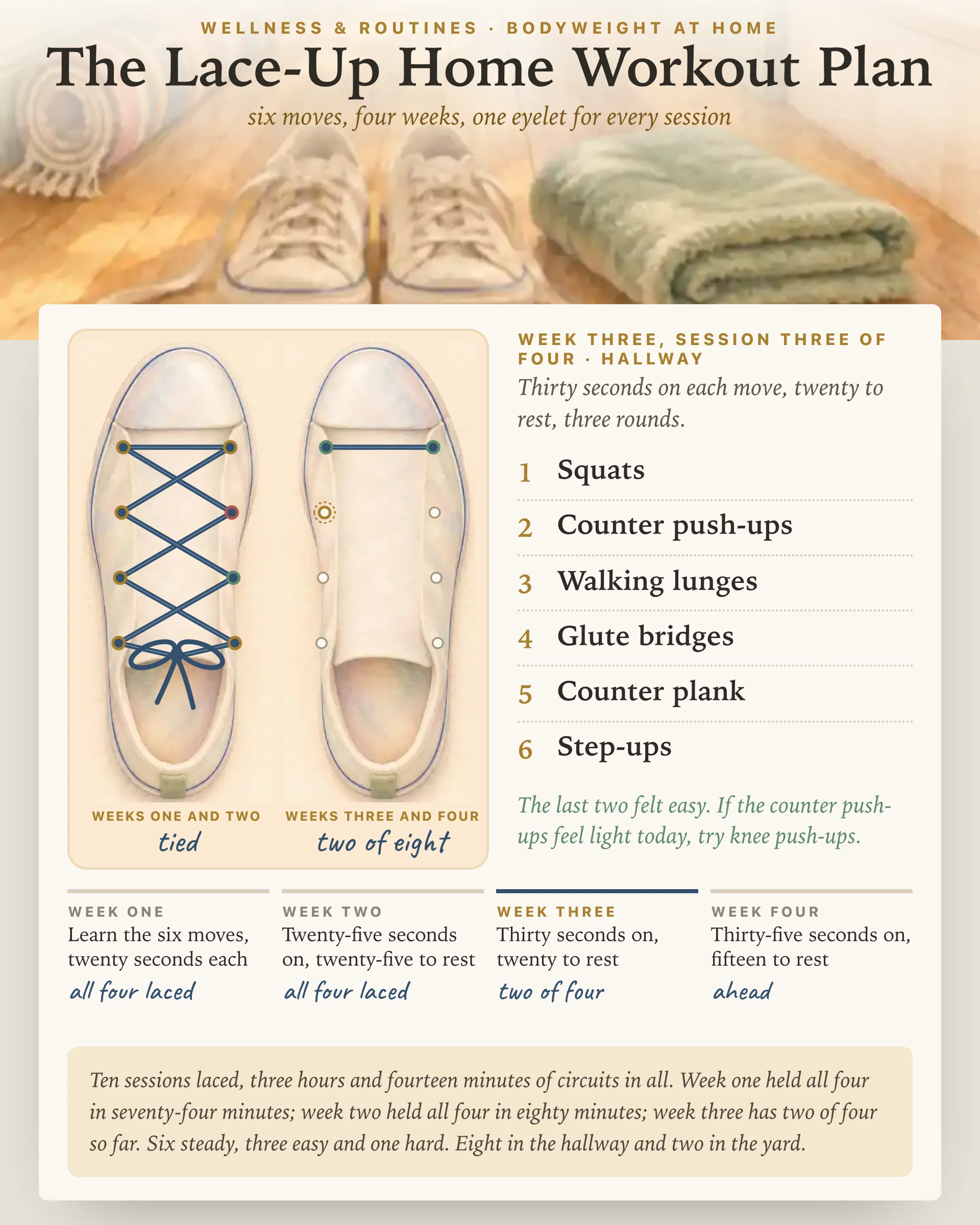
Most home workout plans stall in the second week, when the novelty is gone and the living room looks like a living room again. This page is built for that week. It gives you one circuit of six bodyweight moves, a clock that runs it for you, and a pair of painted shoes that lace up one eyelet for every session you finish. Four weeks of sessions fill both shoes.
If you are new to exercise, live with joint pain or a heart or blood pressure condition, or are healing from an operation, ask your doctor before the first session. Stop any move that hurts, as opposed to the ordinary effort of hard work. Keep a sturdy chair, a counter or the stair rail within reach for the lunges and the step move.
The circuit trains what your body does all day: squats for sitting down and standing up, push-ups for pushing off the floor, lunges for stairs and curbs, glute bridges for the back of your hips, a plank for your trunk, and a step move to raise your heart rate.
Where you move changes two of them. In a small room the lunges step backward in place and the step move becomes knee lifts beside a chair. A hallway gives you walking lunges and the bottom stair; a yard gives you the grass and the porch step.
Push-ups and the plank move together through four levels: against the wall, on a kitchen counter, on your knees, then on your toes. Start at the level where you can finish the whole work spell with good form and a little left in the tank.
Choose your space, three to five days a week, and fifteen to thirty minutes a session. Every session has the same shape: three minutes of warm-up, rounds of the six moves, and two minutes of cool-down. Each move gets a fifty-second station split into work and rest. Week one is twenty seconds of work and thirty of rest, and each week shifts five seconds from rest to work, so week four runs thirty-five on and fifteen off. A longer session adds rounds rather than speed: two rounds at fifteen minutes, five at thirty.
Press start and the clock names each move, counts down the work and tells you what is coming during the rest. It works out where you are from the time that has really passed instead of counting its own beats, so if your phone locks halfway through a plank, the circuit is still in the right place when you look back. Stopping early keeps the minutes you did.
When you finish, tap how it felt: easy, steady or hard. That laces one more eyelet, ringed in a color for the feeling. The left shoe holds weeks one and two and ties in a bow when they are done; the right shoe holds weeks three and four. After a session that felt hard, the page points you to the easier level for push-ups and plank. After two easy ones in a row, it suggests the next level up. Underneath, a reading adds up your sessions and minutes and says how each week went.
The World Health Organization's 2020 guidelines ask adults for 150 to 300 minutes of moderate activity a week, plus muscle-strengthening work on at least two days. Three twenty-minute circuits give you an hour of strength work, and a few brisk walks fill in the rest.
Bodyweight work can build strength when the effort suits you. In a small eight-week trial, young men who did push-ups set to a matched load, kneeling when they needed to, gained chest strength and muscle on a par with a group doing light bench presses. It had eighteen men around twenty years old, so it says nothing direct about women over forty or older adults, but it supports the idea behind the levels: fit the move to your strength, then nudge it up.
Over the long run, adults who do muscle-strengthening activity tend to live longer and get heart disease and diabetes less often. A 2022 review of cohort studies put the lower risk at roughly ten to seventeen percent, with the biggest drop at about thirty to sixty minutes a week. Those studies show a link, not proof that the exercise caused it, and more than an hour a week did not clearly add more benefit. Nothing here promises a smaller waist or a different number on the scale.
Open it on any day you have fifteen to thirty minutes and a cleared bit of floor. If even fifteen minutes is out of reach, The 7-Minute Workout runs a shorter circuit you can fit almost anywhere. If push-ups from the floor feel far off, The Wall Push-Up Ladder climbs toward them one rung at a time. On rest days, a gentle lap of The Living Room Mile keeps you moving without touching the circuit. When you want weights in the mix, The Coil Pot Workout Plan is a twelve-week full-body plan at home or at a gym.
When both shoes are tied, start new laces. Keep the days that worked, and take the next level up where the moves felt easy.
Something for each big job your body does: a squat and a lunge for the legs, a push-up for the chest and arms, a glute bridge for the back of the hips, a plank for the trunk, and a step or knee move that raises your heart rate. Six moves like these in a timed circuit cover the whole body in about twenty minutes, using only the floor, a wall, a chair and maybe a stair.
Yes, as long as each move is hard enough for you and keeps getting a little harder. In one small trial, young men who did push-ups adjusted to their strength, kneeling when needed, gained about as much chest strength and muscle as a group doing light bench presses over eight weeks. That is why this plan has levels for push-ups and plank and lengthens the work spells each week.
Three days a week is a solid start, with a rest day between sessions, and four or five works once those feel routine. World Health Organization guidance asks adults for muscle-strengthening work on at least two days a week alongside 150 to 300 minutes of moderate activity, so three twenty-minute circuits plus some walking lands well within it.
Fifteen to thirty minutes is plenty. Here every session holds a three-minute warm-up and a two-minute cool-down, and the time between them is rounds of the six moves, two rounds at fifteen minutes and five at thirty. Pick the length you can repeat on a busy day rather than the longest one.
A small room needs about two steps of clear floor in each direction. Lunges step backward in place there, and the step-ups become knee lifts beside a chair, so nothing in the circuit needs a stair, a long run of floor or any gear.
By the team behind Fabulous, the science-based self-care app used by over 30 million people.


