
Leaves on a StreamEmotional Fitness · ~3 min
About this template · Updated September 2026
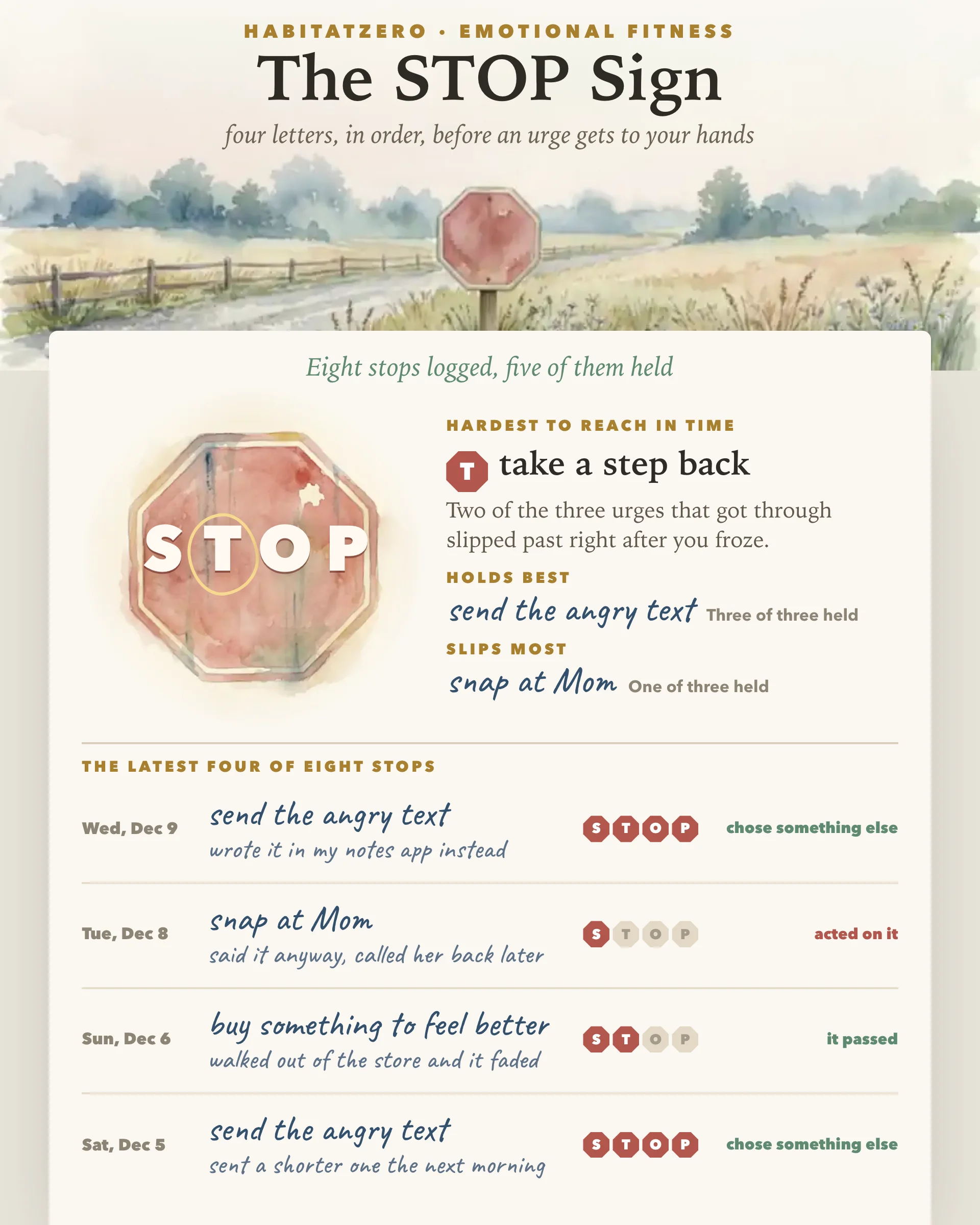
STOP is a skill from dialectical behavior therapy (DBT), the treatment psychologist Marsha M. Linehan developed, and it opens the distress tolerance module of her DBT Skills Training Handouts and Worksheets. It arrived with the 2015 second edition, and Linehan's preface credits the skill it was adapted from to Francheska Perepletchikova, Seth Axelrod and colleagues, whose team was adapting DBT for children. HabitatZero built this sign on its own. It has no connection to Dr. Linehan, the Linehan Institute or Behavioral Tech, and none of them has reviewed or endorsed it.
Most of the moves you regret happen fast. A text goes out before you reread it, a door slams, a shopping cart gets checked out, a sharp sentence leaves your mouth while the feeling is still climbing. Psychologists call the pull toward rash action under strong feeling urgency. A review in Psychological Bulletin described two forms of it, one tied to intensely bad feelings and one to intensely good ones, and linked them to problem drinking, binge eating and drug use.
STOP is built for the gap between the surge and the move. It does not ask you to feel differently. It asks you to hold still long enough to choose.
The order matters. Observing before you have stepped back tends to become arguing with the moment, and choosing before you have looked is often the urge wearing a disguise.
The sign sits near the top of the page with its four letters. When an urge hits, tap S and follow the card beside it. The letters light up one at a time and will not let you jump ahead. At O you tap what you notice rather than typing it out, and at P you can pick a move from a short list, which then rides along into your log.
Each stop gets its own line: the urge in your words, the last letter you reached, and, once you know it, how things went. A moment when the urge won still belongs in the log, and it is often the most useful entry there. The log keeps twelve stops, so an old one has to go before a thirteenth can join.
Once three stops have an ending, the sign starts reading back two things. The first is the letter your urges most often slip past, which gets a ring on the sign and a gentle nudge the next time you reach it. The second is which of your urges STOP holds best, and which it holds least often.
DBT skills training has solid backing. In a randomized trial with ninety-nine women at high risk of suicide, the versions of DBT that included skills training brought bigger drops in nonsuicidal self-injury and depression than the version without it. That result covers the skills as a package, taught by trained clinicians over a year. No study we could find tests STOP by itself, so read your log as a record of your own pattern rather than proof that the skill works.
This page is a place to practice, not therapy, and it cannot tell you what is wrong or whether you need care. If you are in a DBT program, bring the log to your individual therapist or skills group, where it can feed the rest of your work. If you are not, a DBT-trained therapist can teach STOP alongside the skills that surround it.
Use STOP for the urges that tend to cost you: snapping at someone you love, firing off a message, buying something to change how you feel, pouring a drink, quitting on the spot. Practice on small urges too, while little is at stake, so the letters come quickly when a lot is.
When a stop does not hold, trace how the urge got through with Link by Link, then look for the letter where a different move would fit. STOP is the first of the crisis survival skills, and The Crisis Survival Tin keeps the rest of them packed for moments that need more than a pause.
Some urges are bigger than any pocket skill, including urges to hurt yourself. If you are in crisis or thinking about hurting yourself, call or text 988 (US) right now, or reach your local emergency number.
Stop, take a step back, observe, and proceed mindfully. You freeze before reacting, put a little distance between yourself and the moment, notice what is going on inside and around you, and then pick the move that makes things better rather than worse.
In Marsha Linehan's DBT handouts the T is take a step back, and a slow breath is one way of doing it. Some mindfulness courses teach a look-alike STOP in which the T means take a breath, which is why both spellings of the acronym turn up online.
Printable STOP handouts are easy to find. This one is interactive instead: it walks you through the letters in order, keeps a log of every stop, and works out which letter your urges slip past. Printing the page puts your sign, reading and log on paper.
No. HabitatZero made this page independently, and neither Marsha Linehan, the Linehan Institute nor Behavioral Tech is affiliated with it or has endorsed it. Linehan's own STOP materials are in her DBT Skills Training Handouts and Worksheets, published by Guilford Press.
The filled-in sign on this page is yours to look over. Taking the letters in order, logging your own stops and getting the reading back all start once you personalize the template in HabitatZero, which costs nothing.
By the team behind Fabulous, the science-based self-care app used by over 30 million people.


