Leaves on a StreamEmotional Fitness · ~3 min
About this template · Updated September 2026
Behavior chain analysis comes from dialectical behavior therapy (DBT), the treatment developed by psychologist Marsha M. Linehan, who also founded the Linehan Institute. The 2015 second edition of her DBT Skills Training Handouts and Worksheets includes a worksheet called Chain Analysis of Problem Behavior, and it opens with the same three pieces this page asks for: the problem behavior, the prompting event and what made you vulnerable. HabitatZero built this paper chain on its own. Linehan, her institute and her publisher had no hand in it, and none of them has reviewed or approved it.
A behavior that seems to come out of nowhere almost never does. Chain analysis slows the minutes before it down to single steps, so you see the sequence rather than only the ending. The prompting event is where the chain begins, something that happened outside your head. Each link after it is small: a thought, a feeling, a sensation in your body, something you did, or something that happened around you. Vulnerabilities sit before all of it. Short sleep, hunger, pain or a week that already wore you down do not cause the behavior, but they make the chain run faster. Consequences come after, and they count too, because what follows a behavior shapes whether it shows up again.
The point is not to build a case against yourself. You are looking for the places where the chain could have gone another way, described plainly enough that next time you can spot them while they are happening.
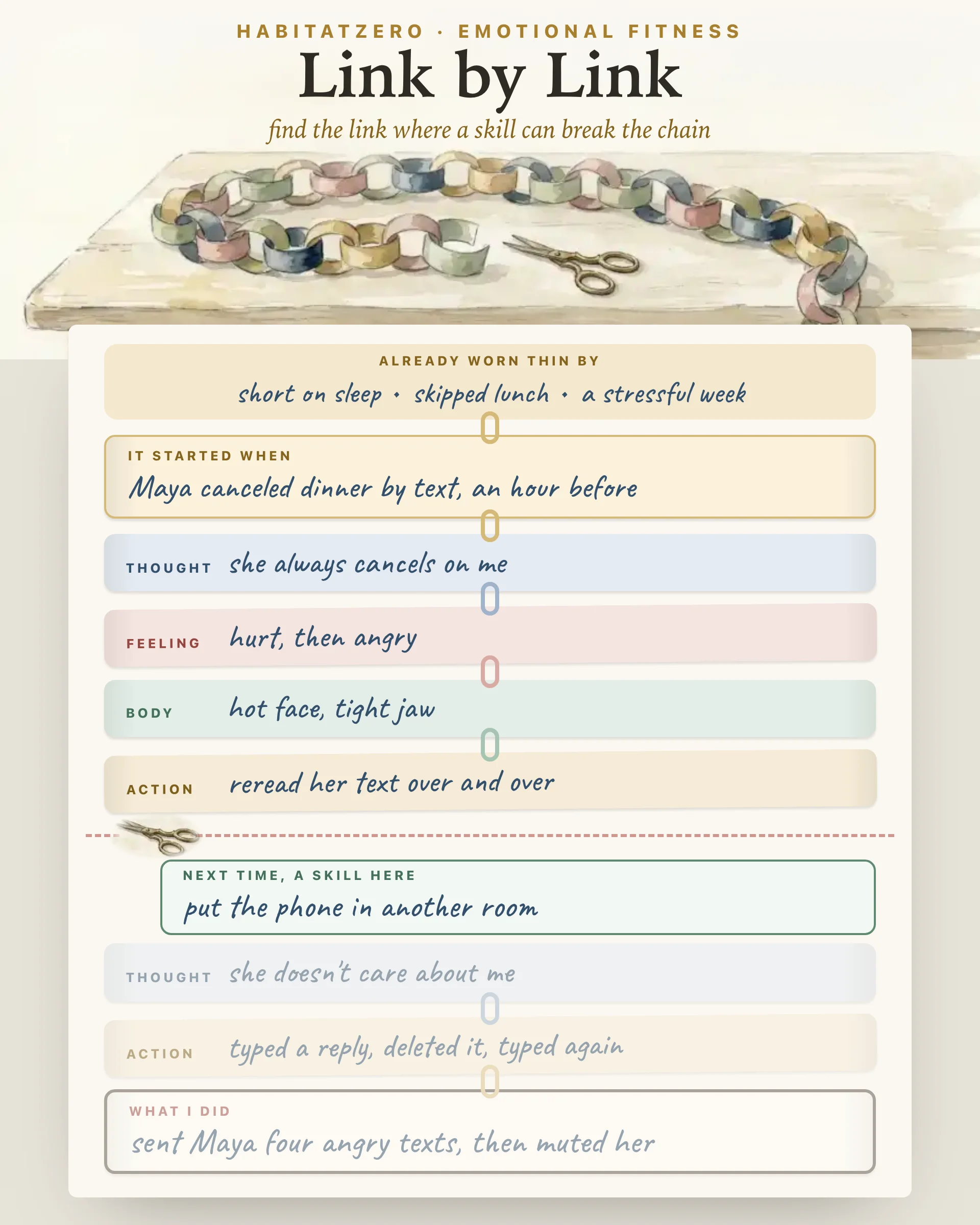
The chain hangs from a tag for what had worn you thin that day; tap what applied or write your own. The first link holds the prompting event. The heavy link at the bottom holds what you did, in words specific enough that someone else could picture it.
In between, choose the kind of link and tap a suggestion or write your own words. The rings between links are how you fit a smaller link in. A jump from "hurt" straight to "sent the texts" usually hides a few steps, and DBT therapists tend to ask for exactly those. The sheet reads your chain back by kind, and when a whole kind is missing, such as anything your body did, it asks about it. Ten links is the limit, plenty for one episode. If yours runs longer, start closer to the behavior.
Then switch to find the break. Tap cut here on a link where a different move was possible. The chain opens under it, the links below fade, and the page offers skills that suit that kind of link: checking the facts for a thought, slow breathing or something cold in your hand for the body, STOP or leaving the room for an action. Pick one or write your own. You can mark up to three breaks, and the Next time card gathers them and counts how far before the behavior the earliest one sits. The earlier a skill comes in, the less of the chain has built up behind it.
Last, note where the behavior landed and one step to mend what it touched. Naming a repair keeps the analysis pointed at what you can still do.
DBT as a whole has a serious research base. A meta-analysis of eighteen controlled trials found that DBT reduced self-directed violence and the use of psychiatric crisis services, while its pooled effect on suicidal thoughts fell short of significance. Chain analysis sits at the center of the treatment: a randomized trial of clinician training picked it and validation as the two core DBT strategies to teach, and found that brief training raised what clinicians knew while their observed skill with the strategies reached only moderate levels.
That second finding matters for anyone working alone. If trained clinicians need practice to run a chain analysis well, doing one alone is harder still. We know of no trial that tests a self-guided chain analysis on its own, and this page is not treatment. Use it to practice the method and to bring a clearer picture to someone trained in it.
DBT puts suicidal behavior and self-harm first among the behaviors it treats, so those are often the first chains a DBT therapist asks for. If the chain you are tracing ends in hurting yourself, work through it with your therapist rather than alone, and stop if going back over it starts pulling you under. If you are in crisis or thinking about hurting yourself, call or text 988 (US) right now, or reach your local emergency number.
Work through a chain within a day or two, while the details are still sharp, and only once any urge has passed. A chain is for looking back, not for the middle of a crisis; in the moment itself, reach for DBT Crisis Survival Skills first. If you keep a DBT Diary Card, the days it flags are the ones worth a chain. And if the same vulnerabilities keep appearing at the top of your chains, short sleep and skipped meals above all, the DBT PLEASE Skills are built for that stretch of the chain.
It is a DBT method for taking one specific behavior apart in the order it happened. You name the behavior and the event that set it off, note what made you more vulnerable that day, fill in every thought, feeling, body sensation and action between them, and finish with what followed.
The prompting event is what happened just before the chain started, outside your head: a text, a comment, a plan falling through. Vulnerability factors had already worn you down before it, such as poor sleep, hunger, illness, alcohol or a stressful week, which is why the same event can hit much harder on one day than on another.
A friend cancels dinner an hour before. The thought that she always cancels brings hurt, then anger, then a hot face and rereading her text over and over, and it ends in four angry texts. Looking back, a skill could have stepped in at that first thought by checking the facts, or at the rereading by putting the phone in another room.
Practicing the steps alone is worthwhile. In DBT, though, chain analysis happens in therapy, where a trained therapist catches the links people skip and helps turn each break into a plan. If the behavior you are looking at is self-harm or a suicide attempt, go through it with a clinician rather than by yourself.
The chain shown on this page is a filled example you can look through. Building and cutting your own chain, and keeping the plan for your next session, happens in HabitatZero at no cost.
By the team behind Fabulous, the science-based self-care app used by over 30 million people.