Leaves on a StreamEmotional Fitness · ~3 min
About this template · Updated September 2026
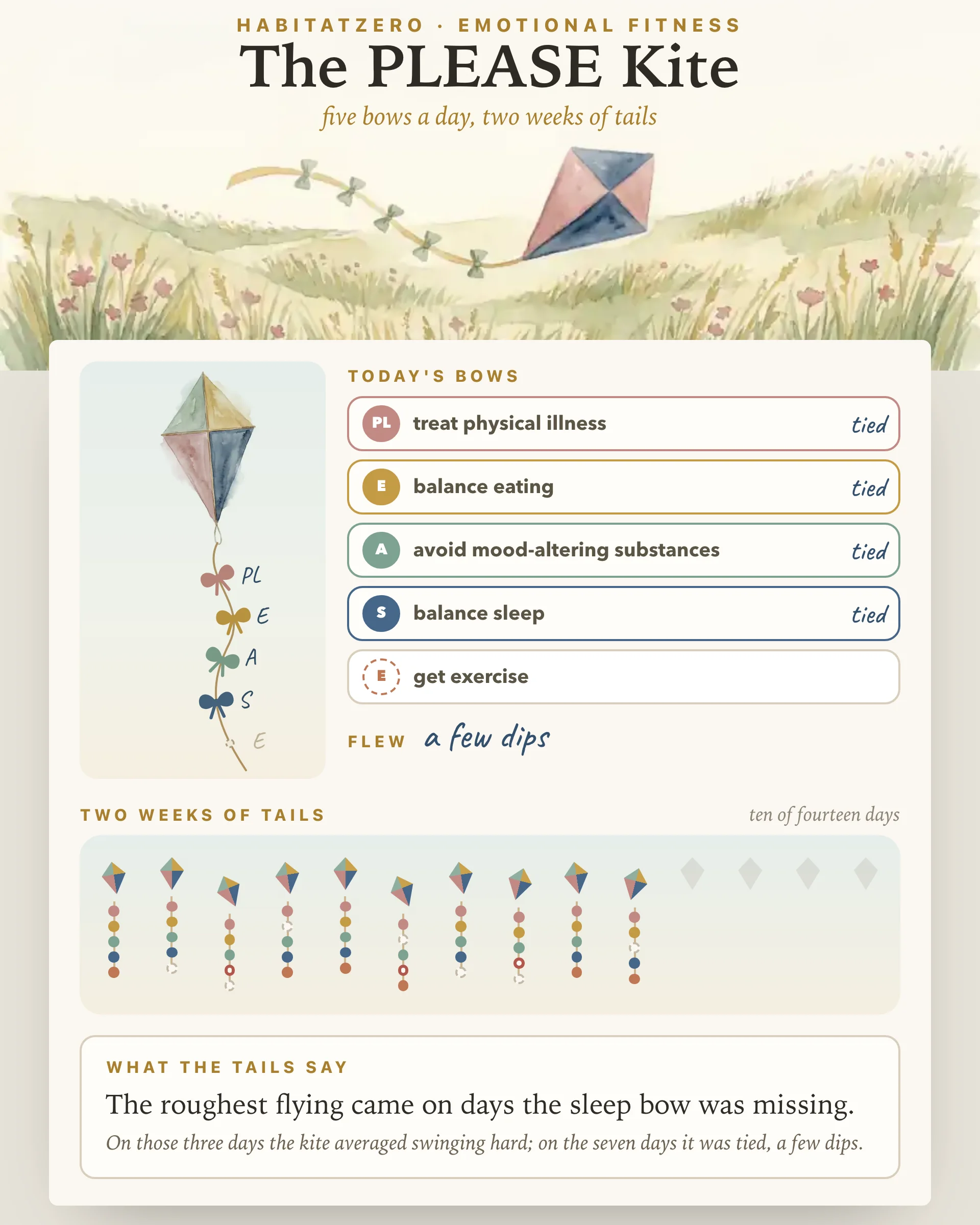
PLEASE comes from Marsha M. Linehan, the psychologist who developed Dialectical Behavior Therapy. It sits in the emotion regulation module of her skills training manual and its companion book of handouts, on a handout she titled "Taking Care of Your Mind by Taking Care of Your Body." The kite is our own way of practicing it. This page is independent: it has no affiliation with Linehan, Behavioral Tech or any DBT organization, and none of them has reviewed or endorsed it.
The letters name five kinds of plain body care: treat PhysicaL illness, balance Eating, avoid mood-Altering substances, balance Sleep, and get Exercise. The odd capitals are how the acronym gets built, which is why the L comes from the end of physical. Linehan files the set under reducing vulnerability to emotion mind. The same curt email lands differently after a full night's sleep and a real lunch than after four hours and a skipped one. PLEASE will not stop the email. It changes how far you swing when it arrives.
Once a day, tap a bow for each skill you kept, by your own measure of balanced, then pick the word nearest to how the kite flew: steady, a few dips, tugged about, swinging hard or spinning. That word rates how steady your feelings ran, not whether the day went well. Add a line about what pulled at the string if you like, then log the day. Its tail joins a line of up to fourteen, calm days flying high and rough ones drooping.
From day five, the page does arithmetic a paper sheet cannot. For each bow it averages your flights on the days you tied it and on the days you did not, and when one bow's gap clearly beats the rest, it says so plainly: the roughest flying came on days the sleep bow was missing, for instance. A bow you tied every day, or missed only once, is left out of the comparison rather than guessed at.
Sleep has the firmest support. A set of three meta-analyses in the journal Sleep pooled sixty-four studies in which people's sleep was cut short or skipped, and found that losing sleep lowered positive mood sharply and raised negative mood moderately. That is close to what PLEASE predicts: no new feelings out of nowhere, just less cushioning against the ones already on their way.
PLEASE itself has not, as far as we can find, been tested on its own. Its evidence travels with DBT skills training as a package. In a pilot trial with forty-four adults who were anxious or depressed and struggled to manage their emotions, sixteen weeks of DBT skills training reduced emotion dysregulation more than an activities-based support group did, and the gains tracked how much people used the skills. That supports practicing the skills; it cannot tell you how much of the benefit came from the body-care part.
Your own tails deserve the same caution. A rough day can cost you sleep as easily as a short night can make a rough day, and fourteen days is a small sample. Treat the reading as a hunch to test: tie the named bow on purpose for the next two weeks, start a fresh line, and see whether the flying changes.
This page is a skills practice, not treatment or medical advice. It will not diagnose anything, tell you what to eat, or grade what you drink. If an illness, your eating, your sleep or your mood worries you, talk with a doctor or a therapist, and if you are in a DBT program, bring the tails to your skills group. If drinking or drug use feels out of your control, SAMHSA's National Helpline is free, confidential and open around the clock in English and Spanish: 1-800-662-4357.
Tie the bows in the evening or first thing the next morning, before the details blur. PLEASE works on the days before a hard moment, so pair it with skills for the moment itself. When a feeling is already running hot, Steadying Practices walks you through cooling it. When the A bow keeps slipping because an urge to drink or use keeps building, Urge Surfing helps you ride the urge out. And when you want to see where PLEASE sits among the other DBT skills, The Skills Compass lays them out on one rose.
Treat PhysicaL illness, balance Eating, avoid mood-Altering substances, balance Sleep and get Exercise. The capital letters build the acronym, so the L is borrowed from the end of physical. Marsha Linehan teaches the five together as taking care of your mind by taking care of your body.
They lower your vulnerability to emotion mind. A body running on too little sleep, skipped meals or an untreated illness tends to react faster and harder to the same event, so steady body care leaves feelings less fuel. The skills do not switch emotions off; they make the swings smaller and easier to steer.
It is Linehan's shorthand for the emotion regulation skills that lower your vulnerability before a hard moment arrives. A stands for accumulating positive emotions, B for building mastery, C for coping ahead of emotional situations, and PLEASE for the body care. This kite covers the PLEASE half, one day at a time.
About two weeks. Under five days there is nothing fair to compare, and in a short log one rough day can tip the whole picture. The reading here opens on day five and grows steadier as the line fills toward fourteen.
The sample kite on this page is free to explore without signing up. Tying your own bows each day and keeping the two-week line happens in HabitatZero, which costs nothing and saves every tap as you make it.
By the team behind Fabulous, the science-based self-care app used by over 30 million people.