Leaves on a StreamEmotional Fitness · ~3 min
About this template · Updated September 2026
The diary card comes from dialectical behavior therapy, the treatment Marsha M. Linehan developed and refined during more than forty years leading the Behavioral Research and Therapy Clinics at the University of Washington. The clinic's site still lists the diary cards Linehan and her colleagues developed or adapted for their research programs. HabitatZero made this version on its own. Dr. Linehan and the university had no part in it, and neither has reviewed or endorsed it.
In DBT you fill the card in every day and hand it to your therapist at the start of each session, and much of the hour is built from what it shows: which urges ran high, what you did with them, which skills you reached for. This page is a tidy way to keep that record. The reading of it, and the therapy itself, still happen with a person.
Each row on a diary card is something you and your therapist have agreed to watch:
Printed cards usually run the days down the left edge; here they run along the top so the grid fits a phone.
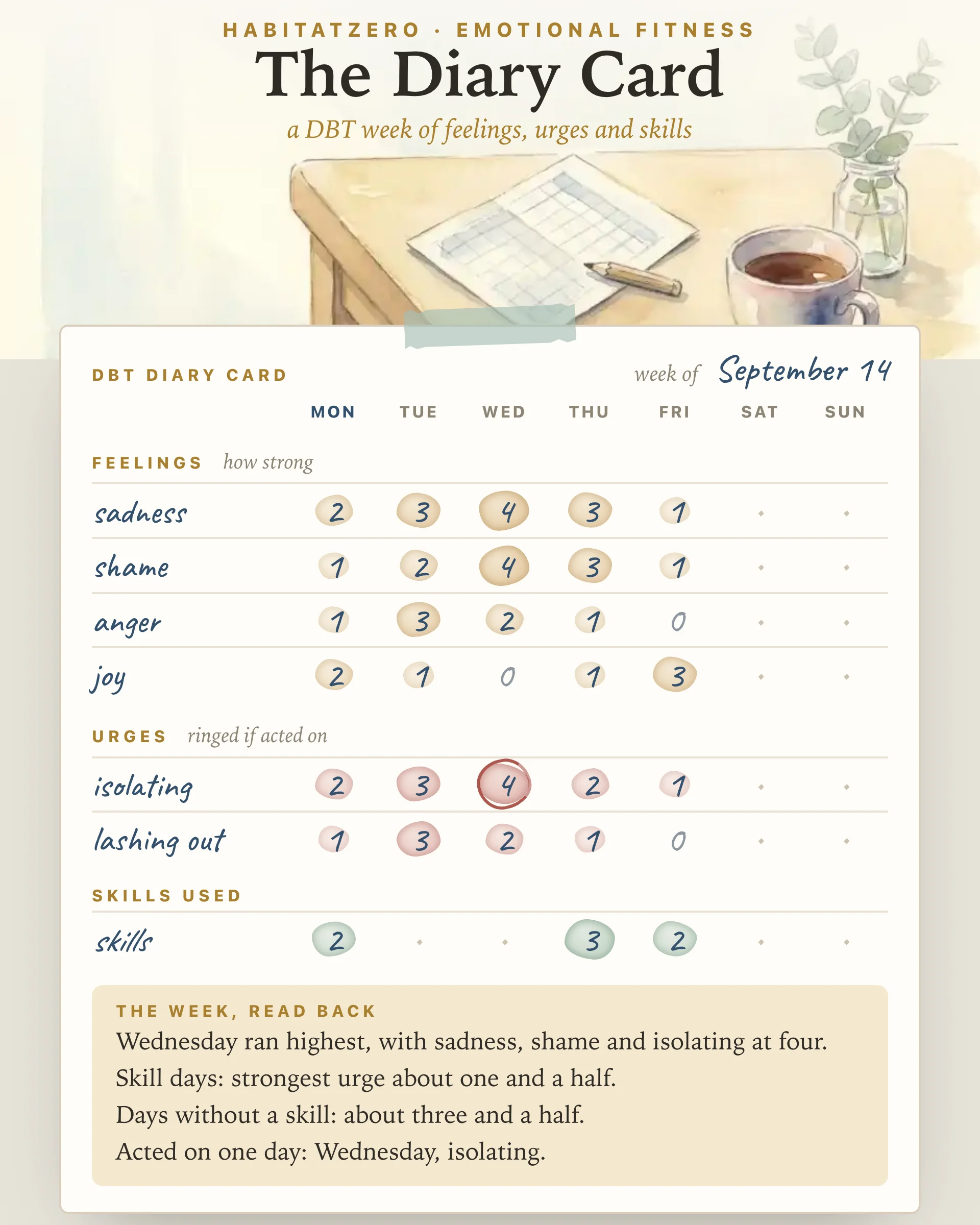
Tap up to five feelings and four urges, or write your own in a couple of words. Then fill in a day: one tap per row, zero to five. Each rating paints a wash into its square, deeper for higher numbers, so by midweek the card is a small watercolor of your week with the heavy days easy to spot. Mark an urge you acted on and its number gets a ring. Tick skills one module at a time; the card counts them under each day and lists them on the back with the days circled.
From the second day on, the card reads the week back. It names the day that ran highest and the rows that took it there. It sets your strongest urge on the days you used a skill against the days you didn't, and says so plainly when the numbers run the other way, which usually means the skills came out on the hardest days. It lists the days an urge was acted on, without comment. Print the week when it is done; starting a new week clears the ratings and keeps your rows.
The card wants daily entries because memory is a poor instrument for feelings. A review of ecological momentary assessment in mood disorders puts greater accuracy and less retrospective bias first among the benefits of rating in the moment. A week pieced together in the waiting room loses its peaks, which are what the session needs.
There is some evidence about the card itself. In a preliminary randomized trial with women who binge ate, fifteen sessions built around adapted DBT diary cards, with no formal teaching of skills, led to large improvements in binge eating, and so did group DBT. It looked at one problem, and a clinician went over the cards with each woman every session, so it cannot show that a card kept alone does the same.
Skills use seems to be part of how DBT works. In data from 108 women across three of Linehan's trials, people in DBT reported about three times as many skills by the end of treatment as people in comparison treatments, and that difference fully accounted for their fall in suicide attempts and depression. One week of skill days beside plain days is a tiny sample by comparison, so treat any pattern on your card as a question for your therapist, not a finding.
If you are in DBT, keep it daily at the same time each evening and print it the night before your session. If you are learning skills alone or waiting for a therapist, the card still shows you what your weeks look like; bring it to a professional rather than letting it stand in for treatment.
If the skills row keeps coming up empty, The Skills Compass hands you one skill for the moment you are in. When the same urge runs high day after day, Urge Surfing gives you fifteen timed minutes of riding one out. When the hard days keep tracing back to one person, The DEAR MAN Script helps you plan what to say to them.
If you are in crisis or thinking about hurting yourself, call or text 988 (US) right now, or reach your local emergency number.
It is the weekly self-monitoring sheet used in dialectical behavior therapy. Every day you rate a handful of emotions and urges from zero to five, note any urge you acted on, and mark the skills you practiced. Your therapist reads it at the start of each session and uses it to decide what the hour works on.
Once a day, ideally at a set time each evening. Score each emotion and urge by its peak that day, where zero means it never came up. Mark any urge you acted on, tick the skills you used, and resist catching up on the whole week in the waiting room, since memory smooths out the highs.
This card is interactive rather than a fixed PDF, and the finished week prints with the buttons left off, so saving it as a PDF from the print dialog gives you a file to send ahead. If your therapist hands out a diary card of their own, keep theirs: the columns they chose are the ones they read.
You can, and noticing your patterns day by day has value of its own. Diary cards were designed to be read with a clinician, though, who turns what they show into the work of the session. Treat a card kept alone as practice, and take it to a professional if the urges you are tracking involve hurting yourself.
The filled-in week on this page is an example you can study but not change. Choosing your own rows, rating your days and printing your week happens once you open the card in HabitatZero, and that costs nothing.
By the team behind Fabulous, the science-based self-care app used by over 30 million people.