Leaves on a StreamEmotional Fitness · ~3 min
About this template · Updated September 2026
DEAR MAN comes from dialectical behavior therapy, the treatment psychologist Marsha M. Linehan developed at the University of Washington. Her profile at the Behavioral Tech Institute, the training organization she founded, is the best place to read about her work. The skill itself is taught in her DBT Skills Training Manual, inside the module on interpersonal effectiveness. HabitatZero built this script builder on its own initiative: Dr. Linehan and Behavioral Tech have no part in it and have not endorsed it.
Dialectical behavior therapy is a full treatment, delivered over months by clinicians trained in it, usually with individual sessions and a weekly skills group. This page is rehearsal space for one of its skills: useful, and a great deal smaller.
Hard conversations tend to go wrong in one of two ways. You circle the request so long that the other person never hears it, or you say everything at once, with three old grievances attached. DEAR MAN gives the conversation an order, one move per letter.
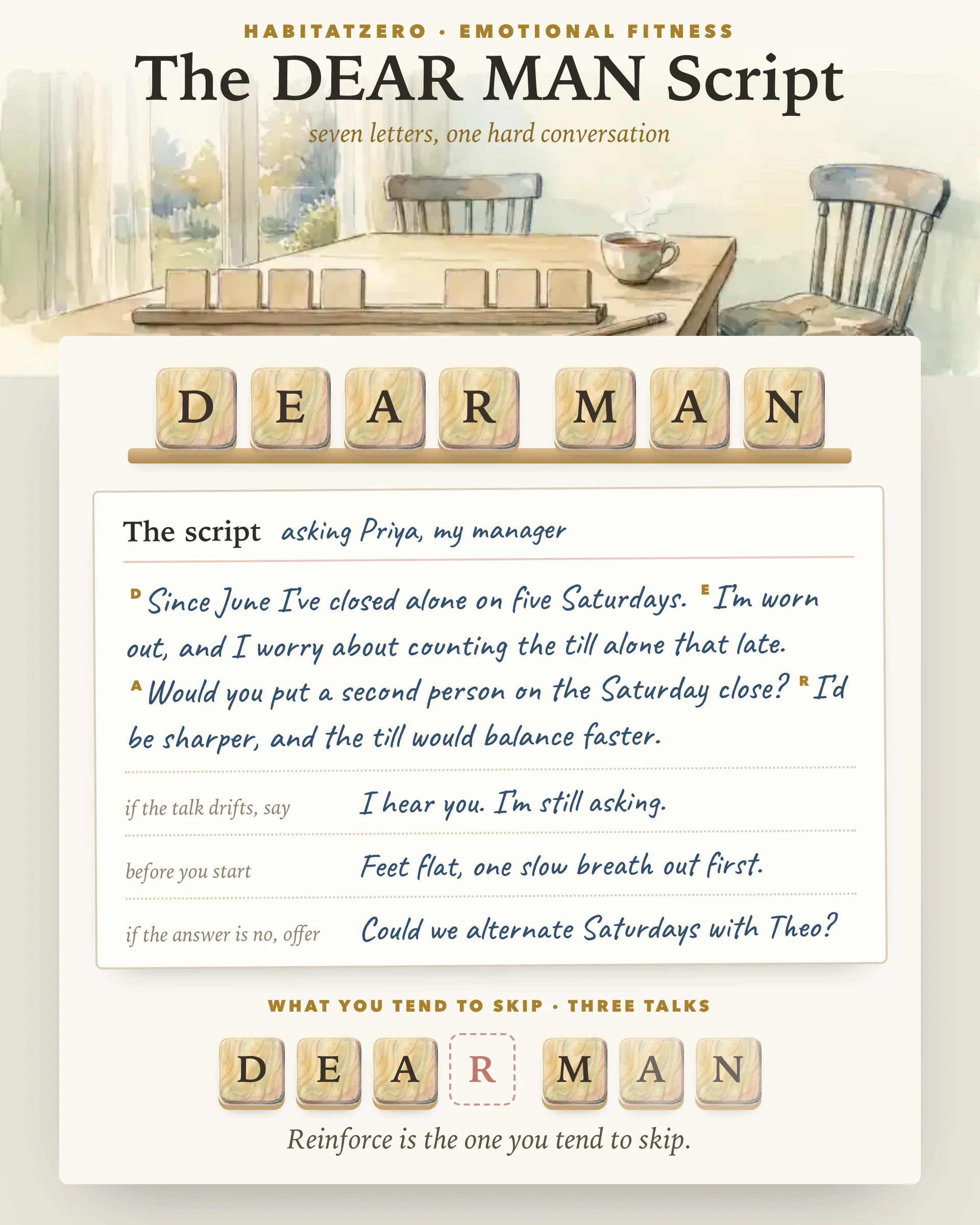
The first four letters are what you say, in that order. The last three are how you carry it.
The seven letters sit on a wooden rack as tiles. Tap one and its line opens underneath, with a hint and a few starters, such as Since last month or Would you, that you finish in your own words. Each line holds about one breath, because a line you can't say in a breath is a line you will rush. A written line stands its tile up on the rack.
Switch between asking for something and saying no, and the starters follow: Would you becomes No, I can't. Below the rack the script assembles itself: the first four lines join into one paragraph in speaking order, and the other three wait underneath as cues.
Then rehearse. The page shows one letter at a time, your line in large handwriting, with a short reminder of how that step works. Say each one out loud, to the wall if need be. A run only counts when you reach the last letter.
After the real conversation, tap the letters that actually made it in, say how it went and add a line. The log holds ten talks, and after two or three of them the row of tiles above it shows a pattern: the letter you tend to leave out fades to an outline. If it keeps being the same letter, write that line first next time.
Practicing the skills looks like one of the ways DBT does its work. When Linehan's group followed 108 women with borderline personality disorder through three of its randomized trials, those treated with DBT reported using about three times as many skills by the end as those in comparison treatments, and that rise in skills use statistically accounted for their drop in suicide attempts and depression and their gain in anger control. The study measured the whole skills curriculum across a year of treatment, so it cannot tell you what DEAR MAN alone contributes.
DEAR MAN also sits close to an older behavioral tradition, assertiveness training. A 2018 review in Clinical Psychology: Science and Practice described it as a forgotten evidence-based treatment, linking unassertiveness to a range of clinical problems and the training to benefits across many of them. That supports practicing the moves, not any promise about a single conversation: the answer is still theirs to give.
Use it for the conversations you keep having in your head and never out loud: a schedule that no longer works, a housemate and the dishes, a favor you want to turn down without a fight. Write the script an hour or a day ahead, rehearse it twice, then have the talk while the words are fresh.
It is the wrong tool when the other person could hurt you. If a conversation might put you at risk, put safety first and talk it over with someone you trust or a professional. If your feelings are running too hot to write, cool them first with Steadying Practices.
If you are not sure DEAR MAN is the skill this moment calls for, The Skills Compass routes across all four DBT modules and hands you one. When the trouble is a line someone keeps crossing rather than a single request, the Boundaries Worksheet helps you find it and hold it.
Describe, Express, Assert, Reinforce, then stay Mindful, Appear confident and Negotiate. The first four letters are what you say, in order: the facts, how they land for you, the request or refusal itself, and what a yes gives the other person. The last three describe how you carry yourself while you say it.
Asking a manager for help on late shifts. Describe: since June I have closed the shop alone on five Saturdays. Express: I am worn out and uneasy counting the till that late. Assert: would you put a second person on the Saturday close? Reinforce: I would be sharper on weekends and the till would balance faster. If the talk wanders, repeat the ask calmly, and if the answer is no, offer to alternate Saturdays with a colleague.
Yes. The order stays the same; only the Assert line turns from a request into a plain refusal, and Reinforce names what the no protects. Switch this page to saying no and the starters follow, from No, I can’t to an offer to help with a smaller part.
All three come from the interpersonal effectiveness module of DBT. DEAR MAN is for getting the outcome you are after. GIVE, short for gentle, interested, validating and an easy manner, protects the relationship. FAST, short for fair, no needless apologies, sticking to your values and truthful, protects your self-respect. Most real conversations need a little of each.
The page above shows a filled example you can read. Writing your own script, rehearsing it and keeping a log of your talks happens once you personalize the template in HabitatZero, which costs nothing, and the finished script prints cleanly with the buttons left off.
By the team behind Fabulous, the science-based self-care app used by over 30 million people.