Leaves on a StreamEmotional Fitness · ~3 min
About this template · Updated August 2026
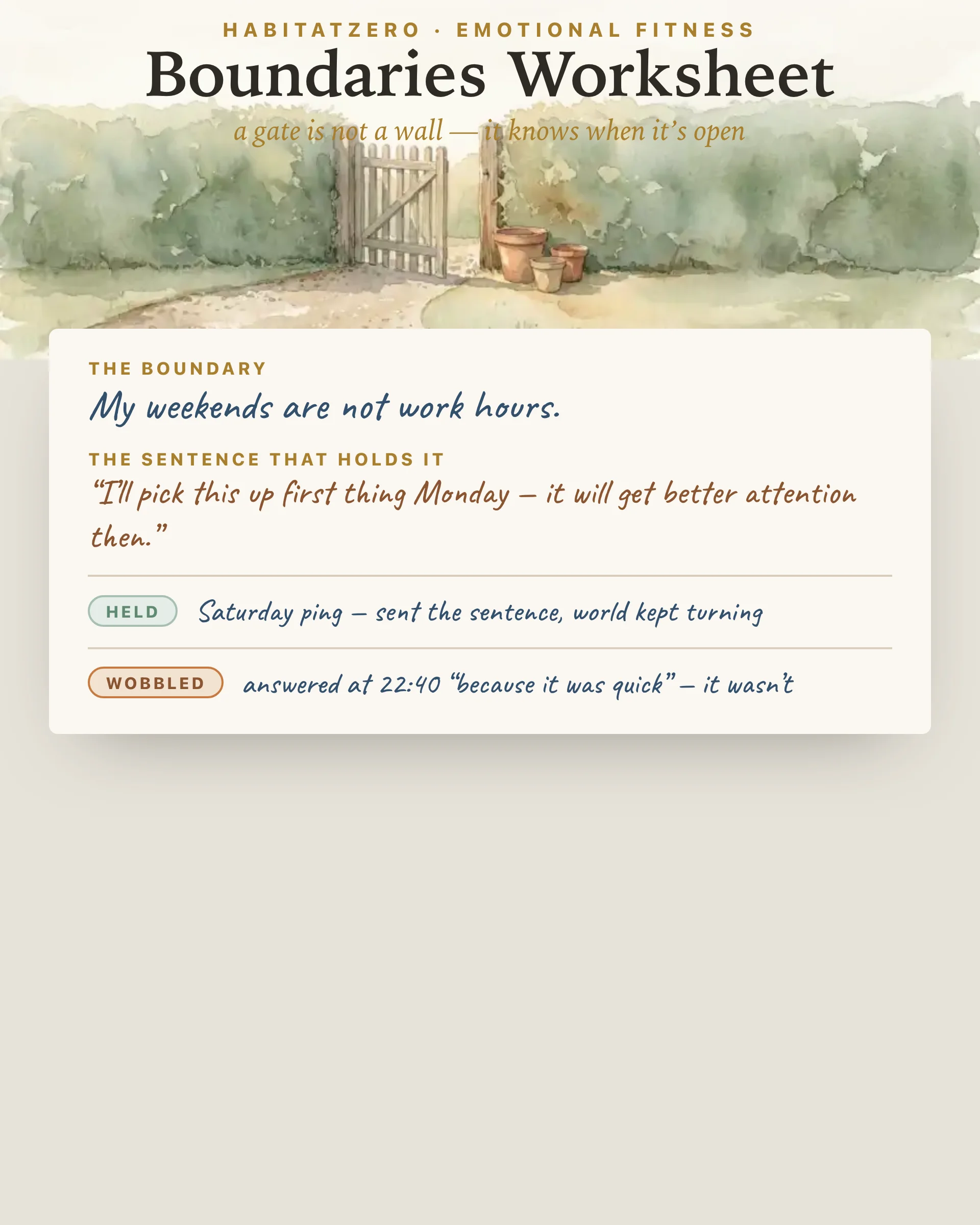
The word boundary gets used like a wall — something you build to keep people out. The working definition is gentler and more useful: a psychological boundary marks where you end and someone else begins, the line between what is yours to carry and what is not (APA Dictionary of Psychology: boundary). A gate, not a wall. The trouble is that most of us discover our gates only after something has walked through them — a weekend that stopped being a weekend, a favor that quietly became a job.
This worksheet works that discovery in reverse: find the drains first, then build one gate, then practice closing it.
Asking "what are my boundaries?" cold produces philosophy. Asking "what keeps taking more than I agreed to give?" produces a list — and the list is where boundaries actually live. The worksheet's first section holds up to eight of those situations, named plainly: weekend messages that expect Monday answers; being the default fixer for every family logistics knot.
Two things happen when the drains are written down. The pattern becomes visible — the same person, the same hour, the same phrase tends to appear on multiple lines. And the priority picks itself: one line will make your jaw tighten as you write it. That's the one.
The middle of the sheet holds exactly two lines, and the second matters more than the first.
The boundary is for you: what is and isn't okay, in your own plain words, present tense. My weekends are not work hours. If it doesn't sound like something you'd actually say, it isn't yours yet — borrow no one's phrasing.
The sentence is for the moment the boundary gets tested, and it's written now, in the calm, precisely because the test won't happen in one. Short, kind, complete: "I'll pick this up first thing Monday — it will get better attention then." Boundaries rarely fail for lack of conviction; they fail at improvisation, at 22:40, when "it was quick" feels true. A pre-written sentence is the difference between deciding once and re-deciding under pressure every time — say it once, kindly, whole, and let it end there.
Every time the boundary meets the world, it gets a log entry: held or wobbled, with a one-line note. The worksheet treats these as exactly equal citizens, because they are — each is one data point about how this boundary behaves under real pressure.
The wobble notes are the sheet's most valuable output. Answered at 22:40 "because it was quick" — it wasn't tells you precisely where the sentence buckled and what excuse got through the gate. Boundaries are held by repetition, and repetition improves through this kind of field note; a log that reads all-helds usually means the line was never really tested. Twenty entries fill the log, and by then the boundary either holds on its own or the wording has earned its revision.
A worksheet can hold a boundary. It cannot hold a person who keeps crossing one. Everyday lines around time, attention, and energy — the gate responds well to a clear sentence and a steady log. But if a reasonable boundary is repeatedly run over, if holding one feels unsafe, or if the relationship around it is doing you harm, that is not a wording problem, and the kindest use of this page is to close it and bring in a professional or someone you trust.
For the ordinary drains, though — the pings, the defaults, the quiet scope creep of being dependable — the practice is small and learnable: name where you end, write the sentence before you need it, and count the wobbles as coaching. The gate gets easier to close every time it's closed.
A structured page for turning a vague sense of being drained into one workable boundary: an inventory of the situations that take too much, a boundary written in your own words, the exact sentence you will say when it is tested, and a running log of how each test went.
Short, kind, and complete — a sentence you can say once without a footnote. It states what you will or will not do, not what the other person must become: I will pick this up Monday morning. I am not discussing my plate at dinner. Drafting it before the moment arrives is most of the trick; boundaries fail at improvisation far more often than at intent.
Because a boundary is held by repetition, and repetition needs focus. One line, one sentence, one log gives you a real experiment: you learn how this boundary behaves under pressure, adjust the wording from the wobble notes, and only then move to the next drain on the map.
Some pushback is normal physics — a boundary changes an arrangement that was working nicely for someone else. Their surprise is information about the old arrangement, not proof the boundary is wrong. Log it, keep the sentence kind and whole, and let consistency do the persuading. Persistent anger or punishment for a reasonable line is a different signal — see the note at the bottom of the sheet.
A wobble caught in a one-line note is the most useful data the worksheet collects. It shows exactly where the sentence buckled — the late-night ping, the guilt phrase, the because-it-was-quick excuse — and each logged wobble makes the next hold more likely. A log with only helds in it usually means the boundary was never really tested.
No. It is a self-help exercise for everyday lines around time, attention, and energy. If a boundary is repeatedly run over, if holding one feels unsafe, or if the relationship involved is causing you harm, that calls for a professional or a trusted person in your corner — a page cannot stand where a person should.
By the team behind Fabulous, the science-based self-care app used by over 30 million people.