
The Overwhelm Recovery ProtocolWellness & Routines · ~5 min
About this template · Updated November 2026
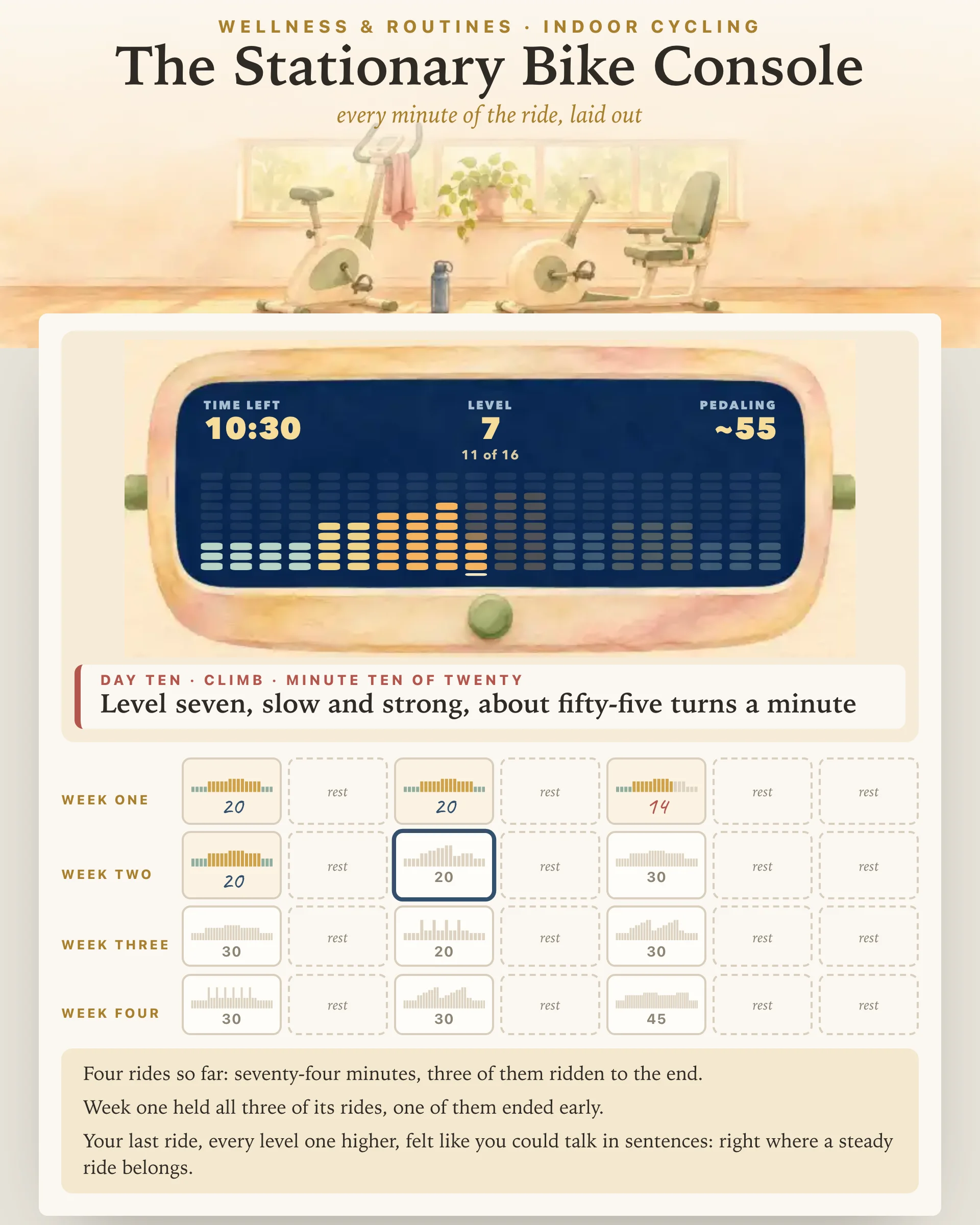
A stationary bike workout is one of the simplest ways to get your heart working at home, and one of the easiest to drift through: too hard on day one, then the same shapeless twenty minutes for months. This page gives every ride a shape. Pick a length and a kind of ride, and a painted bike console lays it out minute by minute, with the resistance level to set and roughly how fast to pedal.
Every ride opens with four to six minutes of easy pedaling at a low level and closes with three to six more. The middle depends on what you choose.
Rides last twenty, thirty or forty-five minutes, and the sheet under the console spells out each stretch, ready to print.
The screen draws the ride as columns of small lamps, one per minute, each as tall as that minute's level: a low plateau for a steady ride, short spikes for intervals, stairs for hills. Above them, three readouts show the time left, the level to set now and the pedal turns a minute to aim for.
Press start and the current minute's column fills from the bottom; finished minutes stay lit. The timer reads the clock instead of counting its own beats, so a locked phone or a switched tab costs nothing, and a pause holds everything in place. Stop early and only whole minutes count: twelve and a half minutes logs twelve, and less than one logs nothing.
Bikes number their resistance differently, from eight levels to a hundred. This page counts one to ten, where one barely pushes back and ten is very hard to turn. Type your bike's top level and the console converts: on a sixteen-level bike, level five here becomes eight.
On an upright bike, the climbing cues ask you to stay seated with your hands light on the bars. On a recumbent bike, where you sit back with your legs out in front, they ask you to keep your back against the seat rest and press through your whole foot. Each bike gets its own note on getting on and off: wait for the pedals to stop, keep a hand on the frame, and stand up slowly when you finish.
The gentle version sets every level two lower and swaps brisk pedaling for a steady pace, for a first month back, knees or hips that need care, or an older rider starting from scratch. A separate setting moves every level one lower, one higher or two higher.
The plan sets three rides a week, on days one, three and five. Week one is three steady twenty-minute rides; week two brings a first hill and a thirty-minute ride; week three adds short pushes; week four ends with a long, steady forty-five. That grows from sixty minutes of riding in the first week to one hundred five in the fourth.
After each ride you tap how it felt, using the talk test: you could sing, talk in sentences, say a few words at a time, or not talk at all. Two rides easy enough to sing through and the reading suggests every level one higher; a ride too hard to talk through and it suggests one lower or the gentle version.
The World Health Organization's 2020 guidelines recommend 150 to 300 minutes of moderate activity a week for adults, older adults included, and stress that some activity beats none. Three rides cover a good share of that, and walking can make up the rest.
For knee arthritis, a 2021 review of eleven trials found that stationary cycling eased pain compared with no exercise, but its gains in stiffness, daily function and quality of life were smaller than the change usually counted as clinically important. The bike is a comfortable way to keep moving with sore knees, not a cure for them.
A 2022 review of self-rated intensity methods found that the talk test lines up with the breathing thresholds that separate moderate from hard exercise. It remains a rough guide rather than a measurement, and it cannot tell you what pace is safe with a particular heart condition.
If you have had a fall, dizziness, a joint replacement, a heart or blood pressure condition, or pain when you move, talk to your doctor or a physical therapist before your first ride. Set the seat so your knee keeps a slight bend when the pedal is at its farthest point, and get off slowly and rest if you feel chest pain, faintness or breathlessness that does not settle.
When your legs are ready for more, The Three-Step Leg Routine adds strength work between rides and The Aerobic Wreath mixes other cardio into the week. For days without the bike, The Low-Impact Stepping Stones needs only floor space. To judge how hard a ride felt without a heart rate monitor, The Effort Swatch Card rates it from 0 to 10.
Twenty minutes, three days a week, mostly at a pace where you can still talk in sentences. Start with four easy minutes, ride the middle at a moderate level, and finish with three easy minutes so your breathing settles before you stand up. Add hills or short pushes once steady rides feel comfortable, usually after a week or two.
A steady ride with a long warm-up and cool-down, resistance you can turn without straining, and a pace of about sixty to seventy pedal turns a minute. Hills here are seated and gradual, and the gentle version keeps every level two lower and drops brisk pedaling altogether. Check with your doctor first if you have a heart condition, dizziness or a recent joint replacement.
A recumbent bike lets you sit back against a seat rest with your legs out in front, so your back is supported, balance hardly comes into it, and getting on is closer to sitting down in a chair. It still works the legs, heart and lungs. Any of the rides on this page work on one, and the climbing cues change to suit the reclined position.
There is no single right number, because bikes count their levels differently and riders differ. This page uses a scale of one to ten, where one barely resists and ten is very hard to turn, then converts it for a bike with eight, sixteen or any other number of levels. Let the talk test decide: if a steady stretch leaves you only a few words at a time, go one level lower.
Twenty minutes is a good place to start and long enough for a proper warm-up and cool-down. Over four weeks the plan here grows to two thirty-minute rides and one of forty-five. Three rides like that, plus walking or other movement, puts most people within reach of the weekly activity many health guidelines describe.
By the team behind Fabulous, the science-based self-care app used by over 30 million people.


