
The Overwhelm Recovery ProtocolWellness & Routines · ~5 min
About this template · Updated November 2026
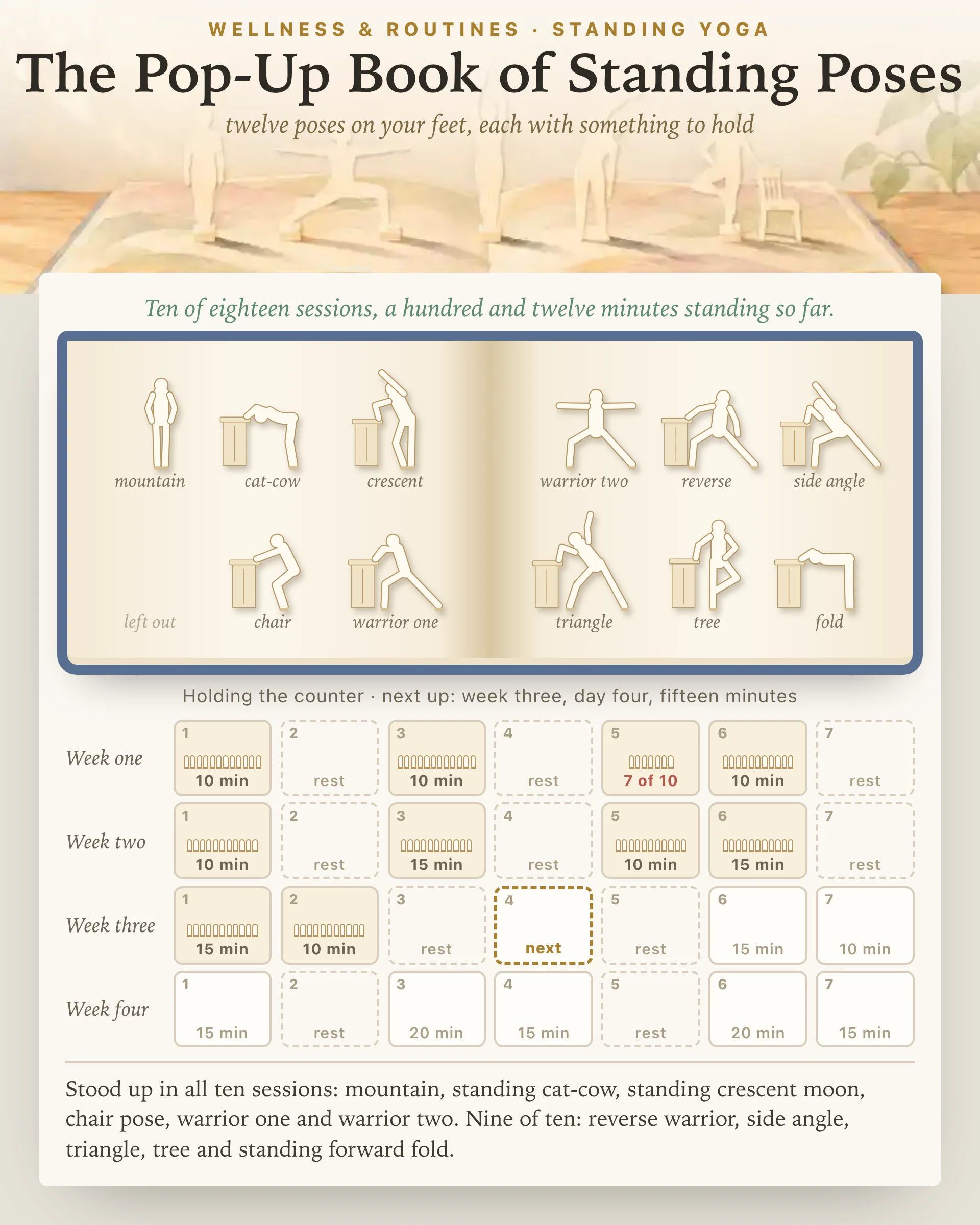
A lot of yoga happens on the floor, and the floor is exactly where some people would rather not go. Maybe your knees object to kneeling, or getting back up takes a chair and a deep breath. Standing yoga poses keep you on your feet for the whole practice, with a chair back, a counter or a wall close enough to touch.
Here are twelve of them as paper figures in a small pop-up book. Hold a pose all the way through and its figure stands up off the page.
The book runs in an order that warms you up before it asks much of your legs:
Every pose has a supported version. Choose a chair back, a counter or a wall at the top of the sheet, and every figure redraws itself holding it while every cue names it. Push a chair against a wall so it cannot slide. Tree never lets go: one hand stays on your support. The other eleven can be marked hands free once they feel steady. In the forward fold, the supported version is a half fold with a flat back, which is also the one to keep if lowering your head makes you dizzy.
For single-leg holds in more depth, the yoga for balance tracker times each leg at a counter or wall. To learn poses slowly, try two at a time on a wooden figure. And if standing is not possible today, seated poses by a window keep the habit going from a chair. To lean on a wall for every pose, The Wall Yoga Gallery builds sessions from ten wall poses.
The plan runs four weeks: ten minutes on four days in week one, ten and fifteen in week two, mostly fifteen on five days in week three, and fifteen or twenty in week four. Each day, pick the planned length or another one. The page splits the minutes into one hold per side, so ten minutes with all twelve poses gives thirty seconds a hold, and twenty minutes gives a minute. If you leave several poses out, the holds stretch, and once a hold would pass ninety seconds the page goes through more than once instead.
While the clock runs, the pose in play rises off the page as you hold it. The timer keeps real time minus your pauses, so a phone that locks mid-session does not lose your place. Only what you held counts: a skipped hold adds nothing and keeps its figure flat, and an early end logs whole minutes, never anything under one. Each session leaves a small paper tab on its calendar day for every pose that stood up, and the reading below tells you which poses stand every time and which ones a short day never reaches.
A 2016 meta-analysis in Age and Ageing pooled six trials with 307 people aged 60 and over and found that physical yoga gave a small improvement in balance tests and a medium improvement in mobility. The authors were careful to say that this does not show yoga prevents falls.
A large trial published in 2025 tested exactly that. In the SAGE trial, 700 people aged 60 and over did a year of yoga-based exercise or a seated relaxation program. The yoga group fell more often, not less, and the researchers concluded that the program should not be recommended for fall prevention in that form. That is why every pose here starts with something to hold, and why this page makes no promise about falls.
On safety more broadly, a review of 94 randomized trials found yoga about as safe as usual care or other exercise, with minor complaints more common than after talking therapies or health education. Lab work on older adults also found that the load a pose puts on the ankles, knees and hips is not always what you would guess, for full poses and modified ones alike, so let how your joints feel, not how the pose looks, decide how deep you go.
Check with a doctor or physical therapist first if you have had a fall, dizziness, a joint replacement, a heart or blood pressure condition, or pain that has not been looked at. Stop any pose that hurts, hold your support whenever you wobble, and rise from the fold slowly.
Use it on days you want to move without lying down, before or after a walk, or as your whole practice for four weeks. Ten minutes on your feet still counts.
The ones most classes come back to are mountain, chair pose, warrior one, warrior two, reverse warrior, side angle, triangle, tree and a standing forward fold. Gentler additions such as standing cat-cow, a standing crescent moon side bend and eagle arms let you warm up the spine and shoulders without leaving your feet.
Yes. Every pose on this page is done on your feet, from the first breath in mountain to the last fold. A sturdy chair back, a counter or a wall gives each pose something to hold, so you never have to kneel, sit on the floor or get back up from it.
Tree is the true balance pose, standing on one leg, and here it always keeps one hand on your support. The warrior shapes, chair pose and triangle also ask your legs and ankles to steady you on a wide or bent stance. Trials in people over sixty show small gains on balance tests, not proof that falls drop.
Thirty seconds a side is a sensible start, which is how the ten-minute page divides its time. As the weeks move to fifteen and twenty minutes, the same poses stretch toward forty-five seconds and then a minute. Come out of any hold early if your legs shake hard or anything hurts.
In randomized trials, yoga has looked about as safe as ordinary exercise, though minor complaints do happen. Check with a doctor or physical therapist first after a fall, dizziness, a joint replacement or with a heart or blood pressure condition, keep your support within reach, and skip the full forward fold if lowering your head makes you dizzy.
By the team behind Fabulous, the science-based self-care app used by over 30 million people.


