
The Overwhelm Recovery ProtocolWellness & Routines · ~5 min
About this template · Updated November 2026
Wall yoga is ordinary yoga with a wall as your prop. Your palms press into it in a downward dog, your back leans on it in a chair pose, and at the end your legs rest up it while you lie on the floor. The wall takes some of your weight, steadies you when your balance wobbles, and gives you a straight line to check your body against. No single teacher invented it; the name covers any practice built around a wall. You need a clear stretch of wall, a mat or rug, and a chair close by.
Six poses are standing. Wall mountain shows you what standing tall feels like, with your buttocks, shoulder blades and head resting on the wall. The chest opener and the side stretch use one palm on the wall to open the front and the side of your body. Wall downward dog lengthens your back and legs without loading your wrists. Wall chair pose slides you a few inches down the wall, and the high lunge steps one foot back with your hands on it.
Two poses train balance, wall tree and wall warrior three, with a hand or both hands on the wall. The last two happen on the floor: the wall figure four for the outer hip, and legs up the wall to finish. Every pose has three short cues and an easier version, so a stiff morning still has a way in.
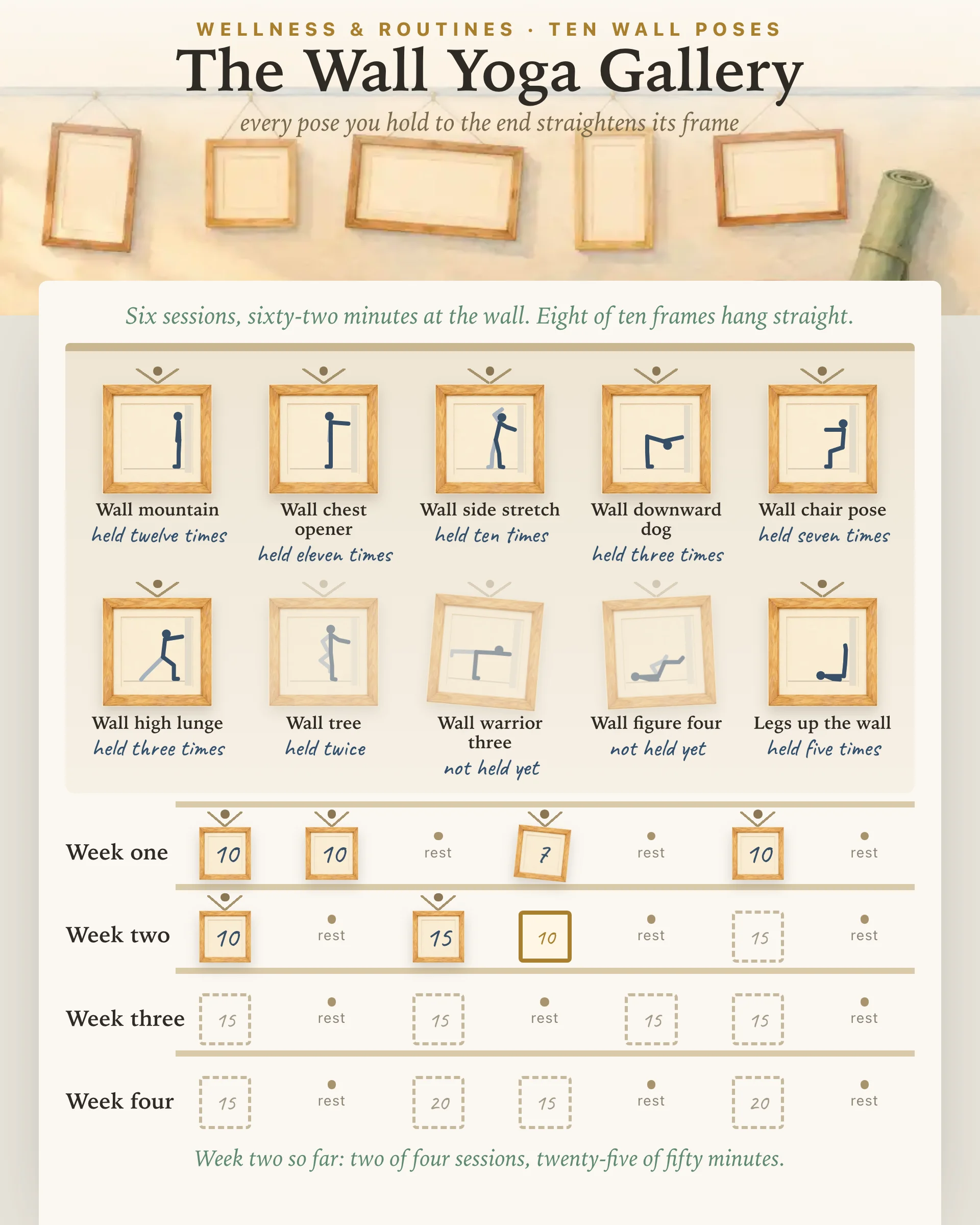
Each pose hangs on the page as a framed sketch. Until you have held a pose all the way through, its frame hangs a little crooked; finish its hold once and it hangs straight. Tap a frame to read its cues, or try a single hold to learn the shape. Single holds never go on your calendar.
Above the gallery sits today's wall. Each plan week hangs its own poses there, and the tag under every frame takes one down or adds another, as long as three stay up. Pick ten, fifteen or twenty minutes and the page builds the session: your poses in gallery order, round after round while time allows, then legs up the wall for whatever is left, or a seated rest against the wall if you took that pose down.
Press start and the clock leads. You get ten seconds to settle into each pose, then it counts the hold, calls the switch to your second side and moves on. The clock follows real time, so a phone that locks halfway through still knows where you are. You can pause, skip a pose or end early. A finished session logs its full length; one you end early logs only the whole minutes you did, and a skipped pose does not count as held.
The plan asks for four sessions a week. Week one keeps to five poses (mountain, chest opener, side stretch, chair and legs up the wall) for ten minutes at a time. Week two adds downward dog and the high lunge, week three adds tree and the figure four, and week four hangs all ten and reaches twenty minutes twice, for two hundred and twenty minutes across the month. On the calendar a finished day hangs a small frame with its minutes inside, and a short session hangs crooked.
We could not find trials of wall yoga as such, so the evidence comes from yoga in general. A 2016 review in Age and Ageing pooled six trials with about three hundred people over sixty and found that yoga brought a small improvement in balance and a medium one in getting around, while saying plainly that nobody knew yet whether that meant fewer falls. A large Australian trial published in 2025 then put that question to the test: seven hundred people over sixty took a year of twice-weekly yoga classes or a short seated relaxation program. The yoga group ended up more active and more confident about its balance, yet it had more falls, not fewer. So treat this page as a way to move well, not as fall prevention.
The World Health Organization's 2020 guidelines say that some activity beats none, and they ask adults for 150 to 300 minutes of moderate aerobic activity a week plus muscle strengthening. Ten to twenty minutes at the wall is a calm part of that week, not all of it.
Talk to a doctor or physical therapist before your first session if you have had a fall, dizzy spells, a joint replacement, a heart or blood pressure condition, or ongoing pain. Move only as far as feels easy, stop if anything hurts, and keep a sturdy chair within reach for tree and warrior three. Legs up the wall lifts your legs above your heart, so if you have glaucoma or have been told to avoid that position, rest your calves on a chair seat instead.
For firmer strength work against the same wall, try The 28-Day Wall Pilates Challenge. On days when standing feels like too much, The Chair by the Window keeps you seated, and The Woven Mat offers each of its poses in a chair, with support or on the mat.
It means doing familiar yoga poses with a wall as your prop. Your hands, back or feet press into it, so it carries some of your weight, steadies you in balance poses and gives you a straight line to check your alignment against. A clear wall and a mat are all the equipment it takes.
It suits both, because the wall lets you try a pose with support before you try it in open space. Begin with the standing poses and the easier version of each, keep a chair near for balance work, and ask a doctor or physical therapist first if you have had a fall, dizziness or a joint replacement.
No single rule applies. This plan holds most standing poses for thirty to forty-five seconds, the harder balance pose for twenty seconds a side, and legs up the wall for two minutes or more at the end. Breathe slowly through each hold, and come out early whenever a pose strains instead of stretching.
For most people it is a restful way to finish, but it puts your legs above your heart, which is not right for everyone. If you have glaucoma, a heart or blood pressure condition, or have been told to avoid that position, check with your doctor first, or rest your calves on a chair seat instead.
Four short sessions a week is plenty to learn the poses and grow steadier in them. The plan here starts at ten minutes and reaches twenty by week four. It does not replace walking or other activity that raises your heart rate, so keep that in your week too.
By the team behind Fabulous, the science-based self-care app used by over 30 million people.


