
Leaves on a StreamEmotional Fitness · ~3 min
About this template · Updated September 2026
The stages of change come from psychologists James Prochaska and Carlo DiClemente, who noticed in the early 1980s that people quitting smoking, on their own or with help, moved through recognizable phases rather than changing in one leap. Their idea became the transtheoretical model, and the 1997 overview Prochaska wrote with Wayne Velicer is still its clearest summary. This page is an independent, interactive way to apply their stages to one habit of your own; it has no connection to the model's authors and carries no endorsement from them.
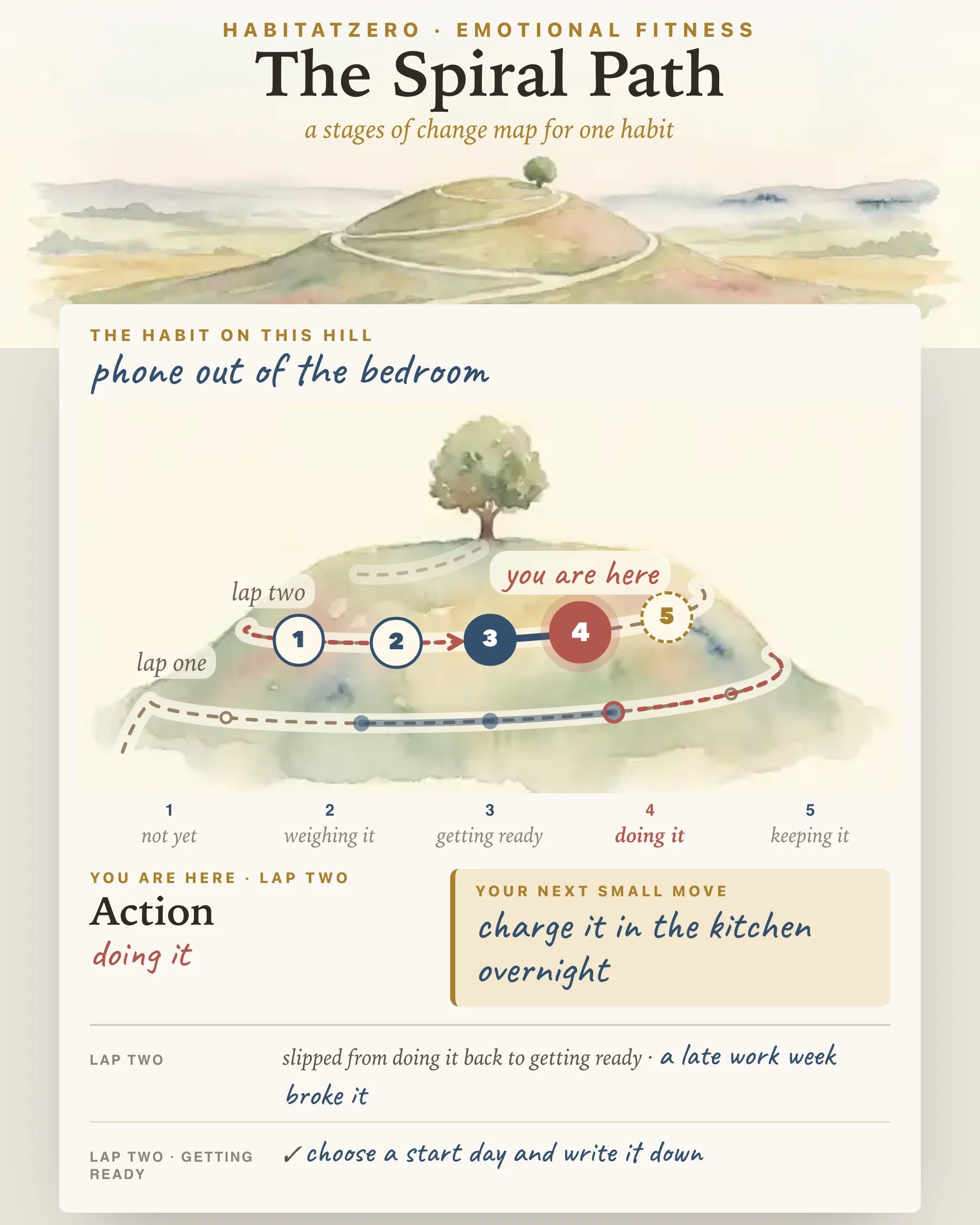
The model names five stages, and this page draws each as a stop on a trail that winds up a painted hill:
The trail spirals because change rarely runs in a straight line. The authors found relapse to be the rule rather than the exception, yet people who slip seldom land back at the start: for smoking and exercise, only about 15 percent went all the way back to not yet, while most returned to weighing it or getting ready. So a slip here sends you around the hill again, one turn higher, instead of back to the trailhead.
Name one habit or tap a suggestion, then find your stop: answer two quick questions, or tap the stop that fits. A red pin lands on the hill, the stops you have walked fill in, and the one ahead turns gold. Under the hill, pick one of four small moves matched to your stop, or write your own, and mark it done once it is.
If you slip while doing it or keeping it, tell the page where the slip left you. A single slip you recover from stays on the same lap. A setback that takes you back to getting ready or weighing it starts a new lap higher up the hill, and the page asks what the last lap taught you.
Prochaska and Velicer paired the processes of change with the stages where people lean on them most, and the suggestions here follow that pairing:
Weighing it is also where pros and cons matter most: the same overview found the cons of changing fall as people move from weighing it into action. If you are stuck there, The Cost of Avoidance helps you count what the delay is costing you. Once you are doing it, Urge Surfing helps you ride out a craving.
The model is widely used and widely argued over. In a 2005 editorial in Addiction, Robert West argued it was time to put the model to rest: the lines between stages are arbitrary (a start planned 30 days out counts as getting ready, one 31 days out as weighing it), plans shift over short periods, and many quit attempts happen with no planning at all.
Matching help to the stage has mixed support. A Cochrane review of stage-based help for quitting smoking, covering 41 trials, found that staged self-help and counseling beat offering nothing, but did no better and no worse than the same help without the staging.
What holds up is plainer. Readiness predicts how change goes: a meta-analysis of 76 psychotherapy studies found that people further along the stages when treatment began had better outcomes. And the moves themselves are ordinary tools that do not depend on naming your stage exactly. So treat the stops as a rough map for reflection rather than a verdict, and if you feel ready before the map says you are, start anyway.
Open it when one habit keeps nagging and you cannot tell whether you are ready, after a slip that makes you feel back at zero, or before a talk with a counselor. If your slips keep following the same situations, map them with The Road From a Trigger.
This worksheet is a tool for reflection, not treatment. If the habit is drinking or drug use, SAMHSA's National Helpline at 1-800-662-4357 offers free, confidential treatment referral and information around the clock, every day of the year, in English and Spanish. If a slip ever leaves you thinking about harming yourself or ending your life, call or text 988 in the US, or your local emergency number, right away.
Precontemplation, when you are not planning to change in the next six months. Contemplation, when you mean to change within six months but feel torn. Preparation, when you plan to start within a month. Action, the first six months of doing it. Maintenance, once the change has held for six months or more.
Psychologists James Prochaska and Carlo DiClemente, from research in the early 1980s on how people quit smoking, both on their own and in treatment. The stages became the center of the transtheoretical model, which pairs each stage with the processes of change people lean on to move forward.
Not in the model as its authors now describe it. Relapse is an event, a return from action or maintenance to an earlier stage, and in their studies of smoking and exercise most people who slipped went back to weighing it or getting ready rather than to the very start. Lists of six stages add either relapse or termination, the point where the old habit no longer tempts you at all.
They are separate ideas that are often used together. The stages describe how ready someone is to change. Motivational interviewing, developed by William Miller and Stephen Rollnick, is a way of talking that draws out a person's own reasons for change, and its founders have stressed that the two are not the same thing.
Partly. How ready you are does predict how change goes, and a large review of therapy studies found that people further along the stages at the start did better. But a Cochrane review found that matching quit-smoking help to the stage worked no better than the same help unmatched, so use the stages as a rough map, not a rule.
By the team behind Fabulous, the science-based self-care app used by over 30 million people.


