Leaves on a StreamEmotional Fitness · ~3 min
About this template · Updated September 2026
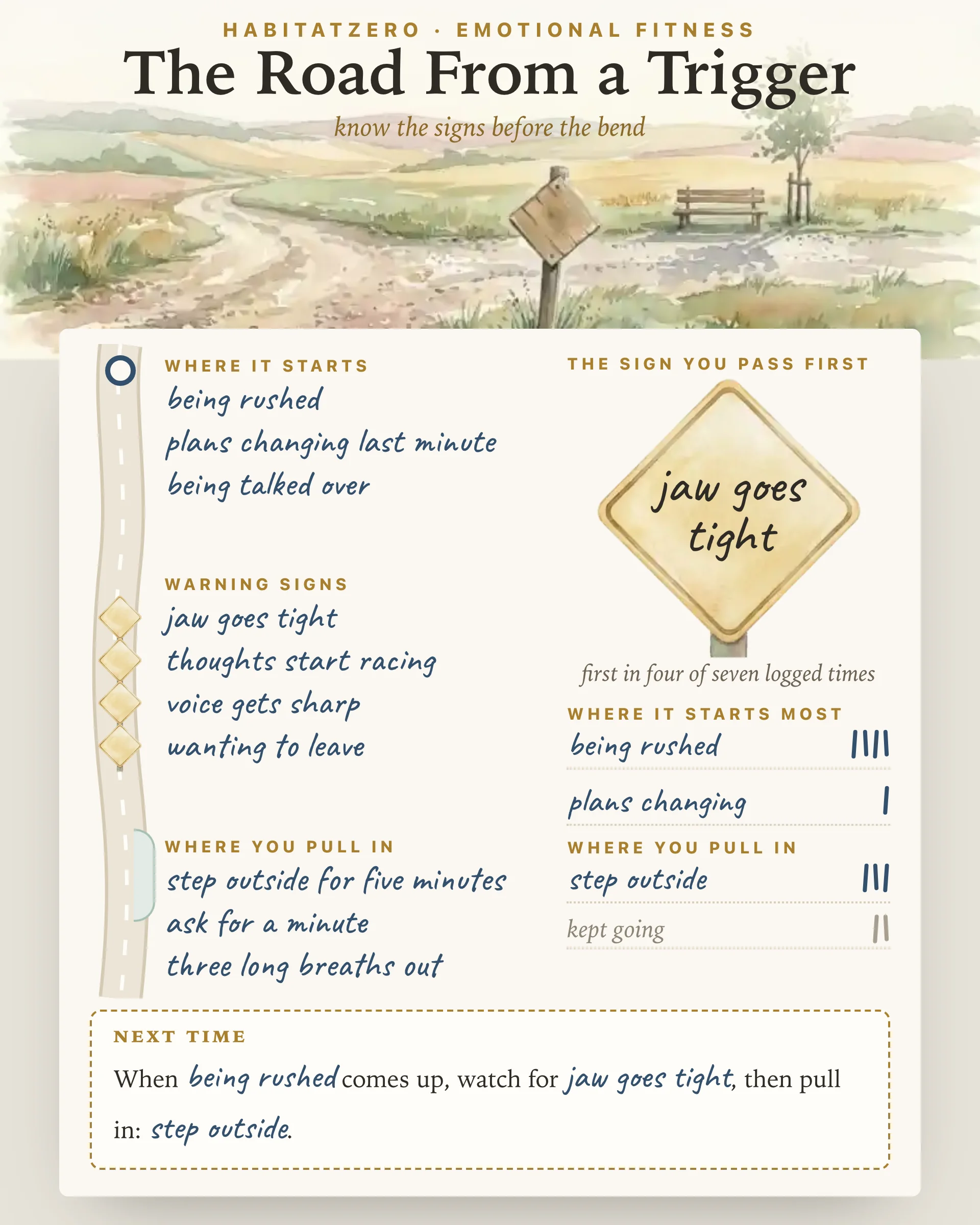
A trigger is anything that sets off a reaction bigger than the moment seems to call for: a certain tone of voice, being hurried out the door, a date on the calendar, a night of broken sleep. The reaction can feel instant, as if nothing happened in between. Usually something did. Most reactions travel a short road, and that road has signs along it.
This triggers worksheet draws the road. At the top is where it starts, the trigger itself. Along the way are your warning signs, the early changes in your body, your thinking and your behavior that turn up before the bend. Beside the road is somewhere to pull in: a small, planned thing you do instead of driving straight into the reaction you would rather avoid.
Some triggers are around you: criticism, crowded rooms, plans that change at the last minute, someone talking over you. Others begin inside you: hunger, pain, feeling behind, a memory that surfaces without warning. The inside ones are easy to miss because they do not look like events. Four hours of sleep never feels like a trigger in the moment, yet it can decide whether the ordinary irritations of a day slide past or stick.
You do not need a complete list; two or three starts you recognize from recent weeks are plenty.
Most people fill in the trigger and skip the middle, but the middle is where the choices live. By the time you reach the bend, whether that means snapping, shutting down or walking out, deciding anything is hard. A few minutes earlier, while your jaw is only tightening or your thoughts are only starting to speed up, there is still room to steer.
Emotion research supports acting early. In a classic experiment, James Gross showed 120 people a disgusting film and asked some to think about it in a way that would leave them feeling nothing, and others to hide their reaction. Rethinking the film lowered the disgust people felt. Hiding the reaction kept it off their faces but increased sympathetic activation, part of the body's stress response. It was one lab study with one film, not a study of triggers, but it is why this page cares most about the start of the road.
Tap the triggers you recognize at the top of the road, sorted into around you and inside you, or write your own; the road holds six. Then put up your warning signs, up to six, each on its own painted sign beside the lane. Finish with up to five places to pull in, things you can genuinely do in the moment.
The part a printout cannot do comes afterwards. Each time something sets you off, tap three things in the logger: what started it, the signs in the order you noticed them, and where you pulled in, or that you kept going. There is nothing to type, and the logbook keeps twenty entries.
From those taps, the page reads your road back to you. It names the trigger that keeps returning and writes the sign that most often reaches you first on a large road sign, with the order your signs usually arrive in. It counts which pull-ins you actually use and marks the ones you planned but have not tried. Then it writes a next-time line from your own entries: when this starts, watch for that sign, then pull in here.
No study has tested this page, and a worksheet is not treatment. Two lines of research make the approach reasonable.
The first concerns planning in if-then form. Peter Gollwitzer and Paschal Sheeran pooled 94 independent tests of if-then plans and found a medium-to-large effect on reaching goals. Part of the reason, they argue, is that naming a situation in advance makes it easier to spot when it arrives. The next-time line is written in exactly that shape.
The second concerns keeping a record. Across 138 experiments, monitoring progress toward a goal helped people reach it, and the effect was larger when the information was physically recorded rather than simply kept in mind. Those studies measured progress toward goals, not triggers, so read them as general support for writing things down, not proof about this page.
Draw the road on a calm day, when you can think about hard moments without being inside one. Log soon after something sets you off, once the heat has passed but while you still remember which sign came first.
If your warning signs live mostly in your body and are hard to name, The Emotions Body Map helps you find where a feeling sits. If the bend for you is usually anger, The Anger Iceberg looks at what sits underneath it. And if your reactions swing between too much and too little, The Window of Tolerance maps both edges and the ways back in.
Some triggers lead straight back to painful memories, and working with those is different from noticing a short fuse before a meeting. If yours feel overwhelming, or if logging them stirs up more than it settles, a therapist can help you work through them at a pace that feels safe.
It is a structured page for noting what sets off a strong reaction in you, what you notice as that reaction builds, and what you plan to do instead. Most printable triggers worksheets stop there. This one adds a tap-only log, so your own entries show which triggers repeat and which planned responses you actually reach for.
Work backwards from a recent moment when you reacted more strongly than you wanted to. Ask what happened just before it, where you were, who was there and how rested or hungry you were. One moment can be a coincidence, so log several and look for the start that keeps turning up.
Guides slice them differently, and there is no single official list. A practical split is external and internal. External triggers sit around you, such as criticism, crowds or plans changing late. Internal ones begin inside you, such as poor sleep, pain, hunger or a memory. Dates and anniversaries can work as triggers too.
Use something small that you chose ahead of time, so you are not inventing a plan in the middle of a reaction: a slow breath out, asking for a minute, cold water on your hands or a short walk. If triggers often feel overwhelming or pull you back into painful memories, a therapist can help you work through them.
You can explore a filled-in example right here without signing up. Drawing your own road and keeping a log across weeks happens in HabitatZero, which is free to use.
By the team behind Fabulous, the science-based self-care app used by over 30 million people.