Leaves on a StreamEmotional Fitness · ~3 min
About this template · Updated September 2026
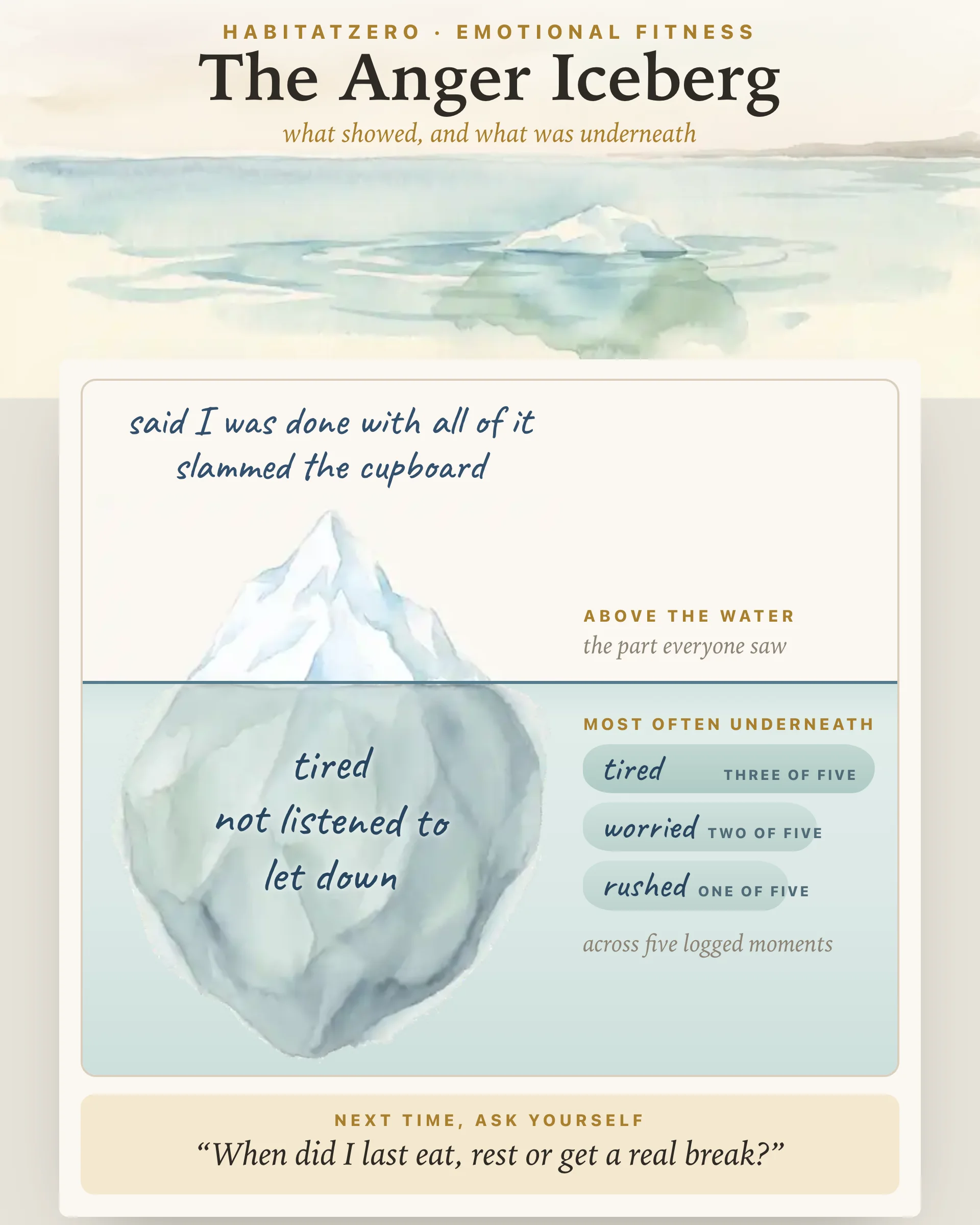
The anger iceberg is best known as a teaching image from the Gottman Institute, which laid it out in What is the Anger Iceberg?, a 2016 article by Kyle Benson on the Institute's blog. The Institute credits its drawing as inspired by one from the Creative Play Therapist. What you are using here is an independent, interactive take on that picture: the Gottman Institute did not make it, has not reviewed it and does not endorse it, and the same goes for the Creative Play Therapist.
The picture itself is simple. Anger is the tip, the part anyone in the room can see: the raised voice, the slammed door, the text you wish you had never sent. Below the waterline sits the bigger, quieter mass that fed it. Hurt. Embarrassment. Fear of what happens next. Disappointment. Sometimes nothing more mysterious than being worn out and hungry at six in the evening.
Anger grabs the attention because it is loud, and that includes your own attention. The iceberg asks you to look lower.
The worksheet is a painted iceberg with a real waterline drawn across it.
Above the water, you name what the anger looked like from the outside. Tap a suggestion such as raised my voice, went quiet or sent an angry text, or write your own line just above the peak. The tip holds three lines, because it is meant to be the small part.
Underneath, you bring up what else was there. Tap from sixteen common feelings, from hurt and let down to not good enough and powerless, or add a word of your own. Each one rises into the ice in handwriting. Six can sit there at once, which is plenty to look at side by side.
When both parts hold something, log the moment. The iceberg clears for next time, and the moment joins a log that keeps twelve.
Here the page does something paper cannot. From the moments you log, it draws an iceberg of your own: every feeling becomes a band of ice, and the widest band is the one that turned up under your anger most often. It tells you so in a sentence, then offers one question matched to that feeling to carry into the next hard moment. If tired keeps surfacing, the question is about when you last ate, rested or had a real break. If it is hurt, the question asks what you needed from someone and did not get.
The iceberg is a teaching picture rather than a finding, but it sits close to ideas that therapists and researchers take seriously.
Therapists who work directly with emotion separate primary feelings from secondary ones. In his overview of emotion-focused therapy, Leslie Greenberg describes secondary emotions as responses to other feelings rather than to the situation itself, and his example is feeling angry in response to feeling hurt. Not all anger works that way. Sometimes anger is the first and fitting answer to being treated unfairly, and nothing on this page should talk you out of it.
Putting a precise name to what sits under the anger seems to matter as well. Across three daily diary studies with 628 people, those who were better at telling their feelings apart reported less aggression on the days they felt angry than people whose feelings blurred together. Those were patterns in what participants reported about themselves, not a trial of any worksheet.
Timing counts too. In a pair of experiments, people who recalled an anger-provoking run-in from a step back, asking why they felt as they did, could reflect on it without the hot feeling flooding back. That is why this page is built for afterwards, once you can look at the moment instead of standing inside it.
None of this makes the page a diagnosis or a treatment. It is a way of looking. If your anger is leading to anyone getting hurt, or it frightens you, talk to a doctor or a licensed therapist.
Teenagers often know exactly what the tip looked like and have no words at all for the rest. Sit down on a calm evening, not in the middle of the argument, and let them hold the phone. Ask what else was going on that day, then wait longer than feels comfortable. Take their answers as given, even when you would have tapped something different.
It helps to go first. Build an iceberg about a time you lost your own temper and let them see what you found under it. The question at the end belongs to them; nobody has to answer it out loud.
Reach for it once the heat has passed, later the same day or the next morning. If you are still boiling, cool down first with Steady the Flame and come back. If the word you brought up feels too vague, The Feelings Wheel can sharpen it into a more exact one. And for younger children who are not ready to look under the water yet, The Feelings Thermometer asks only how big the feeling is.
It is a picture that treats anger as the tip of an iceberg. The raised voice or slammed door is the part everyone sees, and under the waterline sit the larger, quieter feelings that fed it, such as hurt, worry, shame or plain exhaustion.
The version most people know was published by the Gottman Institute in a 2016 blog article by Kyle Benson, which credits its drawing as inspired by the Creative Play Therapist. This worksheet was built on its own by Fabulous, and neither of them made, checked or endorsed it.
It differs from person to person, which is why a log beats a one-off guess. Hurt, embarrassment, fear, disappointment, jealousy and guilt come up often, and so do tiredness and hunger, which are easy to mistake for a bad mood about someone else.
Choose a calm evening rather than the middle of an argument. Hand them the phone, let them pick the words, and ask what else was going on that day. Try building one about your own temper first, so the exercise feels shared rather than aimed at them.
You can see a filled-in iceberg on this page without an account. Building your own and keeping the log that shows your pattern happens in HabitatZero, which is free.
By the team behind Fabulous, the science-based self-care app used by over 30 million people.