Leaves on a StreamEmotional Fitness · ~3 min
About this template · Updated July 2026
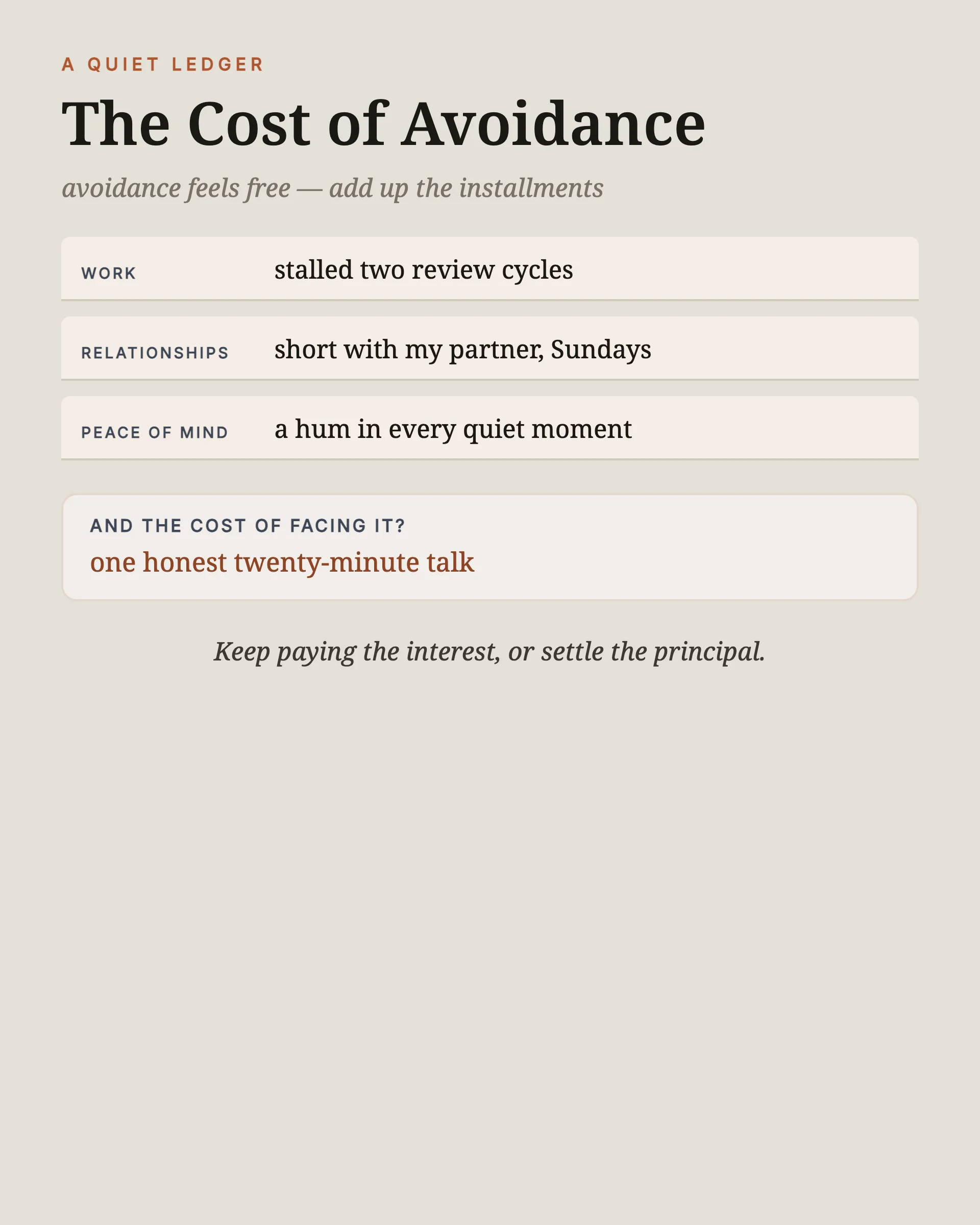
Every avoided thing runs a tab. The conversation you keep not having, the appointment you keep not booking — each feels free at the moment of dodging it, because avoidance collects its fee later, in installments, spread across accounts you rarely audit. The Cost of Avoidance, built by psychologist Jazmin Quill, is a ledger for exactly that arithmetic: one avoided thing, five life areas, and an honest total.
Weighing a choice on paper instead of in your head goes back to Irving Janis and Leon Mann's classic work on decision making, which formalized the "balance sheet" as a tool for conflicted choices — and whose insight was that unaided deliberation systematically misweighs what's comfortable. The idea became a workhorse instrument in behavior-change research, where the decisional balance measure developed by Velicer and colleagues showed that people move toward change in a predictable way: the pros of acting don't need to grow so much as the costs of not acting need to become visible. That is this worksheet's entire mechanism. It doesn't argue with you; it makes the invisible column legible.
Classic cost-benefit grids treat both options symmetrically. Avoidance defeats symmetric analysis, because its costs are engineered to be unauditable — billed quietly to work ("momentum, trust, standing"), to relationships ("closeness, resentment"), to health, to peace of mind, to the person you're becoming. Psychology has a name for the pattern: research on experiential avoidance finds that the strategy of not-facing is itself a common engine of distress, independent of the thing being avoided. The sheet's five-area column is the audit those scattered charges never otherwise get. The instruction in the middle of the page is the pivot: read the column back slowly.
The last entry prices the alternative — and the sheet's framing is deliberately financial, because the comparison usually embarrasses the avoidance. What facing it costs is typically one uncomfortable hour, one honest sentence, one phone call, paid once. What avoiding it costs is smaller per day but compounds daily. Sometimes the honest ledger genuinely says wait — decisional balance is a scale, not a shove. But most tabs, once totaled, read the way the closing line predicts: you can keep paying the interest, or settle the principal.
When the ledger says act and the act still won't start, the task paralysis exercise shrinks the first move until it's startable — this sheet decides whether, that one handles how to begin.
A structured way to put a decision's real costs and benefits side by side instead of weighing them in your head, where avoidance always wins. This one is tuned to the avoided thing specifically: the running cost of not acting, tallied across five life areas, against the one-time cost of acting. The imbalance you see at the end is the finding.
Because its relief is immediate and its costs are billed later, quietly, and to five different accounts. Skipping the hard conversation pays off tonight; the stalled project, the low-grade resentment, and the background hum accumulate where no single glance can see them. The ledger exists to gather those installments onto one page.
It is the same family of tool. Cognitive behavioral work often uses a four-square cost-benefit grid on a thought or behavior; this sheet folds that logic onto avoidance in particular, where the analysis is most lopsided and least often run. Nothing here diagnoses or treats anything - it is a thinking tool you fill in yourself.
Then the worksheet has done its job just as well. Decisional balance is not a trick to force action - occasionally the honest ledger says the conversation can wait or the price is genuinely high right now. The point is that the decision gets made by a column of written evidence rather than by dread.
Read the closing line and take it literally: keep paying the interest, or settle the principal. If the balance says act, the cost-of-facing-it line is already the plan - it names the one uncomfortable hour or the one phone call. Put it somewhere with a date on it, and the ledger closes itself.
By the team behind Fabulous, the science-based self-care app used by over 30 million people.