The Overwhelm Recovery ProtocolWellness & Routines · ~5 min
About this template · Updated September 2026
The SMART acronym is usually traced to a 1981 article by George T. Doran in Management Review, decades before it became one of the most common ways to set an exercise goal. A team of exercise and sport researchers later took a hard look at how SMART goals are used to promote physical activity. This worksheet is independent, with no tie to Doran, his publisher or that research team.
Get fit sits on a lot of lists, and it gives you nothing to check: no activity, no amount, no finish line, so a lazy week and a strong one look the same. A SMART goal for exercise swaps the wish for a sentence you can test on a Sunday night.
Specific names the activity, the days and the effort. The easiest effort check is the talk test: at a moderate pace you can talk but not sing, and at a vigorous pace you only get a few words out before you need a breath.
Measurable means minutes per session, which multiply into minutes per week, the unit the guidelines use.
Achievable starts from the minutes you moved last week, not from the goal.
Relevant is your own reason, in plain words.
Time-bound is the number of weeks you give yourself to build up.
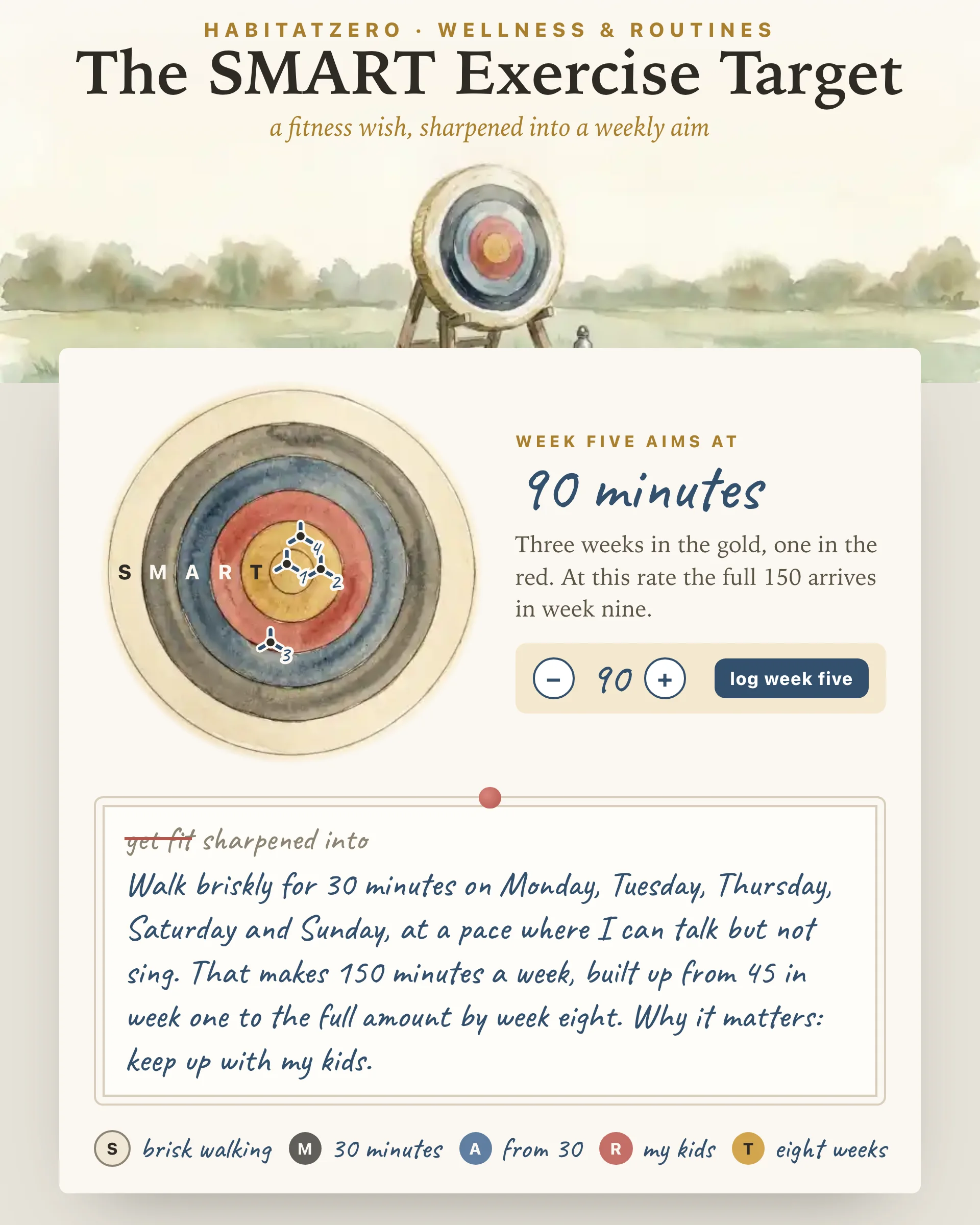
The page is a painted archery face with one ring per letter: S on the outer white band, then M, A and R, with T in the gold. A ring stays pale until you answer its question. Tap a wish such as get fit and the page sketches every ring except R, the reason only you can supply.
Once all five rings are inked, the page sets an aim for week one and spreads the climb evenly over the weeks you chose. At the end of each week you log the minutes you actually got, and an arrow lands on the face. A week that met its aim goes in the gold, most of it lands in the red, and each ring further out is a quarter less. The next aim follows the arrow: gold moves it up a step, red holds it, and a short week, or one where something hurt, steps it back. The reading then says when the full weekly goal will arrive at your current pace. The page counts minutes, not pounds, because minutes are the part you control.
Personalize the worksheet in HabitatZero to keep your arrows from one visit to the next.
The weekly numbers come from the Physical Activity Guidelines for Americans: 150 to 300 minutes of moderate activity or 75 to 150 minutes of vigorous activity each week, plus muscle-strengthening work on two or more days. It also tells inactive people to start low and go slow, building up over weeks to months, and says plainly that some activity beats none. The American College of Sports Medicine position stand agrees from the training side: fit the program to a person's usual activity, health and response, and progress gradually.
Setting goals does help. A meta-analysis of 52 goal-setting interventions found a medium, positive effect on physical activity. The acronym stands on shakier ground. The review credited at the top argues that SMART has no theory behind it, sits poorly with the evidence, ignores what kind of goal is being set and carries a risk of harm. So this page treats the letters as a first draft, and your logged weeks, not the acronym, set the next aim. Its line between a steady and a steep climb, ten extra minutes per session each week, is a cautious rule of thumb of our own, not a figure from the guidelines.
Healthy adults who build up gradually generally do not need a doctor's clearance first. If you live with heart disease, diabetes, arthritis or another condition, or you feel chest pain, dizziness or joint pain when you are active, work out your aim with your doctor or a physical therapist. Do the same if a new symptom appears as your minutes rise.
Reach for it when a fitness goal has gone months without a number, or when plans keep collapsing because week one asked too much. If the goal is not about exercise at all, the SMART Goals Worksheet sharpens any goal into one testable sentence. When the aim needs a longer season, the 12-Week Fitness Planner splits twelve weeks into phases you name, and the Workout Calendar shows which days you actually moved.
It is an exercise goal that names the activity and the days, counts the minutes, starts from what you do now, ties to a reason you care about and runs for a set number of weeks. Walking briskly for 30 minutes on five days a week, built up over eight weeks, is one example.
Walk briskly for 20 minutes on Monday, Wednesday and Friday, building from 10 to 60 minutes a week over six weeks. Do strength training for 30 minutes on Tuesday and Friday for six weeks. Run for 25 minutes three times a week, building from 30 to 75 minutes a week by week eight.
US guidelines suggest 150 to 300 minutes of moderate activity a week for adults, or 75 to 150 minutes of vigorous activity, plus muscle-strengthening on two or more days. If you are far from that today, aim lower first, since the guidelines say some activity is better than none.
Slowly, over weeks to months. On this page the weekly aim moves up only after a week that met it in full, holds after a near miss, and steps back after a short week or one where something hurt, so the pace follows what your body actually managed.
Most healthy adults who build up gradually do not need to. If you have heart disease, diabetes, arthritis or another condition, or notice chest pain, dizziness or joint pain when active, talk with your doctor or a physical therapist about the right aim first.
By the team behind Fabulous, the science-based self-care app used by over 30 million people.