
The Overwhelm Recovery ProtocolWellness & Routines · ~5 min
About this template · Updated November 2026
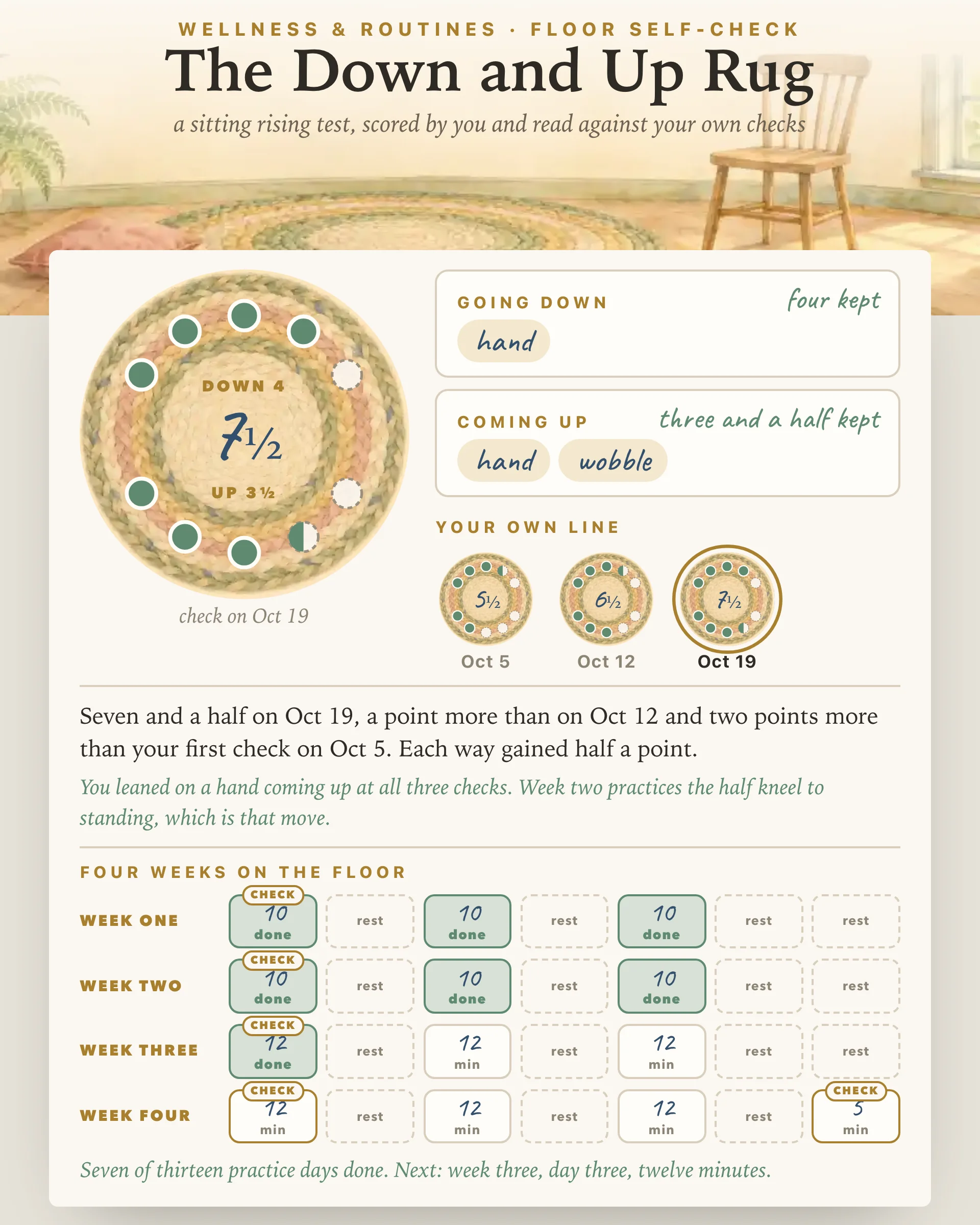
The sitting rising test comes from Brazilian exercise physician Claudio Gil Araújo, who set out the procedure in 1999 as a way to look at strength, flexibility and balance in an office with no equipment at all. This page is an independent practice sheet built on his published scoring. It has no connection to Dr. Araújo or his clinic, and neither he nor his colleagues have reviewed or endorsed it.
You sit all the way down to a soft floor and stand back up. Speed does not matter; how much help the trip took does. Going down is worth five points and coming up five more. Each support costs a point: a hand or a knee on the floor, or a hand or forearm pressed on your knee. A noticeable wobble costs half a point. Add the two halves and you have a score from zero to ten.
Getting to the floor and back draws on several things at once: strength in the thighs and hips, enough range in the ankles, knees and hips to fold and unfold, balance while your weight shifts, and how much body you are moving. So one number can change for many reasons, a stiff morning or slippery socks among them.
The rug at the top starts with ten full points, five around its upper edge for going down and five around the lower edge for coming up. After you try the test, tap what you leaned on in each half. Each support empties a point and a wobble empties half of one. A half that reaches zero takes no more taps, and a mark tapped by mistake comes off with two taps.
Save the check and it joins your own line, a row of small dated rugs. The sheet reads the newest against your earlier ones, says which half moved, and names the support you keep reaching for. It never compares you with anyone else or sorts a score into a band or a verdict.
Between checks runs a four-week floor plan, three short sessions a week: lowering by stages beside a chair, rising from a half kneel with hands on the seat, hips and ankles, then lighter hands and a slower descent. A check opens each week, and the last day is the check on its own.
The test is best known from a study of 2,002 adults aged 51 to 80 seen at an exercise medicine clinic in Rio de Janeiro. Over a median of about six years, people with lower scores were more likely to die than people with higher scores, even after the researchers accounted for age, sex and body mass index. A later and larger study by the same group, with about twelve years of records, pointed the same way.
Those findings describe patterns across large groups. Both studies were observational, so neither can show that the test, or practicing for it, changes anyone's lifespan. About two thirds of the people in the first study were men, all of them were tested at one clinic, and a single score on a single day says very little about your own future. That is why this sheet keeps every comparison inside your own line.
There are plainer reasons to practice getting down and up. In a study of more than a thousand people aged 72 and over, nearly half of those who fell without being hurt reported at least one fall they could not get up from without help. Separately, a Cochrane review of exercise for older people living at home found that programs built around balance and functional exercises lowered the rate of falls across many trials. That review did not test this plan or the sitting rising test, and it cannot tell you what practice will do for you in particular.
Before your first check, talk with a doctor or physical therapist if you have had a fall, dizziness, a joint replacement, a heart or blood pressure condition, or pain when you kneel or rise. Stop if anything hurts. Keep a sturdy chair or a counter within arm's reach for every standing move, including the slow squats in week three, and have someone with you for the first few checks. After a hip replacement, ask before you sit cross-legged, since some surgeons advise against it.
If your score slides two checks running, or getting off the floor feels harder in daily life, bring it up at your next appointment. A lower number on one morning is not a diagnosis.
For standing balance, The Balance Ladder climbs from feet together to one leg with a counter in front of you. If your marks keep landing on the side of a leg or a wobble, The Hip Compass gives your hips a few minutes most days. For the leg strength that rising depends on, The Whole-House Strength Routine turns the kitchen chair and the grocery bags into equipment. For a chair-based check of the same legs, The Thirty-Second Chair counts your stands in thirty seconds against your own earlier tries.
Use the rug once a week. The line it draws over a month says more than any single score, and getting down to a grandchild on the floor, then back up with ease, says the most.
It is a quick floor check: you sit down on the floor without a chair, then stand back up, and the score shows how much support the trip took. It calls on leg strength, hip and ankle range, balance and body size all at once, and it needs no equipment. Brazilian exercise physician Claudio Gil Araújo first set out the procedure in 1999.
Going down and coming up each start at five points. In the published method a point comes off for every support you use, a hand or knee on the floor or a hand or forearm pressed on your knee, and half a point comes off for a noticeable wobble. This sheet also counts a forearm or the side of a leg on the floor. The two halves add up to a score between zero and ten.
In two large Brazilian studies of people in midlife and later, those with lower scores were more likely to die during the follow-up years. That is a pattern across big groups, not a forecast for you, and it does not show that practicing to raise a score adds years. This sheet sets each score only beside your own earlier ones.
For many people who already get down to the floor now and then, yes, with care: a soft surface, a sturdy chair in reach, someone close by and no rushing. If you have had a fall, dizzy spells, a hip or knee replacement, a heart or blood pressure condition, or pain when kneeling, ask your doctor or physical therapist first, and stop if anything hurts.
No. This page follows the published way of scoring, five for each half with points off for supports and wobbles, but it is an independent practice sheet. It was not made with, reviewed by or endorsed by the researchers who created the test.
By the team behind Fabulous, the science-based self-care app used by over 30 million people.


