
The Overwhelm Recovery ProtocolWellness & Routines · ~5 min
About this template · Updated November 2026
You stand on one foot more often than you notice: stepping into pants, climbing a stair, getting into the tub. The single leg balance test turns that everyday skill into a number you can watch. This page gives you a clock, three tries on each foot, a shelf where every check stands up as a pair of carved shorebirds, and four weeks of counter practice between checks.
Clinicians call it the unipedal stance test, and the version most often quoted comes from Springer and colleagues' 2007 study of 549 healthy adults. It is easy to copy at home, with a counter at your side for safety.
Keep the setup identical each time: same floor, same footwear, about the same hour.
In the 2007 study, the best of three eyes-open tries averaged about 45 seconds for people aged 18 to 39 (most reached the cap), 42 for those in their forties, 41 in their fifties, 32 in their sixties, 21.5 in their seventies, and 9 for those 80 and older. With eyes closed, the averages dropped to roughly 15, 13, 8, 4, 3 and 2 seconds across the same groups. Men and women scored alike.
Those figures have limits. The spread inside each age group was wide; among people in their seventies it was nearly as large as the average. Everyone tested was a healthy volunteer at one military medical center, and people with balance problems, nerve damage in the feet or a joint replacement were left out. A smaller 2024 study of forty healthy adults over fifty found that time on one leg differed more from decade to decade than grip strength, knee strength or walking did. Both studies compared different people at different ages, so neither shows how one person changes.
Treat the tables as a rough sketch, never a grade. The worksheet does not use them at all: each check is set beside your own earlier ones and nobody else's.
Pick the foot you will stand on and whether your eyes are open, then press start. Three seconds of lead-in let you settle; on go, lift the other foot, and tap foot down the instant the try ends. The clock keeps true time even if the screen dims, and stops itself at forty-five seconds, the 2007 study's ceiling.
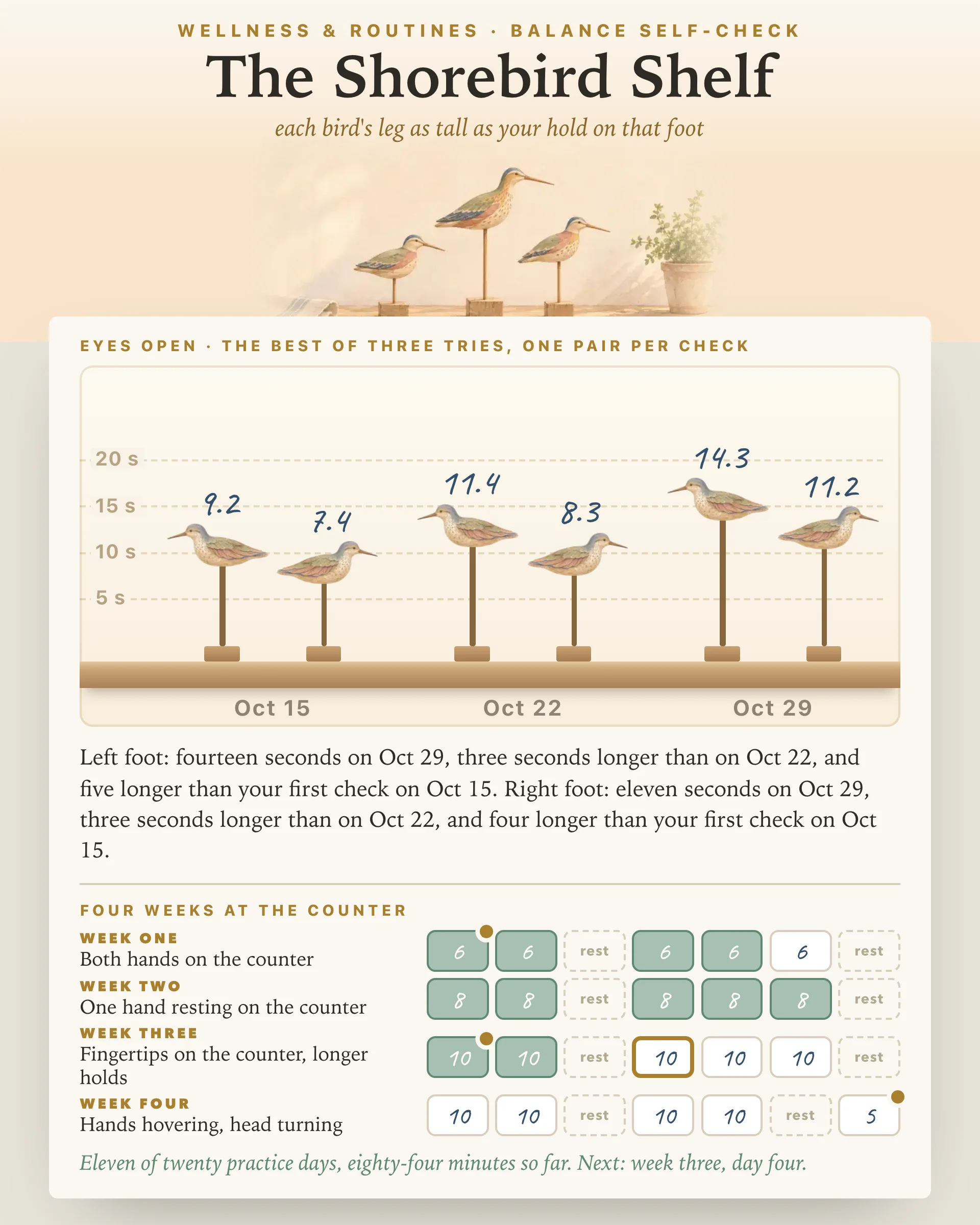
Each foot gets up to three tries a day, and the best stands on the shelf as a carved bird whose single wooden leg is as tall as that hold; the bird facing left is your left foot. A dashed line marks your last check, so during a try you see only your own earlier time. Beneath the shelf, plain sentences compare your newest check with the one before and with your first.
The plan runs five days a week for four weeks, six to ten minutes a day, every move beside the counter:
Check on day one, as week three begins, and on the final day. A Cochrane review of 108 trials found that, for people over sixty living at home, programs centered on balance and functional exercise reduced the rate of falls by about 24 percent. That review studied whole exercise programs across groups of people. It does not show that four weeks of counter practice will prevent a fall for you, or that a longer stance means you will not fall, and its authors rated most trials at unclear or high risk of bias on at least one point.
For more holds, The Balance Ladder climbs ten of them one rung at a time. The Thirty-Second Chair tracks leg strength against your own earlier counts, and if standing practice is too much right now, The Chair Circuit keeps every move seated. For standing poses between checks, The Door Frame times six yoga balance poses at the counter, the wall or free.
Speak with a doctor or physical therapist before your first check if you have fallen, had dizzy spells, had a hip or knee replaced, live with a heart or blood pressure condition, or feel pain when you stand. Keep the counter within arm's reach for every try and practice move, and stop right away if anything hurts or you feel lightheaded. If your times keep slipping from one check to the next, bring that up with your doctor.
Published averages fall with age. In a 2007 study of 549 healthy adults, timed barefoot with arms crossed and a 45-second limit, the best of three eyes-open tries averaged about 41 seconds for people in their fifties, 32 in their sixties, 21.5 in their seventies and 9 from eighty on, with a wide spread in every group. Read those as a rough guide only. This worksheet compares you with nobody but yourself.
Stand side-on to a kitchen counter, barefoot, arms crossed or hands on your hips, eyes fixed on a spot ahead. Lift one foot just clear of the floor near your other ankle and time how long you hold before it touches down, the standing foot moves or you reach for support. Take three tries on each foot and keep the best one.
Only later, once eyes open feels easy. Closing your eyes takes away a big share of the information your body balances with, so times drop sharply for everyone, often to a few seconds after sixty. Stand right at the counter with your fingertips hovering just above it, and have someone close by if you can.
Short, frequent practice with support close at hand. The plan here runs five days a week for four weeks, moving from both hands on the counter to hands hovering, with sways, heel raises, one-foot holds and heel-to-toe steps. A Cochrane review found programs built mainly on balance and functional exercise cut the rate of falls among people over sixty living at home by about a quarter, though that describes groups in trials, not what four weeks will do for you.
For most people who walk on their own, it is a gentle check when a sturdy counter is within reach. If you have had a fall, spells of dizziness, a joint replacement, a heart or blood pressure condition, or pain on your feet, ask a doctor or physical therapist before you try it, and stop if anything hurts.
By the team behind Fabulous, the science-based self-care app used by over 30 million people.


