
The Overwhelm Recovery ProtocolWellness & Routines · ~5 min
About this template · Updated November 2026
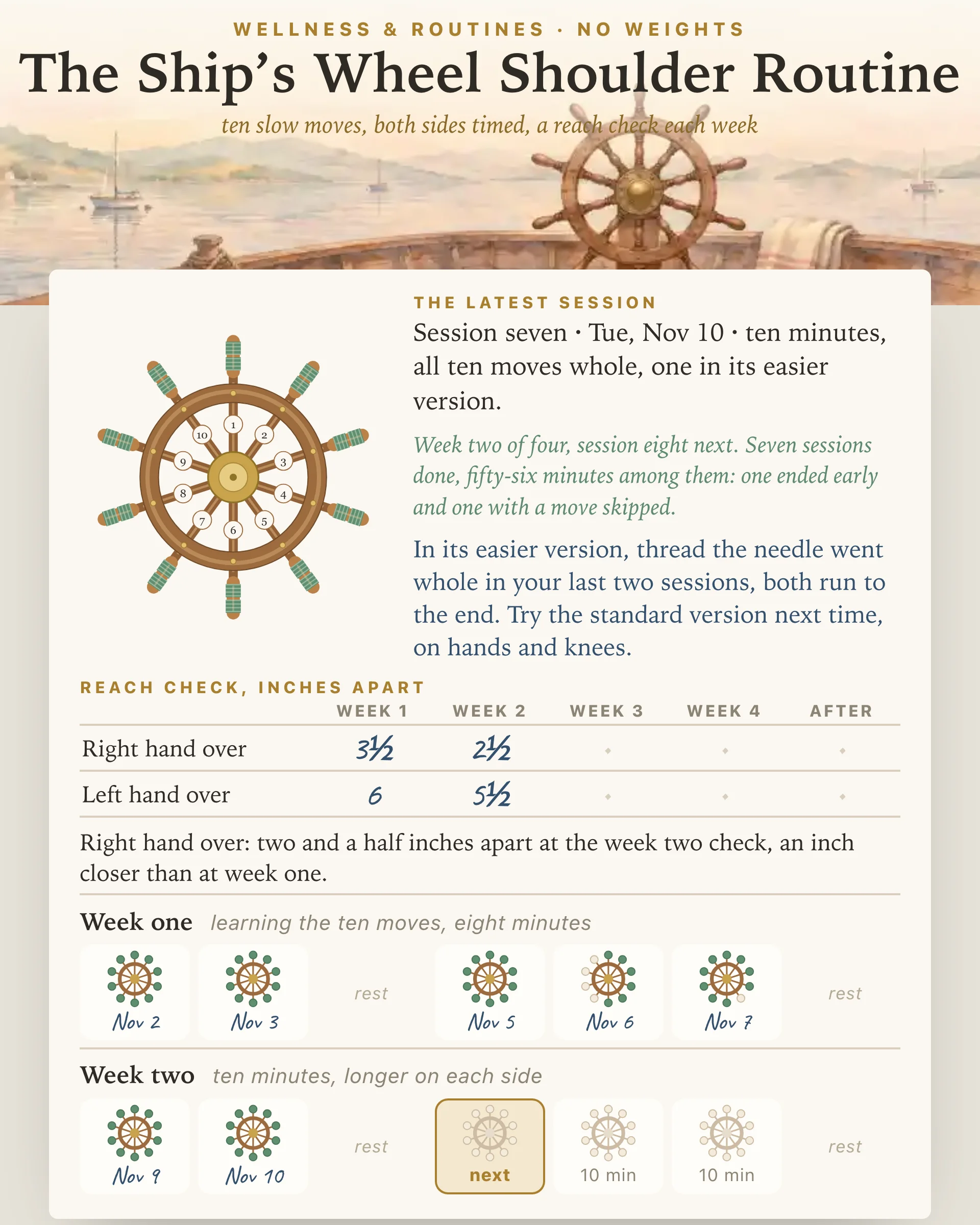
A high shelf, a sweater pulled over your head, a shirt tucked in at the back: each takes a shoulder to the far ends of its range. These shoulder mobility exercises go there on purpose, slowly and with no weight. Ten moves sit around a ship’s wheel, one handle each, with every side timed and a reach check once a week.
Standing first, then a table, then the floor, so you get down only once: arm circles from small to large, wall slides, wall angels, a cross-body reach, a towel behind the back, a broom pass-over with a wide grip, slow straight-arm circles beside a counter, table slides, thread the needle and a side-lying open book.
Each has an easier version, such as elbow circles or thread the needle at a table, for any move that pinches. The clock stays the same.
Every move gets a tenth of the session: six seconds to get set, the first side or half, six to switch, then the second. The clock reads real time, so a phone that locks mid-session loses nothing.
Each side that runs to its end wraps a band of rope on its handle. A skipped move stays bare and its seconds never count, and a session ended early keeps only whole minutes.
The page reads your two latest sessions in order: a move short in both is offered its easier version, and one done whole in its easier version in two whole sessions in a row is ready for the standard one.
Week one is eight minutes on five days, eighteen seconds a side. Weeks two and three run ten minutes, twenty-four seconds a side, on five days and then six. Week four reaches twelve minutes, half a minute a side, on six days.
One hand reaches over your shoulder and down your back, the other up from below, and someone measures the gap between your middle fingertips. Try each side twice and keep the closer try. Each side is compared only with its own earlier checks, with no normal range and no verdict. If a side comes out an inch or more wider at two checks running, the page says so, because a shrinking range is worth showing a doctor.
Shoulder range tends to narrow with age. Orthopedic researchers at a large US medical center measured both shoulders of 280 people aged 4 to 70 and found most motions smaller in older people, with inward rotation the exception. Dominant and other arms differed too. A snapshot cannot show whether exercise slows the change, but it explains why two sides rarely match.
Physical therapy researchers at a Pennsylvania university gave 30 people with one tighter shoulder a cross-body stretch or a sleeper stretch, five thirty-second holds once a day for four weeks. The cross-body group gained more inward rotation than a comparison group without that tightness; the sleeper group’s gain was not clearly different. Nobody had shoulder pain, the comparison group was not chosen at random, and one motion was measured.
The reach check borrows the back scratch test from fitness testing for older adults. Researchers in England had 71 healthy women with an average age near 72 repeat it three times in one sitting, and the tries landed close together, typically less than a centimeter apart. They did not test men or day-to-day change, so give a half-inch shift little weight.
The federal guide above also tells people recovering from tendinitis to keep up range-of-motion work. Gentle daily range work is common advice with small studies behind it, not a proven treatment, and nothing here promises a looser shoulder by a set date.
The Ten-Basket Shoulder Plan builds strength with a band and light weights, two or three days a week. The Neck and Shoulder Yoke eases the tightness of a long desk day. This page moves both shoulders through their whole range with no load, most days, and The Mobility Mobile covers every joint from neck to ankles.
Ask a doctor or physical therapist before week one after a shoulder injury or surgery, a fall or dizzy spells, or a joint replacement, or with a heart or blood pressure condition or pain that lingers. Keep a counter or sturdy chair within reach for the standing moves, and use a firm bed for the floor moves if getting up from the floor is hard.
Slow moves that carry the arm toward the far ends of its range without weight: arm circles that grow from small to large, wall slides, wall angels, a cross-body reach, a towel drawn up behind the back, a broom lifted overhead, table slides, thread the needle and an open book on your side. Each of these has a gentler version here.
Short and frequent suits range work better than long and rare. This plan asks for eight to twelve minutes on five or six days a week for four weeks, with at least one rest day in each week.
Two shoulders seldom match. A study of 280 people found the dominant arm turned outward more, while the other arm had more inward turn and more backward reach. That is why the reach check compares each side only with its own earlier numbers.
Nobody can promise a date. In one small trial, people who did a cross-body stretch once a day for four weeks gained more inward turn than a comparison group, but they had no pain and were measured on a single motion. Use the weekly check to see your own trend.
Before starting if the shoulder aches at night, the pain began with a fall or a blow, your arm tingles or goes numb, or your reach keeps shrinking week after week. Sudden pressure or crushing pain in the shoulder calls for 911.
By the team behind Fabulous, the science-based self-care app used by over 30 million people.


