
The Overwhelm Recovery ProtocolWellness & Routines · ~5 min
About this template · Updated November 2026
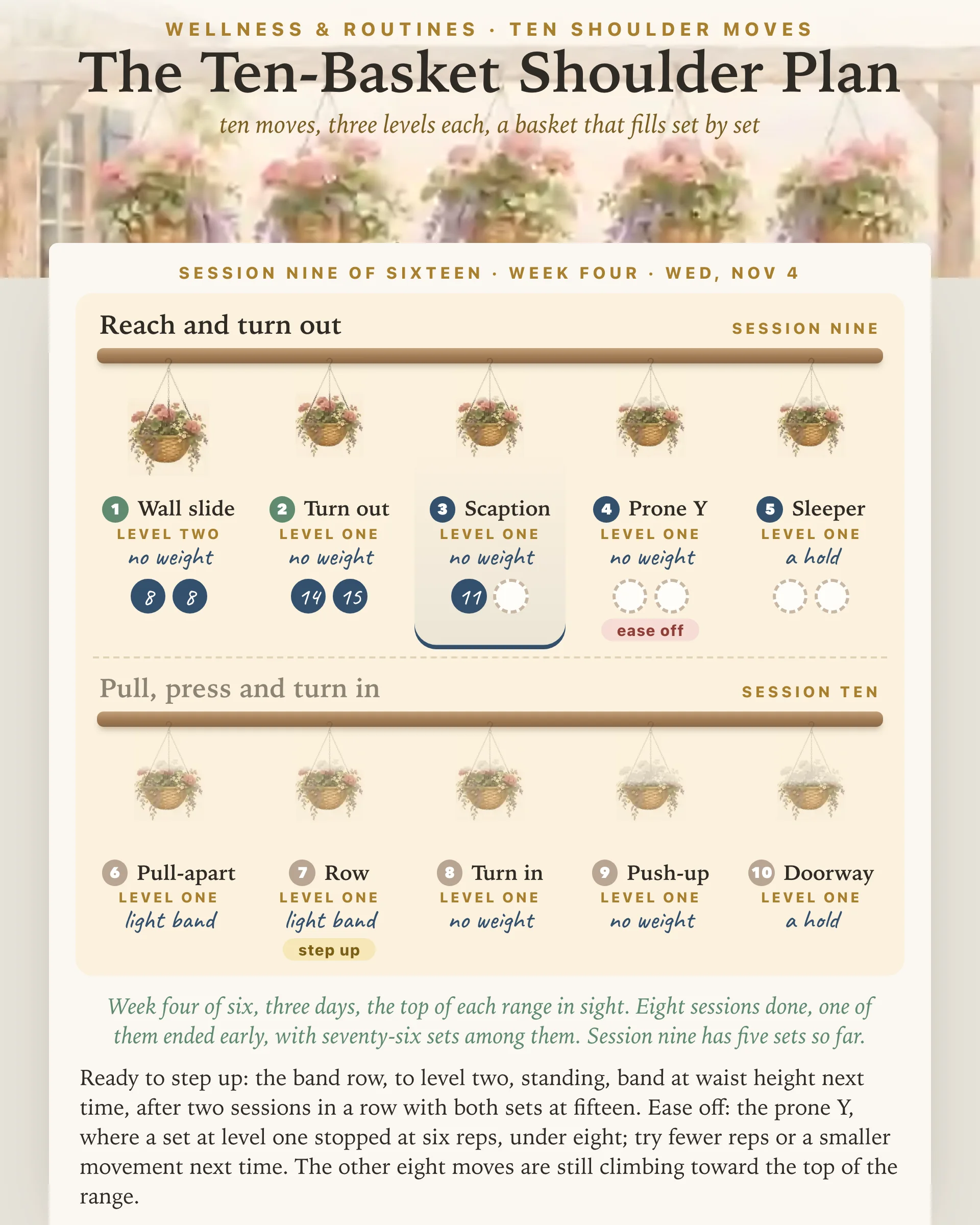
These shoulder exercises are for strength and easier movement, not for the mirror. They work the rotator cuff and the muscles around the shoulder blade with a band, light weights or a wall: ten moves at three levels each, and a painted porch with one hanging basket per move. Each finished set brings color further up its basket, and a basket grows a size with each level.
A frozen shoulder is a separate condition with its own care. The shoulder stiffens, often over months, until the arm moves less in every direction, even when someone else raises it. If that sounds like yours, ask a doctor or physical therapist before strengthening it.
Also check with a doctor or physical therapist before week one if you have had a fall or dizzy spells, shoulder surgery, a joint replacement, or a heart or blood pressure condition, and keep a sturdy chair or counter within reach for the standing moves.
Reach and turn out: wall slides, external rotation (turning the forearm out), scaption raises (lifting in a V, between straight ahead and out to the side), prone Ys lying face down on a bed, and the sleeper stretch for the back of the shoulder.
Pull, press and turn in: band pull-aparts, band rows, internal rotation, wall push-ups and a doorway stretch across the chest.
Level one is the gentlest shape: external rotation starts as a press into a door frame, and the sleeper stretch as a cross-body stretch standing up, reaching the sleeper position only at level three.
Tap a basket in today's row, then choose its level and its band or weight. Count me through paces each rep, about two seconds out, a short hold and three seconds back. A set goes in when its last rep is done. Stop partway and the whole reps you finished go in as a set marked stopped early, which never counts toward stepping up. Or do the set at your own pace and log it with one tap.
A minute's rest follows each set and reads the clock, so it stays right even if your screen locks.
Reps climb one a session until both sets reach the top of the range. When two of a move's sessions in a row finish there, at the same level and band or weight, its basket gets a step up tag. A session that never reached the move breaks the run. At level three the step is a band or a weight up. One set under the range, even in a session you ended early, suggests easing off a level or a band.
Sessions alternate the two rows, two a week at first and three from week three. A session takes about twenty-five minutes at first and nearer thirty once the reps climb, warm-up included.
The clearest signal comes from people already in pain. In a trial of 102 people with long-standing shoulder impingement who were on the path to surgery, physical therapists and orthopedic surgeons at a Swedish university hospital compared twelve weeks of targeted rotator cuff and shoulder blade strengthening with general neck and shoulder movement. At three months, 20 percent of the strengthening group chose surgery, against 63 percent of the others. That program also had hands-on treatment and guided visits, and it stopped at three months.
For worn rotator cuff tears that came on without an injury, an orthopedic team in Finland randomized 180 shoulders of people over 55 to physical therapy alone or with surgery. After a year, shoulder scores were alike in every group. Tears from a fall or a blow were not studied, one more reason pain after a fall goes to a doctor first.
A Cochrane review of manual therapy and exercise for rotator cuff disease is more sobering. Of 60 trials, only one high-quality trial compared therapy and exercise with a placebo, in 120 people, and it found no clinically important difference. Treat this plan as a careful, low-risk habit, not a proven treatment.
The Neck and Shoulder Yoke is a timed stretching routine for desk stiffness, with no load. The Eight-Arm Dumbbell Workout trains the whole arm with one pair of dumbbells. The Resistance Band Rack is a full-body band session. This plan stays with the shoulder itself: its turning and steadying muscles, mostly with a light band or no weight.
Keep your band and a light weight nearby. If a move keeps hurting from one session to the next, leave it out and ask a physical therapist what suits you instead.
Moves that train the rotator cuff and the muscles around the shoulder blade at low effort make a sensible start: wall slides, a gentle outward and inward press into a door frame, raises to shoulder height with no weight, and pull-aparts and rows on a light band. Every move on this page starts at its easiest level for that reason.
Two or three days a week with a rest day between suits most people starting out. This plan begins with two sessions a week for the first two weeks, then three, and each session works only five of the ten moves, so every move gets several days off before its next turn.
No. A band or weight should feel like effort and a stretch like a mild pull, nothing sharp. Stop a move that hurts, and see a doctor before going on if your shoulder pain wakes you at night, started with a fall or injury, comes with numbness, tingling or weakness in the arm, or keeps getting worse.
A frozen shoulder is a separate condition: the shoulder turns stiff and painful and loses movement in every direction, often over months, and its care follows its own stages. If that sounds like your shoulder, ask a doctor or physical therapist what to do before starting this plan.
When two of that move's sessions in a row end with both sets at the top of its range, at the same level and with the same band or weight, and no set was stopped early. Its basket then shows a step up tag, and the next level starts again at the bottom of the range.
By the team behind Fabulous, the science-based self-care app used by over 30 million people.


