
The Overwhelm Recovery ProtocolWellness & Routines · ~5 min
About this template · Updated November 2026
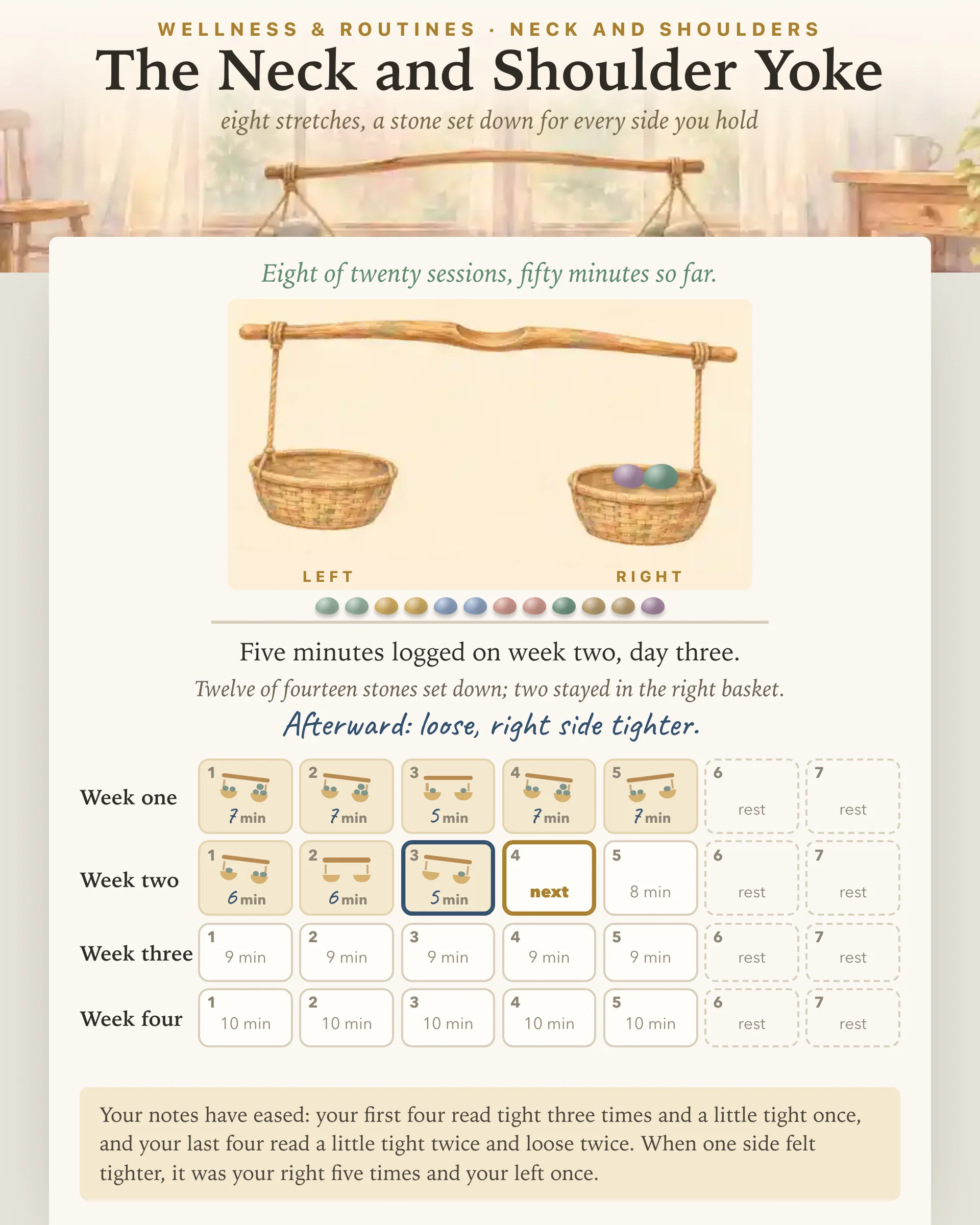
By late afternoon on a screen-heavy day, your head has drifted toward the monitor, your shoulders have crept up toward your ears, and looking over your shoulder feels stiffer than it did at breakfast. These neck and shoulder stretches give that hunched shape somewhere else to go. This page turns eight of them into one short routine, with a clock that runs each side for you and a painted yoke that shows, stone by stone, what you actually finished.
The routine starts in your chair and ends on the floor, so you only get down once.
Two-sided stretches do your left side first, then the right. Rolls and tucks work both sides at once.
The yoke carries sixteen stones, one for each side of each stretch. Press begin and the clock gives you a few seconds to settle, then counts each hold. When a hold runs all the way to its end, its stone comes off and joins the row on the floor. A side you skip keeps its stone, and since the yoke dips toward the heavier basket, an uneven day shows at a glance.
A stretch that does not suit you can be left out, and its stones stay off the yoke until you put it back. Paused time and skipped holds never count, and a session ended early logs whole minutes only, so stopping before the first full minute logs nothing.
Afterward, one tap records how your neck and shoulders feel (loose, a little tight, tight, or it hurt) and another records whether one side felt tighter. Each day in the four-week grid draws a small yoke from that note, and the reading compares your earlier notes with your recent ones.
Five desk days a week, weekends off. Holds grow from fifteen seconds a side in week one to thirty in week four, so a full session runs from seven minutes up to ten.
For flexibility, the American College of Sports Medicine's position stand on exercise for healthy adults recommends stretching the major muscle groups on at least two days a week, about sixty seconds per stretch in total. This plan stops at thirty seconds a side, so if a stretch feels especially good, do it a second time.
In a randomized trial with ninety-six office workers who had lived with moderate to severe neck pain for three months or more, everyone got a brochure on workstation setup, and half were also taught neck and shoulder stretches to do twice a day, five days a week, for four weeks. The stretching group improved more on pain, neck function and physical quality of life, and people who stretched at least three times a week gained more in neck function than those who stretched less often.
A broader look is more cautious. A Cochrane review of exercise for neck pain found no high-quality evidence for any exercise. For lasting neck pain, its best evidence favored strengthening the neck, shoulders and upper back, alone or alongside stretching, while low-quality evidence suggested stretching on its own may not change pain or function much.
Treat this routine as a way to move after sitting, not as a treatment. If tightness keeps returning, add some strength work, such as the band pull-aparts and wall angels in The Plumb Line Posture Plan, or ask a physical therapist what fits you.
Stretch to a mild pull, never into pain, and stop any stretch that makes you dizzy. The National Library of Medicine's guide to neck pain suggests contacting your provider if pain has not eased after a week of self-care, began with a fall, blow or injury, or comes with numbness, tingling or weakness in an arm or hand. Pain that spreads down an arm belongs on that list too. A stiff neck with fever and headache, or arm or jaw pain with shortness of breath, is an emergency: call 911. After neck or shoulder surgery, ask your surgeon or physical therapist which of these stretches suit you.
For a whole-body set, try The Daily Stretch Mat; to build a gentle routine, seated or at a counter, from wherever you feel tight, try The Stiffness Map. And if most of the stiffness comes from a working day at a desk, The Paper Clip Chain times two-minute breaks around your own hours.
Start with the ones you can do in your chair: shoulder rolls, a cross-body shoulder stretch, an upper trap stretch and a levator scapulae stretch. Add a doorway chest stretch to open the front of the shoulders, and thread the needle on the floor when there is room. Keep the ones that give a gentle pull and drop any that pinch.
Fifteen to thirty seconds a side is a common range, and this plan climbs from the first to the second over four weeks. The American College of Sports Medicine suggests about a minute in total per stretch on two or more days a week, so a stretch that feels good can be done twice.
The evidence is mixed. A trial with office workers found four weeks of stretching eased neck pain more than workstation advice alone, while a Cochrane review found stretching on its own may change little and strengthening helps more. Treat these stretches as a good break from sitting rather than a treatment.
See a doctor if the pain has not eased after a week of gentle care, began with a fall or injury, spreads down an arm, or comes with numbness, tingling or weakness in an arm or hand. A stiff neck with fever and headache, or arm or jaw pain with shortness of breath, needs emergency care right away.
No. Aim for a mild pull that softens as you breathe out, never a sharp or pinching pain. If a stretch hurts, ease off or leave it out, and if it hurts every time you try it, ask a physical therapist to take a look.
By the team behind Fabulous, the science-based self-care app used by over 30 million people.


