
The Overwhelm Recovery ProtocolWellness & Routines · ~5 min
About this template · Updated November 2026
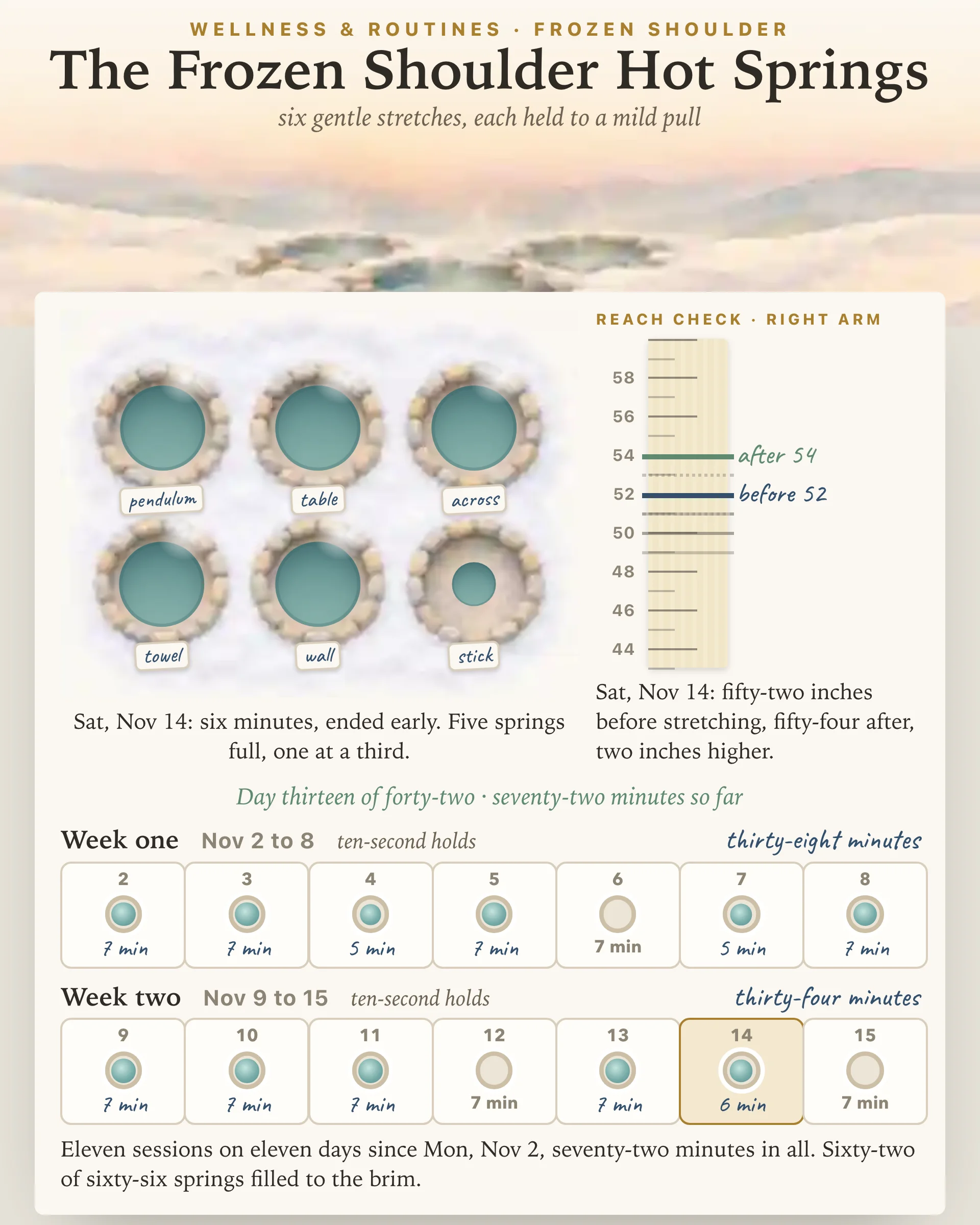
A frozen shoulder turns ordinary reaches into hard ones: the top shelf, a back pocket, the sleeve of a coat. The capsule around the joint thickens and tightens, the arm loses movement in every direction, and turning it outward is often the first to go. These stretches for frozen shoulder sit alongside the care of your doctor or physical therapist, who can confirm the diagnosis and say how far to push. This page gives you six small hot springs in the snow, one for each stretch, a timer that paces every hold and rest, a reach strip you mark against a wall, and a six-week log.
In the freezing stage, pain builds while movement shrinks, and the ache is often worst at night. In the frozen stage the pain may settle while the stiffness stays. In the thawing stage the pain fades and movement may slowly return, though stiffness can linger. The guideline below places freezing at roughly three to nine months after symptoms begin, frozen at nine to fifteen and thawing at fifteen to twenty-four, and notes that mild symptoms can last for years. Recovery often takes many months, and nobody can promise you a date. It is most common from forty to sixty-five, in women, and with diabetes or thyroid disease.
Each goes only to a mild stretch, never into sharp pain, and every cue names the side you choose.
The timer lets you settle into each stretch, then counts three holds, each followed by a short rest. A hold that runs its full time adds a third of its spring’s warm water; one you end early or skip adds nothing. A session ended early keeps only its whole minutes.
The plan runs six weeks, one session a day: ten-second holds for two weeks, then twenty, then thirty, so a session grows from seven minutes to thirteen. If your shoulder still aches at rest or wakes you at night, keep the holds at ten seconds.
Face a wall, toes on a spot you can find again, walk the fingers of your stiff hand up until the stretch begins, pencil a mark and enter its height from the floor, before stretching and after. The strip sets your marks only beside your own, with no normal range and no verdict, because reach shifts with sleep, pain and the hour.
The clinical practice guideline on adhesive capsulitis from the American Physical Therapy Association’s orthopedic section recommends stretching exercises, with their intensity set by how irritable the shoulder is, on moderate evidence. It also rates a steroid injection plus mobility and stretching work as better for pain and function over the first four to six weeks than the stretching alone. Several of its recommendations rest on weak evidence or expert opinion.
A Cochrane review of manual therapy and exercise for frozen shoulder gathered thirty-two trials with 1,836 adults. Six weeks of hands-on therapy and exercise probably helped less than a steroid injection at seven weeks, a gap that no longer mattered by six months. No trial compared them with no treatment, and most of the evidence was low quality, so it cannot say what a home routine adds by itself.
A systematic review of the natural history of frozen shoulder found seven studies of adults who had no treatment. Their movement improved somewhat over one to four years, though not completely, and most of the gain came early rather than in a late thaw. It describes untreated shoulders, not what stretching changes.
The Neck and Shoulder Yoke is built for desk-day tightness on both sides. This page is for one stiff shoulder with a tightened capsule: the stretches are gentler and helped by your other arm, and the wall-reach check follows the very reach a frozen shoulder takes away. For a broader routine, The Stiffness Map builds one from wherever you feel tight.
Check with your doctor or physical therapist before you start if you have had a fall, dizzy spells, a joint replacement, a heart or blood pressure condition, or pain that is new or getting worse, and keep a sturdy table or counter beside you for the standing stretches. A recent injury, a fall or sudden severe pain needs a doctor before any stretching. The National Library of Medicine's guide to shoulder pain advises contacting a provider about pain with fever, swelling or redness, and going to the emergency room after a severe injury. Sudden pressure or crushing pain in the shoulder, especially with chest discomfort, shortness of breath, dizziness or sweating, can be a heart attack: call 911.
Gentle, assisted ones that let the stiff arm move without straining: pendulum swings, table slides, a cross-body stretch, a towel stretch behind the back, finger walks up a wall and outward rotation with a stick. Your physical therapist may add or drop some depending on how sore the shoulder is right now.
Often many months, and sometimes longer. Pain tends to settle before movement returns, and some people keep a little stiffness for years. No one can promise a timeline, so treat these stretches as daily care for the shoulder rather than a countdown.
No. Go to a mild pull you can breathe through and stop well short of sharp pain. If the shoulder aches at rest or wakes you at night, keep each hold short and gentle, and let your doctor or physical therapist know.
This plan sets one short session a day for six weeks, with holds growing from ten seconds to thirty, or staying at ten if the shoulder is sore. If your physical therapist has given you a different schedule, theirs comes first.
Before you stretch, if the pain began after an injury or a fall, came on suddenly and severely, or comes with fever, swelling or redness. Shoulder pain with chest pressure, shortness of breath or sweating can signal a heart problem, so call 911.
By the team behind Fabulous, the science-based self-care app used by over 30 million people.


