
The Overwhelm Recovery ProtocolWellness & Routines · ~5 min
About this template · Updated November 2026
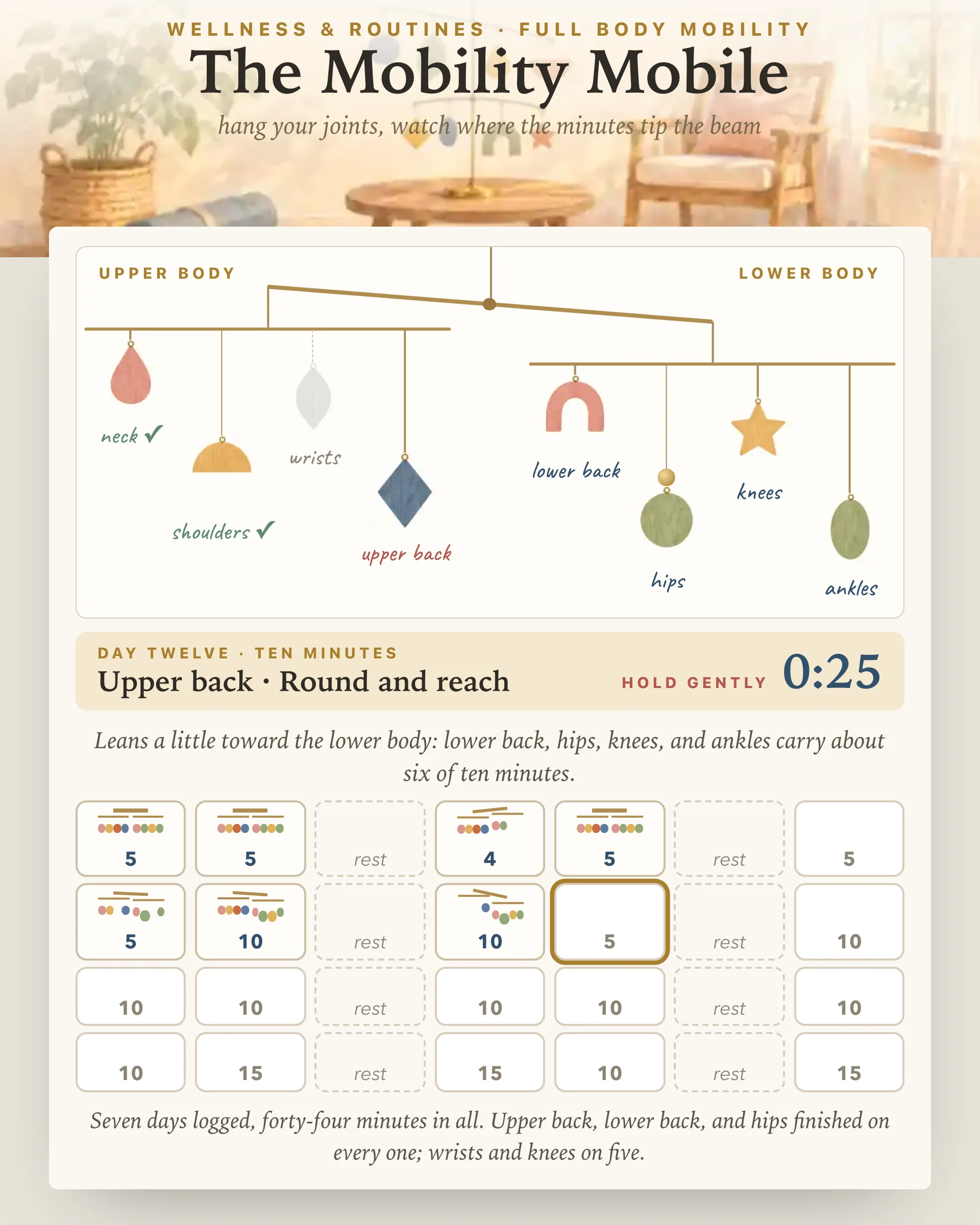
Search for mobility exercises and you get long lists: forty moves, a video for each, and no idea which eight to do this morning or for how long. This page gives you one short routine that reaches every major joint from your neck to your ankles, lets you shape it in a few taps, and keeps time while you move.
The routine is drawn as a hanging mobile. Upper body pieces hang from one arm, lower body pieces from the other, and the beam tilts toward wherever your minutes go. When you put together your own full body mobility exercises, it is easy to give ten minutes to the joint that bothers you and thirty seconds to the rest. Here the lean shows before you start.
On this page, a mobility exercise is a slow, controlled movement that takes a joint through as much of its range as it comfortably allows, with your muscles steering rather than momentum. Circles are the classic shape, because a circle visits every direction a joint can go. Each piece pairs that moving part with a short hold at the far end of the range, the part most people would call a stretch.
Tap a piece to read both moves, take it down to leave it out today, or hang a brass bead on it for double time.
Choose five, ten or fifteen minutes. The page shares that time between the pieces you hung, a bead counting twice, and every piece gets at least half a minute. If a short session cannot manage that, it says so rather than quietly shrinking your holds.
Press start and the clock works down the body: five seconds to get set, a slow moving part, then a gentle hold, with a cue at halfway. It reads real time, so a phone that locks in your pocket loses no minutes.
Only what you did goes on the board. A session run to the end logs its full length; one ended early logs whole minutes, and a piece counts as finished only once its hold is done. Each logged day draws a tiny mobile of the pieces you finished, tilted the same way, so over two weeks you can see if one half of your body keeps getting more.
The plan runs four weeks with two rest days a week: five minutes on each moving day of week one, a mix of five and ten in week two, ten on every moving day of week three, and fifteen on three days of week four. Keep up to three routines you like, and one tap hangs any of them again.
Regular stretching does increase how far joints move. A 2024 meta-analysis of 77 studies found a moderate gain in range of motion from stretch training compared with none. Held stretches did better than bouncing or swinging ones over the long run, and neither session length nor how often people trained made a clear difference. That is why every piece here ends in a hold, and why a short routine you repeat beats a long one you skip.
A review of stretching in active adults found that the range gained from one bout usually fades within about half an hour. A morning pass loosens you for a while; the change that lasts comes from weeks of repeats.
What the research does not show matters too. In people over 65, a systematic review found that flexibility training may improve range of motion, while the evidence on everyday function was conflicting. No study has tested this exact mix of circles and holds, and nothing here treats arthritis or back pain. Think of it as a way to keep joints used to moving, alongside walking and strength work.
Move slowly, only as far as feels easy, and stop any move that hurts. If you have had a joint replacement, a fall, dizzy spells, a recent injury, or a heart or blood pressure condition, ask a doctor or physical therapist before you begin. Keep a sturdy chair or counter within reach for the standing pieces.
Hang the mobile when your joints feel stiffest: soon after getting up, or after a long drive or a day at a desk. If your hips need more than one piece can give, The Hip Compass spends a whole session there. For a slower session of floor stretches, try The Daily Stretch Mat, and if stiffness and slouching arrive together, The Plumb Line Posture Plan works on how you stand and sit. For a month with a set routine each day, The Thirty-Crane Mobility Challenge runs ten minutes a day for thirty days.
There is no single agreed definition, but most coaches mean slow, controlled movements that take a joint through as much of its range as it allows, such as circles and swings, often finished with a short hold at the far end. A plain stretch mostly asks a muscle to relax and lengthen; mobility work also asks you to steer the joint while it moves.
One that reaches every major joint from the top down: neck, shoulders, wrists, upper back, lower back, hips, knees and ankles. Here each of those gets a moving part and a hold, the minutes you choose are shared between them, and the beam shows whether the routine leans toward your upper or lower half.
Five to fifteen minutes on most days is a realistic place to start. The four-week plan on this page opens with five minutes on five days and reaches fifteen on three days of the last week. A large review of stretch training found no clear advantage in training longer or more often, so choose a length you will actually keep.
For most people, yes, when the movements stay slow and inside an easy range. Every standing move here has a hand on a counter or a seated way to do it. Check with a doctor or physical therapist first after a joint replacement, a fall, dizzy spells, or a heart or blood pressure condition, and stop any move that hurts.
Do them when your joints feel stiffest and the time is reliably yours. Many people like a short pass soon after waking or after a long sit. The extra range from one session tends to fade within half an hour, so the lasting change comes from repeating the routine across weeks.
By the team behind Fabulous, the science-based self-care app used by over 30 million people.


