
The Overwhelm Recovery ProtocolWellness & Routines · ~5 min
About this template · Updated November 2026
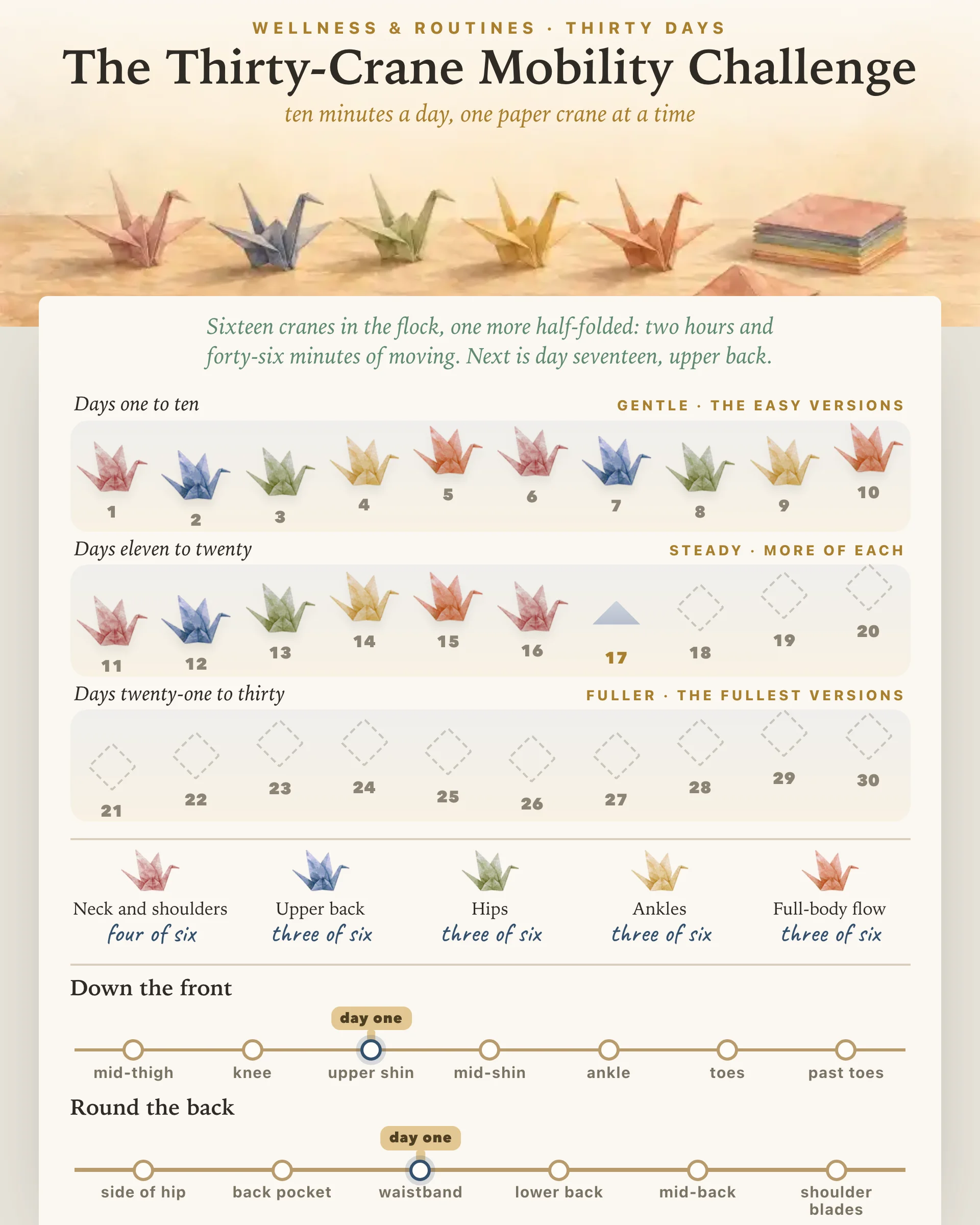
Stiffness rarely announces itself. One morning you notice you turn your whole body to check the car's blind spot, or that the top shelf has quietly become the step-stool shelf. A mobility challenge answers it early, with a little movement done often. This page gives you thirty ten-minute sessions, a timer that keeps honest time, and a flock of paper cranes that grows as you go.
Each day belongs to one of five areas, and they take turns: neck and shoulders, upper back, hips, ankles, then a full-body flow, before the circle starts again. Over thirty days every area comes around six times. A day has five moves, and each move gets two minutes, so the session is ten minutes from the first chin glide to the last slow breath.
The three rows of cranes are three stages. Days one to ten use the gentle versions, the ones you can learn while still paying attention to how they feel. Days eleven to twenty add repetitions or a longer hold. Days twenty-one to thirty use the fullest versions, which are still modest. Nothing happens on the floor. Every move that asks for balance names a counter, wall or chair to hold.
When you finish a day, a paper crane in that area's color joins the flock: rose for neck and shoulders, blue for the upper back, green for the hips, gold for the ankles, terracotta for the full-body flow. One glance shows which parts of you have had their turn.
Press begin and the page walks you through the five moves, says when a two-sided move should switch, and holds the clock while you pause. It reads the time from the clock itself, so a phone that locks halfway through still knows how long you have been moving.
Only what you do is counted. Stop early and the whole minutes you moved are kept, with the day left as a sheet folded in half until you finish it; stop before a full minute and nothing is recorded. Skipped time never counts. If you did a day's moves somewhere else, fold it in by hand.
The flock follows sessions, not dates. Miss a Tuesday and day nine waits for you.
Before the first session, take two quick measurements. For the first, sit on the front edge of a sturdy chair, straighten one leg with the heel down, and reach toward your toes with a long back as you breathe out. Note the landmark where your fingertips stop: knee, top of the shin, middle of the shin, ankle. For the second, slide one hand behind your back with the thumb up your spine and walk it upward until it stops. Try each side and pin the shorter reach both times.
The front reach borrows from the chair sit-and-reach test, which researchers built for older adults as a gentler option than reaching on the floor, and which gave stable, reasonably accurate readings of hamstring flexibility when repeated a few days apart. This page does not use the test's scoring tables. You pin a landmark on your own body, and on day thirty you pin it again. The only comparison is with your own first check.
The clearest finding is about range of motion. A 2024 meta-analysis of 77 stretch-training studies found that regular stretching increased range of motion by a moderate amount compared with not stretching. Held stretches produced bigger gains than swinging or bouncing ones, which is why most days here include at least one slow hold. The same review found that how long, how hard and how often people stretched made no clear difference to the result, a good argument for a short routine you can keep.
Fitness guidelines from the American College of Sports Medicine suggest flexibility work for each major muscle-tendon group on at least two days a week, about a minute in total per exercise. The rotation brings each area back every fifth day, and the full-body flow visits most of them again in between.
What the evidence does not show is just as important. A systematic review of flexibility training in adults over 65 found that range of motion may improve, but the research is mixed on whether that makes everyday tasks easier. So a reach that moves one landmark further is a real change, not a promise about anything else. Whether the top shelf comes easier is worth noticing too.
Move only as far as feels easy and stop if anything hurts. Keep a chair or counter within reach for the standing moves. If you have had a fall, dizziness, a joint replacement, a heart or blood pressure condition, or pain that lingers, talk with a doctor or physical therapist before you start.
Choose a time you can repeat, such as before breakfast or after a day at a desk. If your hips need more attention than one day in five, The Hip Compass gives them a routine of their own. For gentle stretches mapped to wherever you feel tight today, try The Stiffness Map, and if your shoulders round forward by the afternoon, The Plumb Line Posture Plan works on that directly. And if a day at a desk leaves the front of your hips tight, The Hip Flexor Clothesline gives six stretches an easier and a deeper version each.
It is a month of short daily sessions that take your joints through their range on purpose. This one gives you ten minutes a day and turns through five areas, so each one comes around six times before the month is out.
For most beginners it is a sensible place to start. A large review of stretch training found range of motion improved across many different schedules, and the amount of stretching made no clear difference, so a short routine you actually keep is a reasonable choice.
Flexibility usually means how far a joint can be moved, often in a held stretch. Mobility is how freely you can move it yourself, under your own control. This challenge mixes the two: slow active moves with a few gentle holds.
Yes, it was written with them in mind. Every move that asks for balance has a counter, wall or chair to hold, nothing happens on the floor, and the first ten days use the easiest versions. Talk with a doctor or physical therapist first if you have had a fall, dizziness or a joint replacement.
Nothing is lost. The flock does not follow the calendar, so the next day simply waits for you and the routine picks up where you stopped. Thirty sessions spread over five or six weeks still leave you a full flock to look back on.
By the team behind Fabulous, the science-based self-care app used by over 30 million people.


