
The Overwhelm Recovery ProtocolWellness & Routines · ~5 min
About this template · Updated November 2026
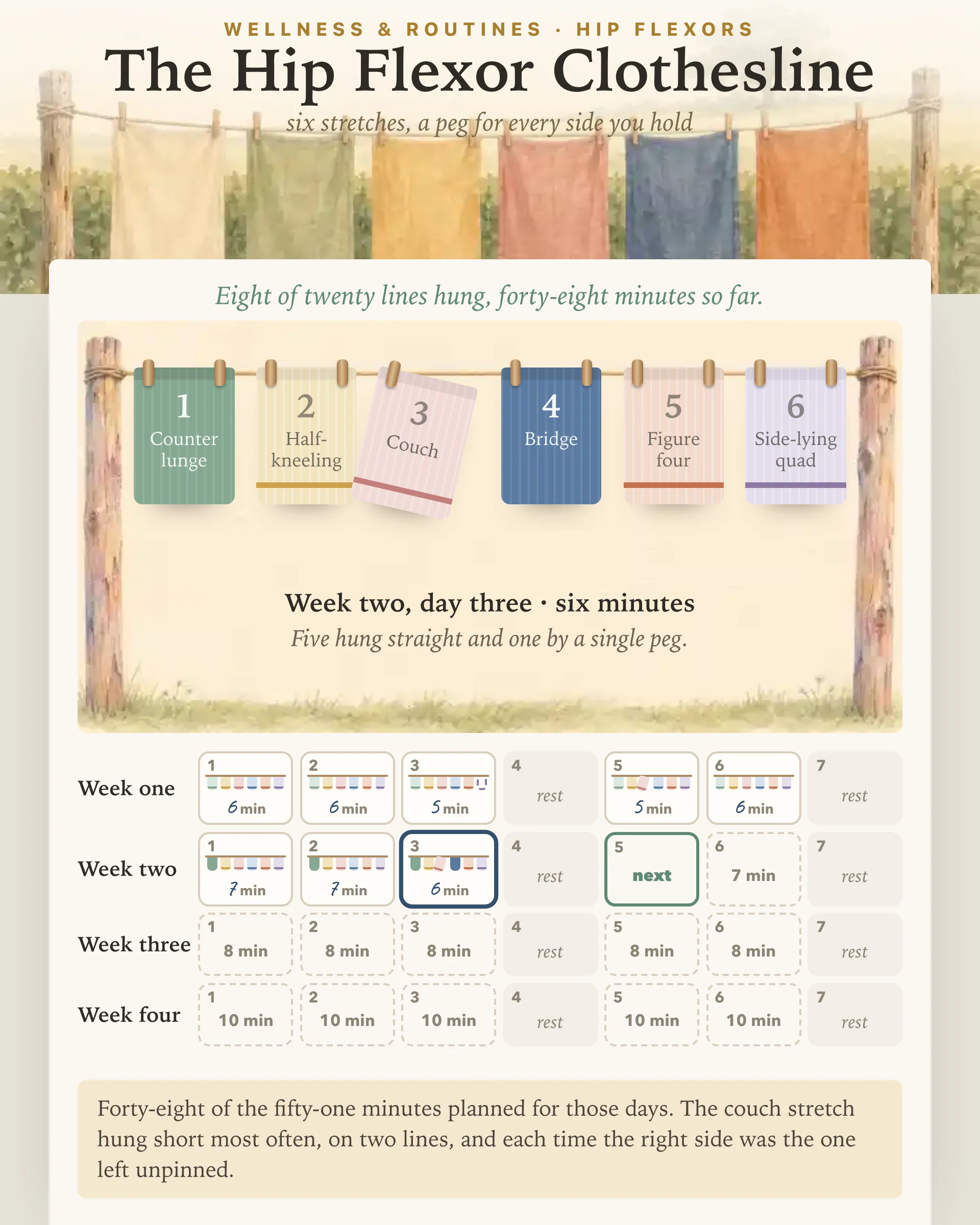
If most of your day happens in a chair, the front of your hips spends hours folded at a right angle, and after a long drive the first few steps can feel short. Hip flexor stretches open that front side back up. This page turns six of them into a short routine with a clock that runs every side for you, and a clothesline that shows what you actually did.
The session moves from standing to kneeling to lying down, so you only get down to the floor once.
Each stretch is a cloth on the line, with two pegs, one for each side. Choose easier or deeper for every stretch before you begin: an easier cloth is pale with a colored hem, and a deeper one wears the full color.
Press begin and the clock takes over. You get twenty seconds to settle into each new stretch and ten to change sides, then it holds each side for this week's length. That starts at fifteen seconds a side in week one and grows to twenty, twenty-five and thirty-five, which makes sessions of six, seven, eight and ten minutes, five days a week. The clock keeps real time, even if your phone locks mid-hold.
A peg goes on only when a hold runs all the way to its end, so a skipped side leaves its cloth hanging by one peg, at an angle. A session ended early keeps only its whole minutes. Each finished session leaves a small line on the four-week grid, and after a few, the note beneath it says which cloth keeps hanging short, on which side, and which stretch looks ready for its deeper version.
Regular stretching does seem to help tight hip flexors. In a randomized trial of thirty-three young patients with back or leg complaints and limited hip extension, both active and passive home stretching increased hip extension over six weeks, with no difference between the two approaches. The style mattered less than doing it.
The effects on daily life are more modest. A trial in frail older adults gave one group ten weeks of hip flexor stretching twice a day, checked twice a week by a clinician. Their passive hip extension improved, and so did their walking speed and stride length, but how far the hip extended while walking did not change significantly.
For dose, the American College of Sports Medicine's position stand suggests about sixty seconds in total for each flexibility exercise on at least two days a week, and it adds that breaking up long sitting with short bouts of standing and movement has benefits of its own. The plan here builds to thirty-five seconds a side on five days a week, close to that advice.
What the evidence does not show is that stretching undoes a sitting day, cures back pain or changes posture by itself. The common claim that chairs shorten the hip flexors is plausible but thinly measured. None of these studies tested this page.
Talk to a doctor or physical therapist before starting if you have had a hip, knee or back operation, a fall or dizzy spells, a heart or blood pressure condition, or pain in your hips, knees or lower back. After a hip replacement, your surgeon's position limits come first, since the couch stretch and figure four both take the hip a long way. Stretch to a mild pull, never into pain, and keep a chair or the counter within reach while kneeling or standing.
The best moment is right after the longest stretch of sitting in your day: the end of a workday, the evening after a drive, or before bed. If you want to move the hip through every direction rather than open its front, The Hip Compass is built around that. The Daily Stretch Mat covers the neck, chest and calves on other days, and if getting down to the floor is hard, The Stiffness Map keeps everything to a chair and a counter.
A short set covers most people: a standing lunge stretch at a counter, a half-kneeling stretch and the couch stretch for the front of the hip, with a side-lying quad stretch for the top of the thigh. A bridge hold and a lying figure four round it out by working the back and outer hip. Each one on this page has an easier version for stiff days and a deeper one for when the easier one stops pulling.
The American College of Sports Medicine suggests about sixty seconds in total for each stretch, which can be split into shorter holds, on two or more days a week. This plan starts at fifteen seconds on each side and reaches thirty-five by week four. Stay still at a mild pull instead of bouncing.
Short and often suits a long sitting day better than one long session on the weekend. The plan here asks for five sessions a week of six to ten minutes. Between them, getting up for a short walk every so often breaks up the sitting itself, which the same guidance recommends alongside regular exercise.
No. Expect a steady pull at the front of the hip or thigh and nothing sharp, pinching or tingling. Back off if a stretch pinches in the groin or presses hard on a knee. Check with a doctor or physical therapist before you start if you have had a hip, knee or back operation, a fall, or pain that is already there.
It is a common explanation and a plausible one, since a chair holds those muscles short for hours, but it has been studied far less than it is repeated. Trials do show that a few weeks of regular hip flexor stretching can increase how far the hip extends, which is reason enough to stretch either way.
By the team behind Fabulous, the science-based self-care app used by over 30 million people.


