
The Overwhelm Recovery ProtocolWellness & Routines · ~5 min
About this template · Updated November 2026
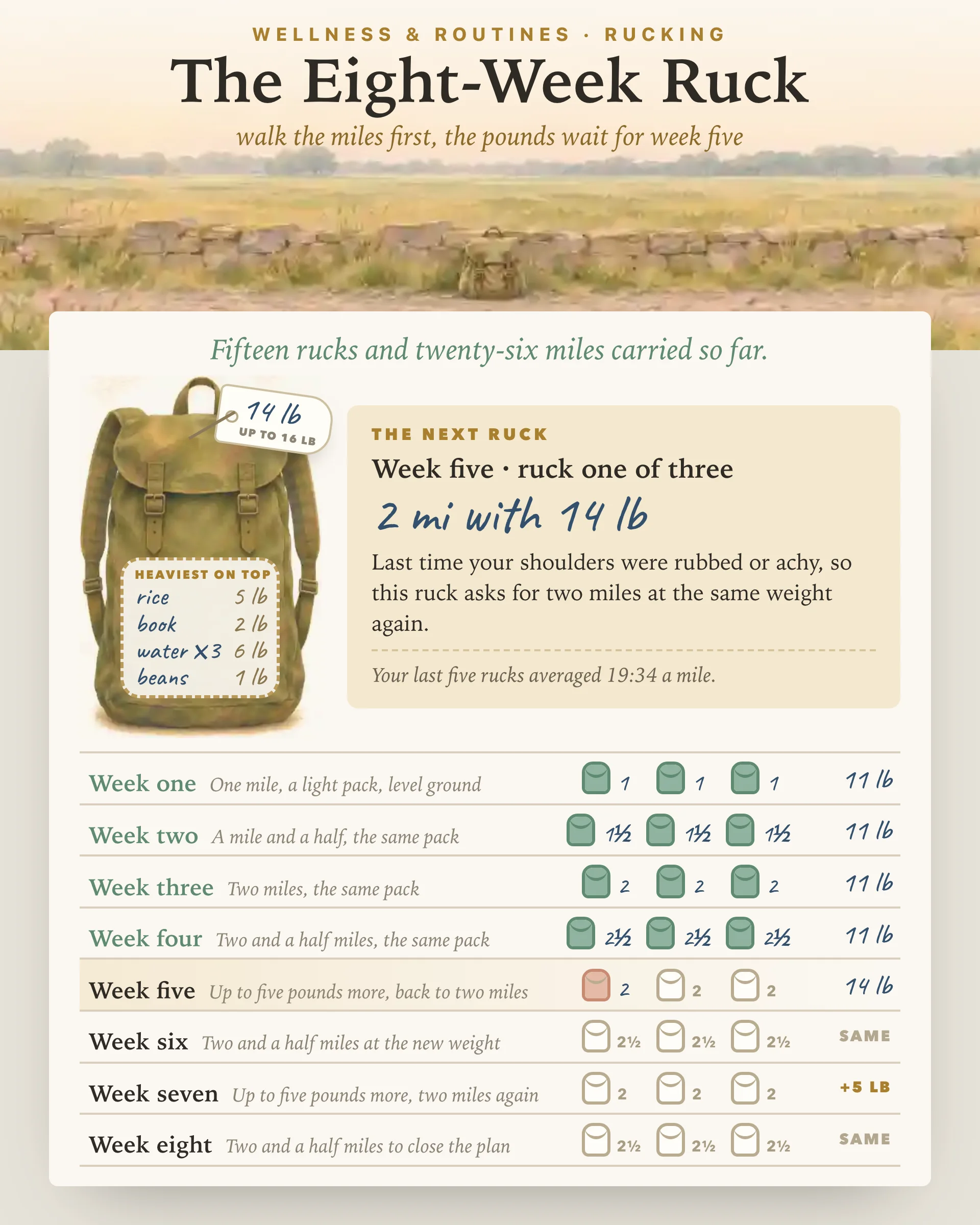
Rucking is walking with weight on your back. It suits people who already like to walk: you keep the route you know and a pace you can talk at, and a loaded backpack makes the same mile ask more of your legs, hips and lungs. The word comes from rucksack, and the habit comes from soldiers, who have marched under packs for centuries. You need nothing close to their loads. You need a sturdy backpack, a few things from the kitchen, and a plan that is patient with your feet.
This page is that plan: eight weeks, three rucks a week, and one rule above the rest. Miles first, pounds later.
Start light. A cautious starting point is ten percent of your body weight or less, so fifteen pounds at most if you weigh one hundred fifty. No study has tested a starting weight for adults who are new to rucking. The ten percent line is careful common practice, not a research finding, and lighter is always fine. If half an hour of plain walking still feels like work, build that first with The Walking Workout Ribbon and come back to the pack in a few weeks. If you would rather wear the weight than carry it on your back, The Six-Week Vest Walk builds up a weighted vest slowly.
You do not need special plates. Bags of rice, liters of water at about two pounds each, a hardcover book or a brick wrapped in a towel all do the job. Tap them into the painted pack on this page and it adds them up, lists them heaviest first, and turns away anything that would carry you past your line. A bathroom scale gives the true number: weigh yourself holding the pack, then without it.
Where the weight sits matters as much as how much there is. A review of soldier load carriage found that keeping a pack's mass close to your own center of mass costs the least energy and keeps you more upright, and that on even ground a high load placement may work best. The same review recommends a hip belt whenever the pack has one, because it takes pressure off the shoulders. In practice: heaviest things at the top against your back, gaps filled so nothing slides, straps snug so the pack rides high.
Weeks one to four keep the same pack while the distance grows from one mile to two and a half, at roughly twenty minutes a mile on level, familiar ground. Week five is the first weight week: the pack may gain up to five pounds over what finished week four, and the distance eases back to two miles. Week six builds back to two and a half. Week seven adds five pounds more at most, and week eight closes the plan at two and a half miles with the heavier pack.
A ruck counts at the distance you actually walked. Turn back at three quarters of a mile and three quarters is what goes in, and the full mile comes around again next time. The ruck clock keeps real time even with your phone locked, and when you tap back home it records whole minutes only.
The check takes ten seconds. All three fine, and the plan moves on. Rubbed shoulders, a stiff back or a hot spot, and the same distance and weight come around again, with a practical fix beside it. Pain, a blister, or numbness or tingling in your arms means at least two days of rest and a lighter pack for the next ruck.
Those three places are not chosen at random. A 1996 review of carrying loads in packs lists the injuries most often tied to long marches, among them foot blisters, foot pain, back strains and rucksack palsy, a traction injury from shoulder straps that can leave an arm numb or weak. Numbness that lingers after the pack comes off is a reason to see a doctor. For feet, the American Academy of Dermatology's advice on preventing blisters is short: moisture-wicking socks, shoes neither tight nor loose, moleskin on problem spots, and stopping when skin turns red. If your feet tire easily, The Footprint Trail builds them up gently between rucks.
Carrying weight makes walking harder. That 1996 review describes the energy cost climbing with the load, your own weight, your speed and the slope, and notes that weeks of walking with loads make the same effort cheaper, which supports a slow build. It says little about everyday walkers. Nearly all of it comes from soldiers carrying far more than this plan ever asks. No good trial yet shows whether rucking beats plain walking for weight, bone or heart health in older adults, so this page promises none of that. Treat it as a way to make a familiar walk more demanding, at a pace your body agrees to.
Talk to your doctor or a physical therapist first if you have back, neck, hip or knee trouble, thinning bones, a heart or blood pressure condition, or a recent fall. Keep to level routes until the pack feels ordinary, and take it off the moment anything hurts. If you notice yourself hunching under the straps, The Plumb Line Posture Plan pairs well with these weeks.
Rucking means walking with weight on your back, usually in a sturdy backpack. A rucking workout sets the distance and the load so each walk asks a little more than plain walking, while staying low impact because one foot is always on the ground.
A cautious starting point is ten percent of your body weight or less, so fifteen pounds at most if you weigh one hundred fifty. No study has set this number for adults new to rucking. It is careful common practice, and starting lighter is fine.
Three rucks a week with a rest day or two between them gives feet, back and shoulders time to adjust. This plan keeps one pack for four weeks while the distance climbs from one mile to two and a half, then adds weight in two small steps.
It is harder. Studies of soldiers show the energy cost of walking climbs with the weight carried, the pace and the slope. Whether that adds up to more fitness or stronger bones for everyday walkers has not been tested well, so treat rucking as a way to make a familiar walk more demanding.
Things you already own work well: bags of rice, liters of water, a hardcover book, a brick wrapped in a towel. Pack the heaviest items high and close to your back, fill the gaps so nothing shifts, and weigh the loaded pack on a bathroom scale.
By the team behind Fabulous, the science-based self-care app used by over 30 million people.


