
Leaves on a StreamEmotional Fitness · ~3 min
About this template · Updated September 2026
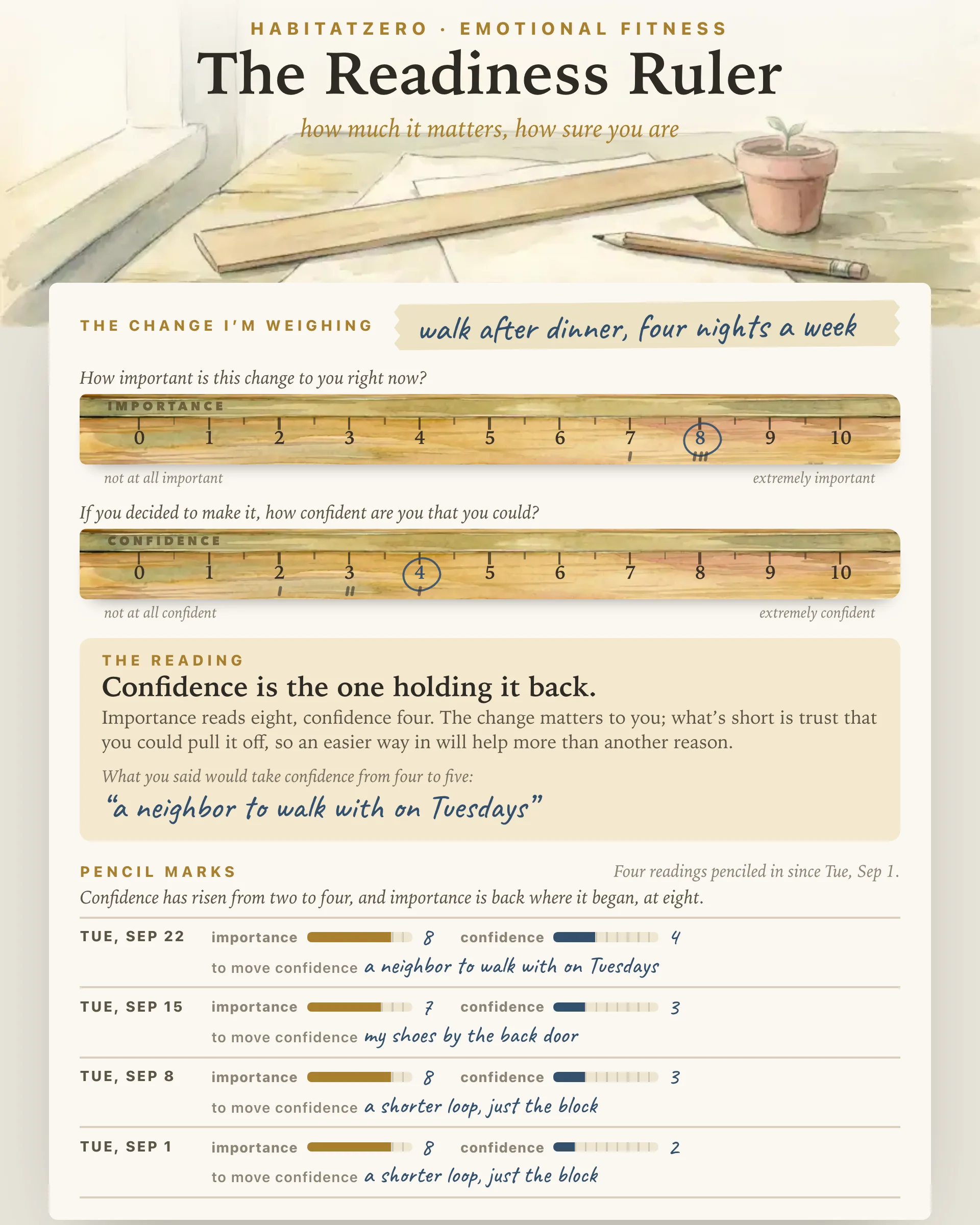
The readiness ruler belongs to motivational interviewing, the approach to conversations about change that William R. Miller and Stephen Rollnick developed, and the Motivational Interviewing Network of Trainers keeps their own description of the method. The version on this page follows the two-sided ruler that the Center for Evidence-Based Practices at Case Western Reserve University publishes for practitioners: importance on one side, confidence on the other, each rated from zero to ten and each followed by the same two questions. Fabulous built this interactive take on its own. Miller, Rollnick, the network and the university had no hand in it and have not endorsed it.
Ask someone whether they are ready to change and you usually get a shrug, because readiness is two questions stuck together. One is whether the change matters enough to you right now. The other is whether you believe you could pull it off if you tried. The two come apart all the time. You might give quitting vaping a nine for importance and a three for confidence, and hearing again why it matters will not help, because you already know. Or you might be sure you could cook at home more, an eight for confidence, while caring about it at a four, and a meal plan will sit unused on the fridge.
So the page asks both and stacks the rulers one above the other, where the gap shows at a glance. Whichever reads lower is usually what is holding the change back.
The number matters less than what you say next, and motivational interviewing has two standard follow-ups for that.
The first asks why you picked that number and not a lower one. If importance is a six, why not a two? The question points down on purpose. Answering it, you end up listing your own reasons for changing, what you want and what the change would give you, and in motivational interviewing the reasons you voice yourself count for more than reasons someone hands you.
The second asks what it would take to move up one point. Not to ten, just one point. The small step is what makes it answerable. Few people can say what would make them fully confident, but most can say what would get them from a four to a five: a walking partner, a smaller first step, a plan for the hardest hour of the day.
Write the change on the strip of tape at the top, or tap one of the examples and edit it. Tap a number on each ruler; the arrow keys work too. Each number opens its two questions, with a few suggestions you can tap when the words stall.
The reading does the comparison for you. It names the ruler that sits lower, or says when the two are too close to call, and quotes back what you said would move that ruler a point. Change a number after answering and your words stay put, marked with the number they were written for, so you can keep them or rewrite them.
Pencil in the reading and it goes into a dated log, one mark a day, up to twelve. Each logged reading also leaves a small pencil stroke on the rulers, so after a few weeks you can see where your numbers cluster and whether the lower one is climbing.
The follow-up questions lean on the best-studied idea in motivational interviewing: people who talk more in favor of a change tend to make it. In a study of motivational interviewing sessions about drinking, Theresa Moyers and colleagues found that particular things therapists did predicted how much change talk their clients produced, and that change talk in turn predicted drinking outcomes. The authors called this preliminary support for a causal chain, not proof.
The ruler itself is a quick gauge rather than a diagnosis, and most of the testing has been with drinkers. In one study at a primary care practice in England, 72 patients whom health professionals had identified as drinking too much rated themselves on a ruler and on a twelve-item questionnaire. The two were clearly related, but less closely than the team expected, and they said the ruler's validity still needed confirming. Treat your own numbers the same way: a snapshot of this week, not a score to live up to.
Nothing here replaces help from a person. If the change is about alcohol or drugs and cutting back alone keeps not working, SAMHSA's National Helpline at 1-800-662-4357 offers free, confidential treatment referral any hour of any day.
Reach for the ruler when you keep meaning to change something and never quite start. Then use it once a week while you work on the change, and watch the lower ruler. If you are not sure you want to change at all yet, the Stages of Change Worksheet helps you find where you stand first. If importance reads low and you suspect avoiding the change is costing you, The Cost of Avoidance lays the bill out line by line. And if what you face is really a yes-or-no choice, the Pros and Cons List Template weighs the two sides.
A zero-to-ten scale from motivational interviewing for gauging how ready you are to change one thing. The two-sided version asks separately how important the change is to you and how confident you feel that you could make it, because those two numbers often land far apart.
In motivational interviewing, the scaling question comes with two follow-ups. The first asks why you chose your number and not a lower one, which draws out your own reasons for changing. The second asks what it would take to move up a single point, which turns the number into a next step you named yourself.
Importance asks whether the change matters enough to you right now. Confidence asks whether you believe you could pull it off if you decided to. When importance is high and confidence low, an easier first step usually helps more than more reasons; when importance is low, the work is finding reasons of your own.
No. The ruler is a conversation tool used across motivational interviewing, not a clinical test or a diagnosis, and this page is an independent version of it. It was not made or endorsed by William R. Miller, Stephen Rollnick or Case Western Reserve University.
You can study the filled-in example on this page without signing up. Setting your own rulers and keeping the pencil marks from one week to the next happens in HabitatZero, which costs nothing.
By the team behind Fabulous, the science-based self-care app used by over 30 million people.


