
Leaves on a StreamEmotional Fitness · ~3 min
About this template · Updated September 2026
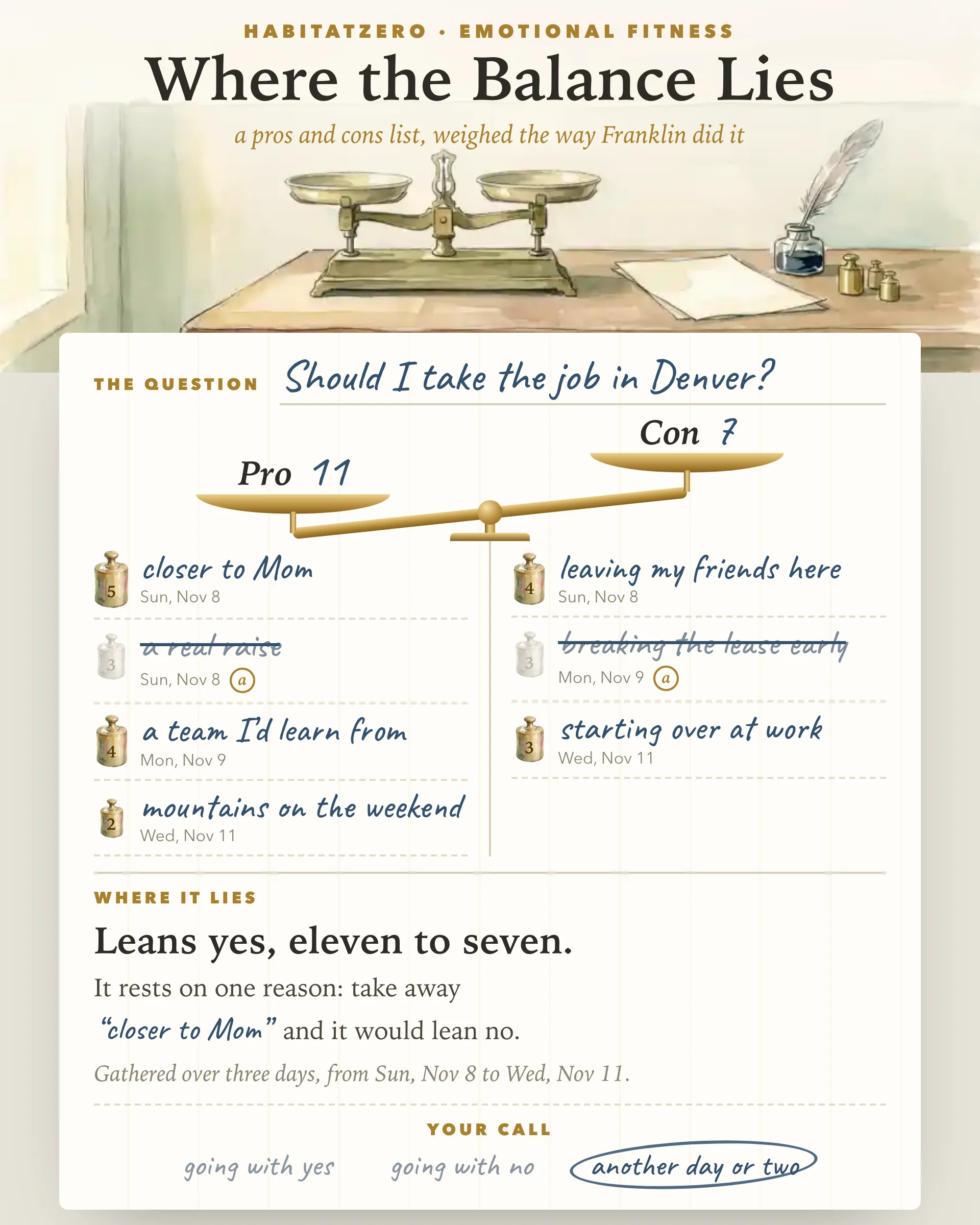
Benjamin Franklin gets the credit here, and he earned it by refusing to give advice. When the scientist Joseph Priestley wrote to him in 1772, torn over an offer to become Lord Shelburne's librarian, Franklin replied that he could not "advise you what to determine, but if you please I will tell you how." The how, set out in his letter to Priestley of September 19, 1772, is the pros and cons list people still draw today, plus two steps the usual version leaves out: weighing each reason, and striking out the ones that cancel. This sheet is our own interactive take on his method; neither the editors of Franklin's papers nor the National Archives, which publishes the letter, had any hand in it.
Hard choices stay hard, Franklin wrote, because "all the Reasons pro and con are not present to the Mind at the same time." On Monday the raise looks decisive; on Wednesday you remember the lease you would have to break. Your leaning flips with whichever reasons happen to be in the room.
His fix was to "divide half a Sheet of Paper by a Line into two Columns," one headed Pro and one Con, and add short notes over three or four days. Then weigh each reason and cross out what cancels. Where one reason on each side seemed equal, he struck both; where one for balanced two against, all three went; where two against matched three for, "I strike out the five." Whatever survives shows where the balance lies.
Write your question at the top as a single yes-or-no choice, then add reasons to either column by tapping a suggestion or writing a short line. Each reason gets a brass weight from one to five, which you can change with a tap. Every line is stamped with the day you wrote it, because the point is to come back. A column holds eight.
The scale above the columns tips toward the heavier side as you go. When reasons on opposite sides weigh the same, the sheet proposes Franklin's step and strikes them out when you say so, marking each matched set with a small letter. Striking never moves the scale: equal weight leaves both pans, so the lean holds while the clutter shrinks.
Below the columns, the sheet reads the result back: which way it leans, by how much, and whether one heavy reason is propping it up. If taking away your heaviest reason would tip the scale the other way, the sheet says so, and that reason is usually the real subject of the decision. It also points out when the longer column is the lighter one. When you are ready, mark your call: yes, no, or another day or two.
We know of no trial of Franklin's exact procedure, so treat the sheet as a way of seeing a decision, not a proven machine for making one. The nearby research points two ways.
Rough numbers are good enough. In a classic American Psychologist paper, Robyn Dawes showed that simple formulas with crude or even equal weights beat expert intuition at predicting outcomes, calling equal weighting "quite robust" for the job. So don't agonize over a three versus a four; getting every reason onto the page matters more.
Reasons can also mislead. When Timothy Wilson and colleagues asked people to think through their reasons before choosing a poster to take home, those people picked differently and were less satisfied three weeks later than people who simply chose. Reasons that are easy to put into words, the researchers concluded, can crowd out what actually drives a preference. If the lean surprises you, ask what you care about that never made it onto the sheet.
For yes-or-no choices about change, one more finding matters. In a large coin-toss experiment, Steven Levitt found that people stuck on an important decision, such as quitting a job, who were told by the coin to make the change were more likely to make it and happier six months later than people whose coin said to stay put. One study settles nothing, but it hints that the status quo can collect more weight than it has earned, so weigh "a lot of change at once" on purpose, not by reflex.
Use this sheet for one yes-or-no question you keep circling: taking an offer, signing a lease, going back to school, adopting a dog. For three or more options, a scoring grid such as the decision matrix suits better. If the question is really whether to face something you have been putting off, The Cost of Avoidance totals what the delay is costing you. If the later consequences worry you more than this month's reasons, The Long Forecast plays each path out over ten minutes, ten months and ten years. And if the yes-or-no is whether to act on an urge in a painful moment, a calm list is the wrong tool; Open When the Urge Hits is the DBT version built for that.
Priestley took the librarian post that December, after months of weighing it, and Franklin never told him to. The sheet shows where the weight sits. The choice stays yours.
Phrase the decision as one yes-or-no question, split the page into a column for and a column against, and jot reasons down as they occur to you over several days. Once both columns have settled, weigh each reason instead of counting them, because one serious reason can matter more than four small ones.
It is a list where every reason carries a number for how much it matters, from one to five on this sheet. Adding the numbers on each side shows the lean, and it exposes the common case where the longer column is actually the lighter one.
Weighing reasons for and against is older than any one person, but the best-known written recipe is Benjamin Franklin's. In a 1772 letter to the scientist Joseph Priestley he described a half sheet split into Pro and Con, gathered over three or four days, with equal reasons struck out in pairs until the balance showed.
It is a good way to see a decision clearly, less so as a machine that makes it. Studies of reason-giving find that people can talk themselves into whatever is easiest to put into words, so read the lean as evidence, then check it against what you actually want.
The page itself shows a finished example sheet to look over. To write your own question, weigh your own reasons across several days and keep the sheet until you decide, open it in HabitatZero, which costs nothing.
By the team behind Fabulous, the science-based self-care app used by over 30 million people.


