ADHD Daily Task OrganizerFocus & ADHD · ~10 min
About this template · Updated September 2026
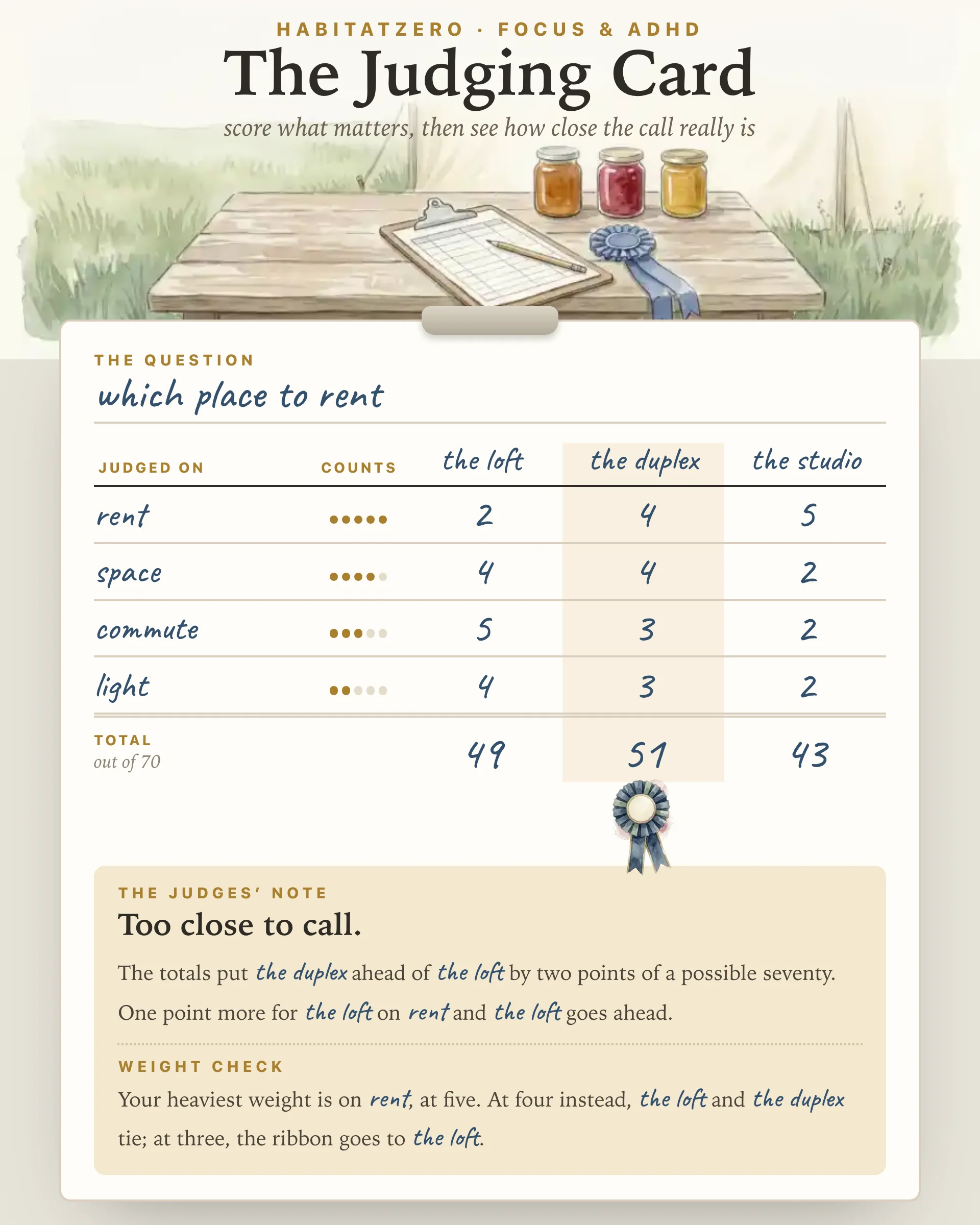
In the summer of 1772, Lord Shelburne offered Joseph Priestley a post as his librarian, and the scientist could not make up his mind. Benjamin Franklin's answer is the best-known ancestor of the card on this page. Divide a sheet into two columns, one for pros and one for cons, gather reasons over a few days, "estimate their respective Weights," and strike out reasons of equal weight on opposite sides until you can see where the balance lies. He called it "Moral or Prudential Algebra" in his letter to Priestley of September 19, 1772. Engineers later added a cousin, the Pugh matrix. What you are using here is HabitatZero's own version of the plainer weighted sum; nobody behind those methods made or reviewed it.
Options go across the top, two to four of them, and what matters goes down the side, up to six, each weighted from one, barely, to five, most of all. Every square then gets a score from one to five, where five means best for you. That rule trips people up with costs: a cheaper rent is better for you, so it earns the higher score.
The card multiplies each score by its weight and adds up every column as you go. It holds the ribbon back until each square has a score, because a half-scored card quietly favors whichever option you judged first.
Judge one criterion at a time across every option, the way a county fair judge tastes every jar of jam before moving on to the pies. Saying the loft gets more light than the studio is easier than rating the loft's light in a vacuum, and it keeps your scores comparable. The scoring desk slides along the row for that reason.
Two more habits help. Score what you would actually get, not what the listing promises. And if staying put is honestly possible, add it as an option, so every new choice has to beat something real.
A total on its own hides how settled a choice is. Fifty-one to forty-nine looks like a win and behaves like a coin toss. So the note asks a sharper question: how many squares would each need to move by a single point for the runner-up to catch the leader? If one square would do it, the card calls the result too close to call and names that square. If nudging every square by a point still would not close the gap, you have a clear winner.
The weight check tries your heaviest weight at every other value and reports whether the ribbon stays, splits into a tie or moves. Decision analysts call this sensitivity analysis, and Triantaphyllou and Sánchez set out a method for testing how sensitive a weighted ranking is to the criterion weights and to the scores themselves. If a single notch flips your winner, the decision turns on how much that one thing matters to you, which is worth knowing before you sign anything.
Last comes a gut check: picture yourself choosing the winner. Relief suggests the card and your instincts agree. A sinking feeling often means something you care about never made it onto the card.
The strongest case for writing it all down comes from Robyn Dawes, who reviewed studies in which simple weighted sums predicted outcomes such as graduate students' grades better than experts' overall judgment. Even models whose weights came from intuition, or were simply set equal, beat the experts (Dawes, 1979). Those were prediction problems rather than choices about where you will be happy, but the lesson carries over: a consistent tally of the right criteria is steadier than a mind juggling six of them at once. It also suggests the choice of criteria matters more than whether rent deserves a four or a five.
The caution comes from the same field. In one study, students asked to rate every attribute of every course on offer chose courses that matched expert opinion less well than students who simply picked, and the rating seemed to blur real differences between the options (Wilson and Schooler, 1991). A matrix rewards whatever is easy to name and score, and it can flatten a strong preference into a string of threes. Franklin saw the limit himself, writing that the weight of reasons "cannot be taken with the Precision of Algebraic Quantities." That is why this card keeps the list short, flags close totals instead of crowning them, and asks how the result feels.
Use it when two to four real options keep trading places in your head: apartments, job offers, cars, colleges, where to spend a vacation. It is less suited to the one thing you keep putting off, where The Cost of Avoidance adds up what the delay is charging you, or to choices that play out over years, where The Long Forecast follows each path out to ten years. If you are ranking tasks rather than choosing between options, the ADHD Priority Matrix sorts a pile down to one next move.
The card will not decide for you. It shows you what you already believe, weighted and added up, and exactly how close the call is.
It is a table with your options across the top and the things you care about down the side. You score each option on each criterion, multiply by how much that criterion counts, and add up each column, so one tangled choice becomes a row of small questions you can actually answer.
Choose two to four real options and no more than six criteria. Weight each criterion from one to five, score every option on every criterion from one to five, then multiply each score by its weight and total the columns. This card does the multiplying for you and redoes it whenever you change a number.
Read a narrow lead as a tie rather than a verdict. The card counts how many squares would need a one-point change for the runner-up to catch up, and it tries your heaviest weight at every other value, so you can see whether a single judgment is carrying the whole result.
They are close relatives. The Pugh matrix comes from engineering design and marks each concept as better, worse or the same as one chosen baseline. A weighted decision matrix scores every option on its own scale and multiplies by weights, which suits personal choices where no option is an obvious baseline.
No spreadsheet and no formulas. This page shows a filled-in example card, and personalizing it in HabitatZero, for free, keeps your own card so you can come back, rescore a square and watch the ribbon move.
By the team behind Fabulous, the science-based self-care app used by over 30 million people.