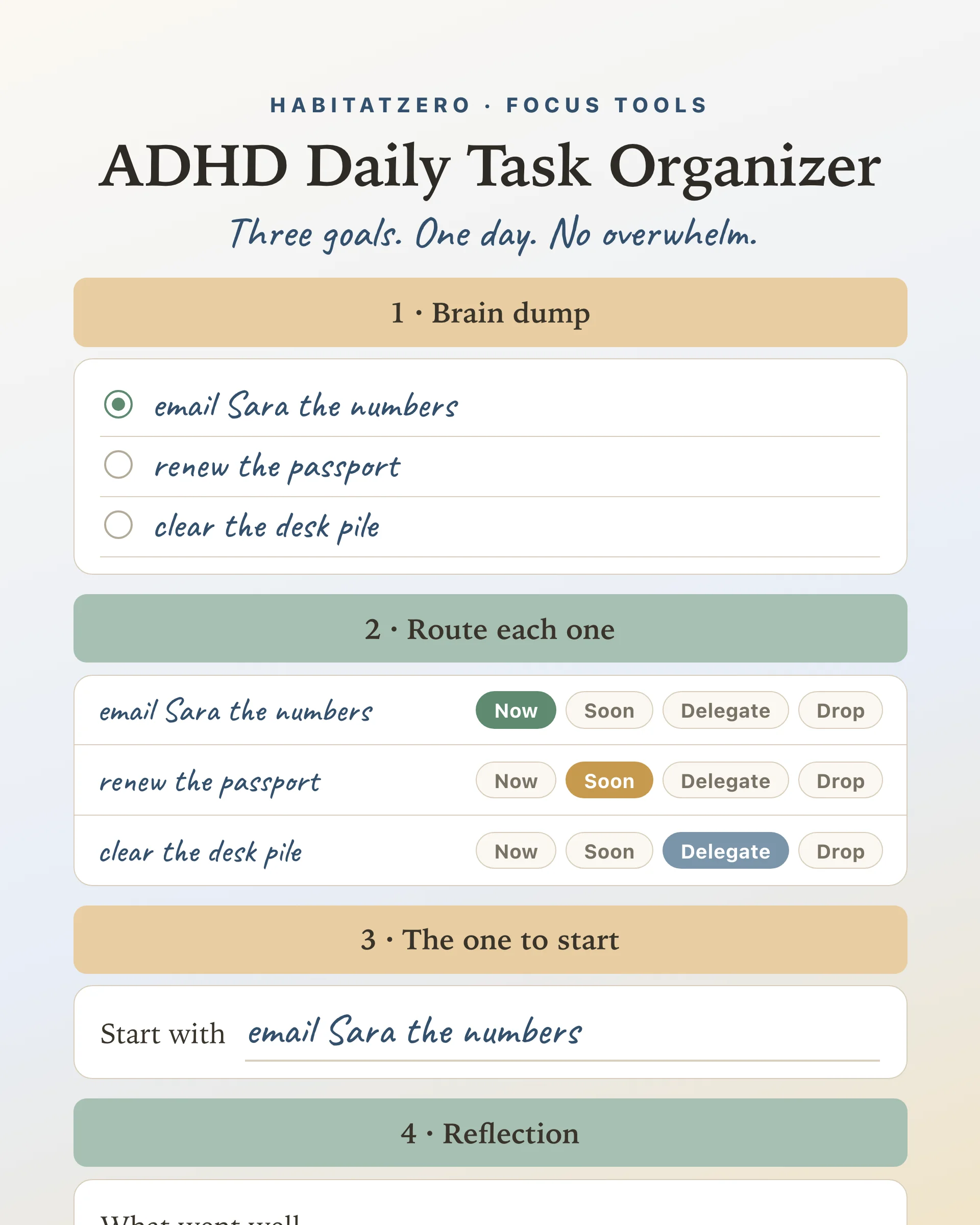
ADHD Daily Task OrganizerFocus & ADHD · ~10 min
About this template · Updated July 2026
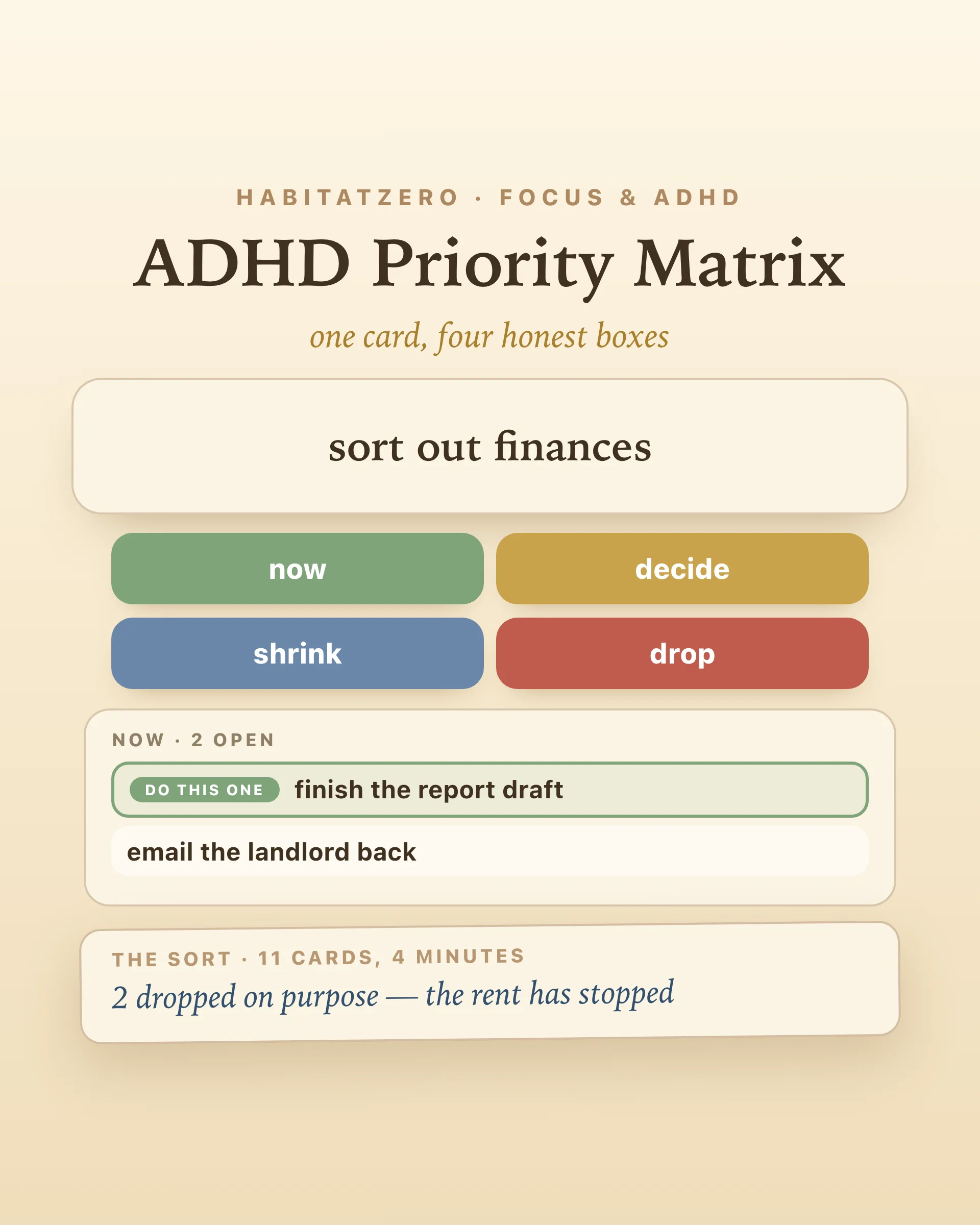
Here's what "just prioritize" actually asks of a brain: hold the entire task list in working memory, rate every item on two abstract dimensions simultaneously, ignore the one screaming loudest in favor of the one that matters most, and do all of this while overwhelmed. For an ADHD brain, that isn't a to-do list technique. That's a decathlon of exactly the executive functions the condition taxes hardest — which is why the classic urgent-important grid, noble as it is, mostly gets admired and abandoned.
This matrix redesigns the job for how ADHD attention actually works: one card at a time, four concrete boxes, one tap each.
Dump first, sort never — yet. Type every task circling your head into the pile. Big, tiny, embarrassing, three-weeks-old — all of it, no sorting allowed. The dump alone drops the volume; a pile you can see is already quieter than a pile you're holding.
Then sort, one card at a time. The matrix deals you a single task — just one, centered, nothing else visible — and four buttons:
One tap, next card. No surveying the whole board, no two-axis judgment calls — momentum instead of deliberation, because for ADHD, a fast imperfect sort you finish beats a perfect one you abandon at card six.
Leave with the Now list. When the pile is dealt, you get the only artifact that matters: a short Now column with a visible top card. Do that one. Everything else is either dated, shrunk, or gone.
The classic matrix's boxes are analytical categories; these are behavioral ones — each maps to a move you can make in five seconds while foggy. That's deliberate: research on ADHD has long framed the condition as, at its core, a difficulty with self-regulation and executive control, not a knowledge gap. You already know what's important. What's expensive is the deciding under load — so the tool's job is to make each decision as small, concrete, and reversible as possible. A card in the wrong box costs one tap to fix. A pile never sorted costs the whole week.
The Drop box deserves special mention, because it's the one no productivity tool wants to offer you. A task that has circled for three weeks without getting a date, a shrink, or a start was already dropped — silently, guiltily, without your consent. Dropping it on purpose is the difference between a decision and a haunting.
The matrix produces clarity; its neighbors produce motion. Your Now list's top card belongs in the ADHD Daily Task Organizer if today needs more structure than one card. If the top card still won't start — named, sorted, sitting right there — that freeze is a task-initiation problem, and Deal With Your Brain is purpose-built for it. And when the pile itself arrived with a side of panic, run the Overwhelm Recovery Protocol first; a calmer nervous system sorts faster.
Dump the pile. Deal the cards. Tap four honest buttons until there's one visible next thing — then go be the person who did it.
Because prioritization is executive function on hard mode: it demands holding the whole task list in working memory, comparing items on several dimensions at once, and suppressing the loudest-feeling task in favor of the most important one — exactly the operations ADHD taxes. The fix isn't trying harder; it's externalizing: get the pile out of your head, then judge one item at a time against four simple boxes.
Same grandparent, different design decisions. The classic urgent-important grid assumes you can rate two abstract dimensions while overwhelmed — the exact skill that's offline. This matrix asks one concrete question per task with four ADHD-honest answers: now, decide when, shrink it, or drop it. And it sorts card by card instead of asking you to survey the whole board, because one decision at a time is the ADHD-sized unit of work.
It's for tasks that are real but too big as written. 'Sort out finances' never gets done; 'find the last bank statement' does. Shrink also covers handing off, asking for help, or doing the twenty-percent version. Half of what feels urgent-and-impossible is just a task that needs to be cut smaller before any box can hold it.
It's more than okay — it's the most honest box on the board. A task that has been circling for three weeks without a date, a shrink, or a start was already dropped; the only question is whether it keeps charging rent in your head. Dropping it on purpose converts silent guilt into a decision, and decisions, unlike guilt, are finished.
Yes — free, in your browser, no signup. Your sorted lists stay with the worksheet, and in the Fabulous app they save and sync so the Now list is waiting on every device.
By the team behind Fabulous, the science-based self-care app used by over 30 million people.