Leaves on a StreamEmotional Fitness · ~3 min
About this template · Updated September 2026
Three people deserve credit here. The question this page keeps asking, and then what?, belongs to the ecologist Garrett Hardin, who made it the test of his third filter, ecolacy, in Filters Against Folly (1985). The three horizons come from Suzy Welch, whose 10-10-10 method weighs a decision at ten minutes, ten months and ten years. Investors know a cousin as second-level thinking, Howard Marks's name for seeing past the surface read most people share, set out in his memo It's Not Easy. This board is our own practice sheet built on their ideas. None of them made it, and Welch has not reviewed or endorsed it.
Most choices look simple from close up. Skipping the hard conversation buys a calm evening. Saying yes to one more project feels generous on the day you agree. The bigger car feels like a treat on the drive home. Each of those is a first-order read, and each one is usually true. What it leaves out is the rest of the story: the conversation that is harder by spring, the weekends the project quietly eats, the payment that arrives every month for five years.
First-order thinking asks what a choice does right away. Second-order thinking keeps going: once that happens, what does it set in motion, and what does that turn into? The immediate effect is vivid and the later ones are vague, so the vivid one tends to win before the others get a hearing.
Watch for a crossover. A way that looks best in the first ten minutes can look worst ten years out, and a way that costs you something today can be the one you are grateful for later. Sometimes the easy option really is right all the way down; the only way to know is to look.
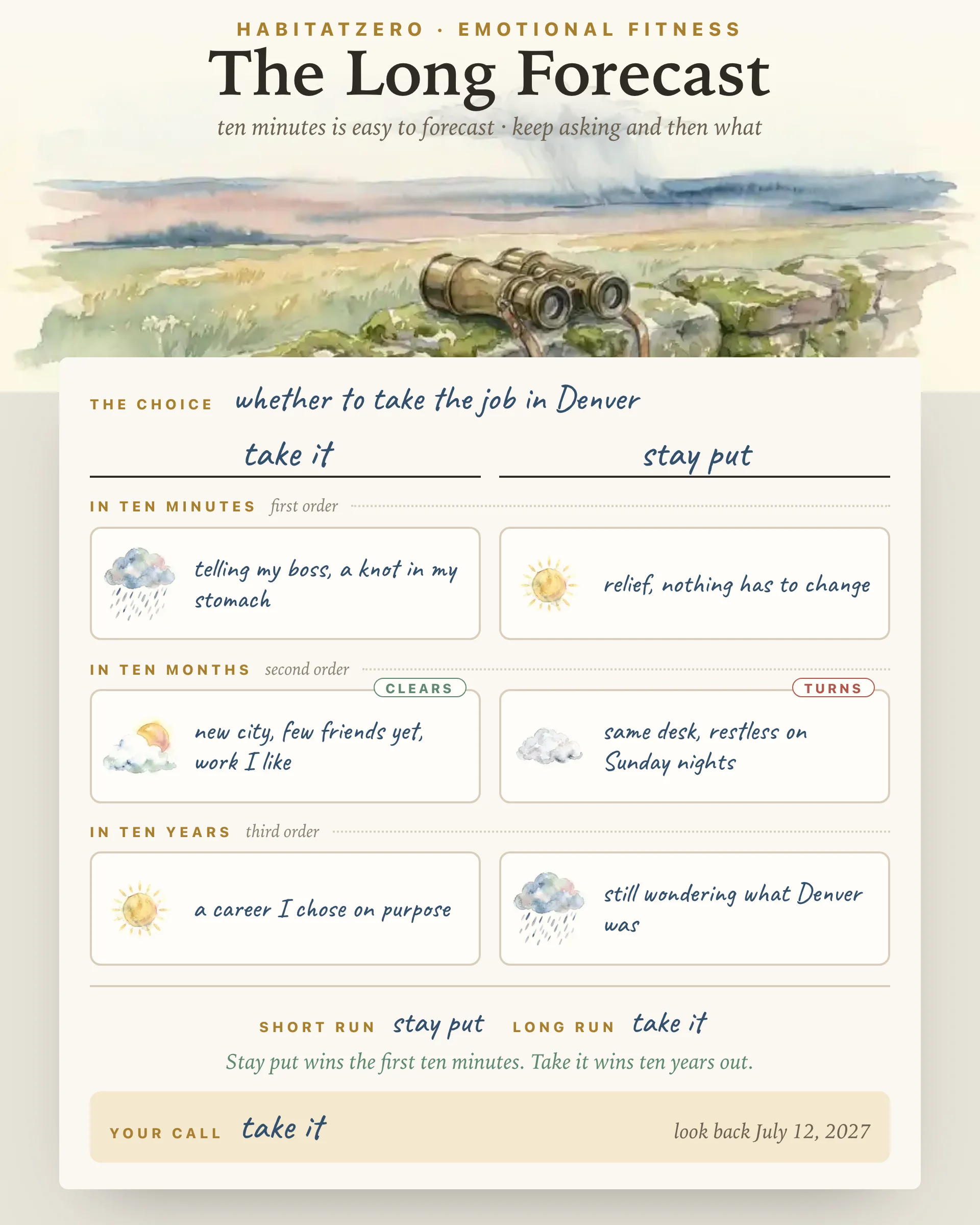
You start with the choice, written as a whether: whether to take the job, whether to move, whether to say yes. Tap a starter and the board names two ways for you, or name them yourself. A third way, such as a trial run, can join; three is the limit so the columns stay easy to compare.
Each way gets a column and each horizon a row. For every square you write a few words about what happens and paint it a sky: clear, mixed, gray or rain. The button underneath is the whole method in three words, and then what?, walking you down the column from ten minutes to ten months to ten years.
Once each way has a forecast past the first row, the board reads itself. It tags the square where a way turns gray or clears, names the short-run and long-run winners, and says so plainly when they differ. Then it hands you the call: choose a way, or choose not yet, add one line of why, and pick a look-back day.
People differ in how far ahead they look. Psychologist Alan Strathman and colleagues proposed that the consideration of future consequences is a stable difference between people, from those who mostly weigh what an action does now to those who routinely weigh what it does later. A worksheet will not change who you are, but it can make you look further on one decision.
The ten-year row has a known weak spot. When people predict how they will feel about future events, they tend to overestimate how strong and how lasting those feelings will be, a pattern Timothy Wilson and Daniel Gilbert call the impact bias. One cause is focalism: picturing the decision so sharply that you forget the rest of life will be going on too. Treat a stormy ten-year square as a reason to ask what else will be true by then.
What nobody has tested is this board, or the 10-10-10 rule itself, in a trial measuring decision quality. The honest claim is smaller. Writing each horizon down makes the later consequences as concrete as the first ones, and a dated look-back gives you a way to learn how good your own forecasts are.
Reach for the board when a choice keeps circling and the easy answer feels a little too easy. If one of your ways is really a way of avoiding something, The Cost of Avoidance adds up what the delay is already charging you. Once you have made the call, the Goal Planning Worksheet turns it into a first step for this week. On your look-back day, the Reflective Journal is the place to set down what happened and what you would forecast differently.
A forecast will not make the choice for you. It makes sure you made it with the whole sky in view.
It is the habit of asking what happens after the obvious result. First-order thinking stops at the immediate effect of a choice. Second-order thinking follows that effect forward with one question, and then what, until the later costs and payoffs come into view.
First-order thinking judges a choice by what it does right away, such as the relief of putting off a hard talk. Second-order thinking also weighs what that relief sets in motion, like a problem that grows quieter and larger over the next few months.
It is a decision method from Suzy Welch's 2009 book 10-10-10: before you choose, ask what each option means for you in ten minutes, ten months and ten years. This board borrows her three horizons, and it is not affiliated with or endorsed by Welch.
They are cousins. Second-level thinking is investor Howard Marks's name for looking past the obvious read that most people already share. Second-order thinking about a personal decision follows consequences through time, which is why this board is laid out by horizon.
Two or three steps usually do the job. Every extra step stacks a guess on a guess, so a third-order forecast at ten years shows direction rather than detail. The board stops at three rows for that reason and asks for a look-back date so you can check your aim.
By the team behind Fabulous, the science-based self-care app used by over 30 million people.