Leaves on a StreamEmotional Fitness · ~3 min
About this template · Updated July 2026
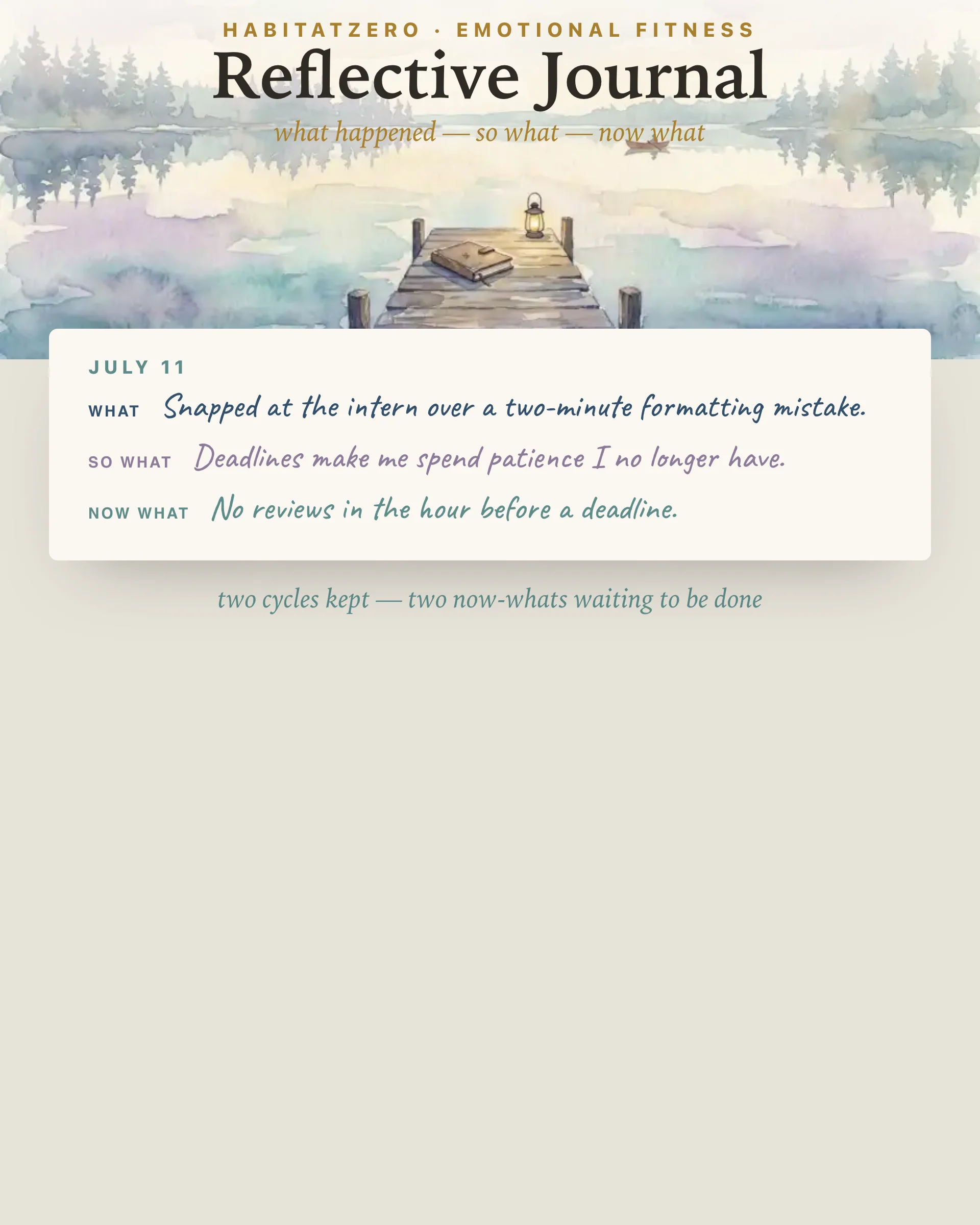
Experience is a strange teacher: it gives the lesson only to people who go back and mark their own work. A diary records what happened; a reflective journal interrogates it. The distance between the two is exactly three questions, and this page is built around them — what happened, so what did it mean, now what changes — the compact cycle that professional training programs have leaned on for decades, descended from Graham Gibbs' reflective cycle and its simpler cousins.
Unstructured reflection tends to loop: you replay the awkward meeting, feel the feeling again, and file nothing. The three-question cycle interrupts that by forcing a change of register at each step. The what must be factual — one or two lines a camera could confirm — which alone strips the melodrama out of most incidents. The so what asks for meaning: not what happened, but why it stayed with you, which pattern it belongs to. And the now what converts the insight into an adjustment small enough to survive the week. The evidence base for this kind of structured reflection is strongest where the stakes are highest: a systematic review across health professions education found reflective practice teachable, measurable, and most effective precisely when it is guided rather than left open-ended.
Because most people have been assigned reflection more often than shown it, the page keeps a complete worked example in view until your first cycle replaces it: an over-committed client call, the pattern underneath it (under time pressure I trade honesty for relief), and a now-what you could actually run tomorrow ("I can confirm that by Thursday" replaces yes-in-the-room). Notice the shape — factual what, uncomfortable so-what, executable now-what. Write against it the way you'd cook beside an open recipe.
The journal also keeps a quiet score: how many cycles you've kept, and how many now-whats are still waiting to be done. That second number is the honest one. Reflection that never changes a Tuesday is just well-organized rumination.
If you landed here because a course requires a reflective journal, the cycle is a legitimate scaffold — practice it here freely, then write your submission in your own prose and your course's format. For working reflection, the page pairs naturally with its neighbors: the weekly review sweeps a whole week while this journal goes deep on single moments, and when the incident is a feelings-first spiral rather than a lesson-shaped event, the thinking trap spotter is the sharper instrument.
One moment, three questions, one adjustment. That's a complete education, repeated weekly.
A journal where events get processed, not just recorded. Each entry here runs one moment through three questions — what happened, so what did it mean, now what changes — a cycle used across nursing, teaching, and management training because it reliably turns experience into adjustments.
The page keeps a worked example visible until your own cycles replace it: a factual line about an over-run client call, a so-what naming the pattern underneath, and a now-what small enough to actually execute. Three sentences can be a complete, genuinely reflective entry.
As a thinking structure, absolutely — the three-question cycle is a recognized reflective framework and practicing it here will make assignment writing easier. The submitted work still needs to be your own prose in your course's required format, so check the rubric before borrowing the layout.
Event-driven beats scheduled: write within a day of a moment that stayed with you, while details are sharp. Most weeks hold one or two cycle-worthy moments — a practice of two honest cycles a week outperforms daily entries that describe without examining.
Right on this page — the sheet ships with a complete sample cycle in view, and the preview above shows two more finished ones. Copy the shape rather than the words: a line of fact, a line of meaning, a line of change, each written against a real moment from your own week.
By the team behind Fabulous, the science-based self-care app used by over 30 million people.