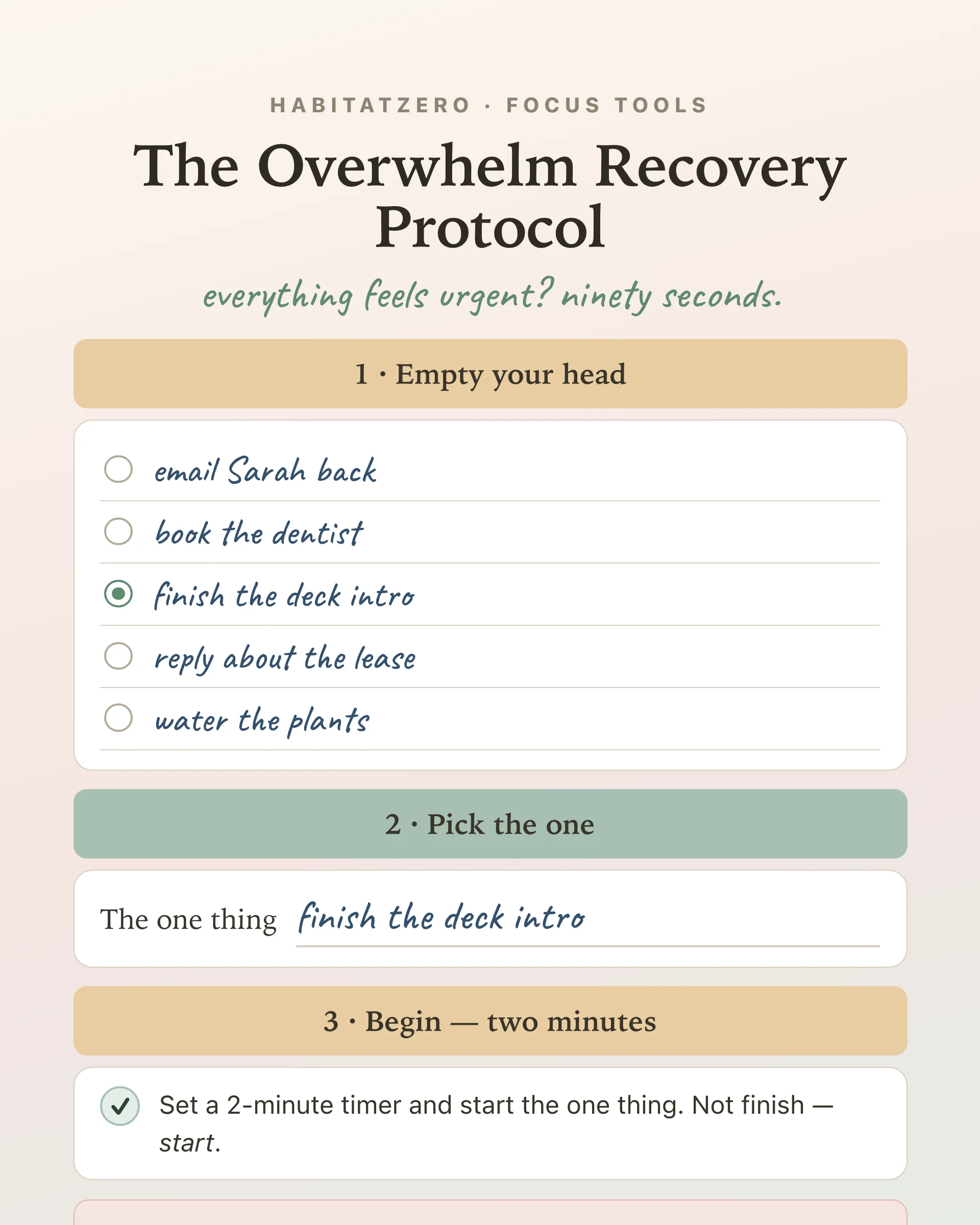
The Overwhelm Recovery ProtocolWellness & Routines · ~5 min
About this template · Updated August 2026
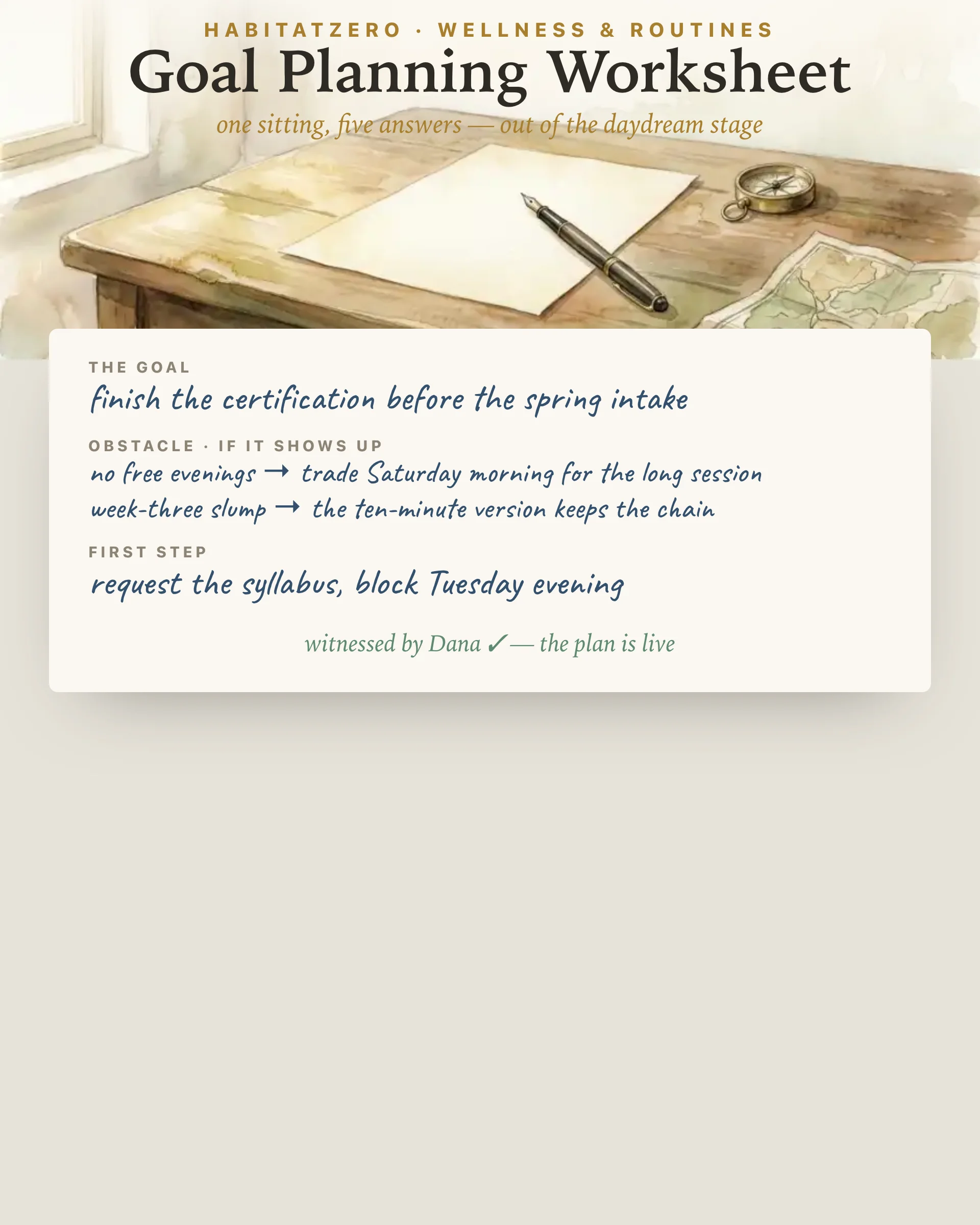
Some goals need a system. Most goals first need five minutes of honesty — one sitting where the wish gets a sentence, a reason, three enemies, a first step, and a witness. That's the whole worksheet. Universities hand out versions of this page for a reason: filled once, properly, it does more than a month of planning apps opened and abandoned.
The sentence. Not a paragraph, not a mood — one line specific enough that a stranger could tell whether it happened. Vague goals aren't humble; they're unfalsifiable, which is a kind way of saying safe from ever being finished.
Why now. Every goal has been available for years. Something makes this season the one — a deadline, a price change, a birthday with a zero in it — and writing it down does two jobs: it fuels the start, and if the line stays honestly empty, it tells you this might be next year's goal wearing this year's clothes. Better to know at minute two.
Three obstacles, each with an if-then. This is the working heart of the page, and the part with the strongest research pedigree. Fantasizing about the achieved goal feels productive and measurably isn't; what works is holding the wish and the obstacle in view together — the strategy Oettingen's research program calls mental contrasting — and pre-deciding the response to each obstacle so week three doesn't get a vote. The worksheet asks for the loudest obstacle, the sneaky one, and the outside one, because those are the three that actually show up.
The first step. Sized for this week, needing nobody's permission. The gap between intending and doing is one of the best-documented in psychology — Sheeran's review of the intention–behavior gap found intentions translate to action far less often than we assume — and a small, dated first step is the cheapest bridge across it: after this week, the goal has a history instead of only a future.
The witness. A name, and a told them stamp that you press after the conversation actually happens. The line under it says why: a goal someone else has heard is measurably harder to shelve. The stamp is the page's only ceremony, and it's earned, not tapped.
This page is deliberately a single sitting — no entries, no streaks, no upkeep. When it's signed and witnessed, the ongoing tools take over: the Goal Planner walks the committed goal backwards into milestone flags and weekly moves, the Goal Tracker gives any accumulating target its thermometer, and if the sentence itself still feels mushy, the SMART Goals Worksheet sharpens wording before you commit to it here.
Five answers. One witness. The daydream, retired from active service.
A one-page, one-sitting exercise that takes a goal from vague to committed: the goal in a single sentence, the reason this season is the right one, three anticipated obstacles each paired with an if-then response, a first step sized for this week, and the name of someone who will hear about it. Five minutes, filled once.
Because pairing a desired future with the obstacles in its way - what researchers call mental contrasting - outperforms positive visualization alone in studies of goal pursuit. Naming the obstacle and pre-deciding the response converts wishful energy into a plan that survives contact with week three.
Something finishable within seven days that requires no permission and no perfect conditions: request the syllabus, book the assessment, run the first slow kilometer. Its job is not progress so much as proof - after it, the goal has a history instead of only a future.
Announcing an identity (I am becoming a runner) can backfire, but committing to a concrete plan in front of someone who will ask about it later tends to help - accountability works best attached to actions rather than images. That is why the witness line sits next to the first step, not next to the dream.
By when you use it. This worksheet is the once-at-the-start decision page. After it, the Goal Planner turns the decision into milestones and weekly moves, and the Goal Tracker measures anything that accumulates toward a number. Most goals only ever need this page plus one of the other two.
Yes - the sheet prints as a clean single page with your handwriting-style answers and without the buttons, which suits the fill-once nature of the exercise. It also stays saved here if you would rather revisit it on screen.
By the team behind Fabulous, the science-based self-care app used by over 30 million people.