Leaves on a StreamEmotional Fitness · ~3 min
About this template · Updated September 2026
Pros and cons, as this page uses it, is a skill from dialectical behavior therapy, the treatment developed by psychologist Marsha M. Linehan. It is one of the crisis survival skills in her distress tolerance module, and the grid, the calm-day preparation and the sorting into short term and long term all come from her DBT Skills Training Handouts and Worksheets. Behavioral Tech, the training company she founded, teaches clinicians to run DBT programs. HabitatZero made these letters on its own: the page has no tie to Linehan, to Behavioral Tech or to any DBT body, and none of them has looked it over or put their name to it.
An ordinary pros and cons list weighs a single option. Linehan's version weighs two, because every crisis offers two: act on the urge, or resist it. Hence four squares, pros and cons for each. Resisting, in DBT terms, means tolerating the distress without giving in to it.
In the handout, an urge counts as a crisis when it is very strong and acting on it would make things worse in the long term. That covers the loud ones, like drinking or lashing out, and the handout adds quieter ones: giving in, giving up, or avoiding what a life you want requires of you.
Be honest about the pros of acting: if the urge offered nothing, you would not feel it, and a grid that pretends otherwise convinces no one. A letter about hurting yourself works differently. It starts on the resisting side, suggests nothing for the pros of acting and keeps the 988 line on top.
The skill assumes you cannot weigh anything mid-urge, so it moves the weighing earlier. Linehan's instructions are to write your pros and cons out ahead of time, "carry them with you" and rehearse them. When the urge arrives, your only job is to take the list out and read it again, picturing what resisting would bring and remembering what acting cost you before.
Her worksheet for the skill, which she credits as adapted from an unpublished one by Seth Axelrod, adds a step that is easy to skip: mark which consequences last just for today and which reach beyond it. Then it asks the question your whole grid exists to answer: "Would you rather have a good day or a good life?"
Because a crisis urge is defined by its long-term cost, the tags tend to lean one way. The pros of acting gather under today, and its cons stack up under later. Resisting runs the other way, charging you now and paying out later.
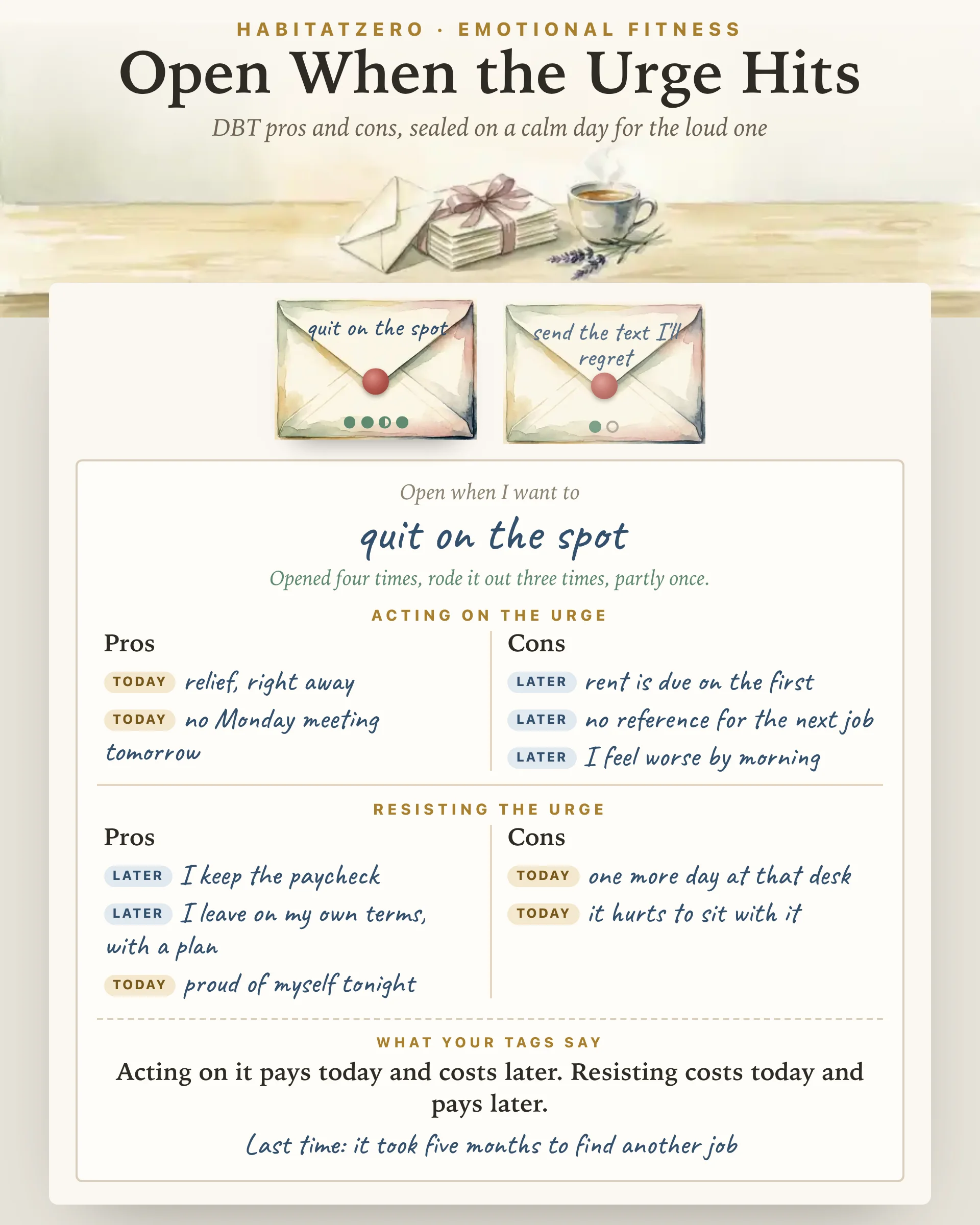
Each urge gets its own letter, addressed on the envelope: open when I want to, then the urge. The bundle holds four, so the right one is quick to find. Tap a square, add lines from the suggestions or in your own words, and mark each one today or later. Five lines fill a square, as on Linehan's 2015 worksheet, which keeps the letter readable at a glance.
As you write, the page reads your tags back, for example: acting on it pays today and costs later. Once every square holds a line, the envelope is sealed. One more line records what happened the last time you acted on the urge.
When the urge comes, press open it now: the tools fold away and the letter asks you to read before deciding anything. Afterward, mark how it went: rode it out, partly, or not this time. Each envelope keeps a row of marks, so over a few weeks you can see which letters hold. Not this time takes you straight to the cons of acting, to record the cost while it is fresh.
Two DBT studies point directly at the skills. In Linehan's randomized component analysis with ninety-nine women diagnosed with borderline personality disorder and at high risk of suicide, every version of the treatment reduced suicide attempts, but the versions that included skills training reduced self-injury and depression more than the version without it. A study of skills use across three trials found that the growth in DBT skills use accounted for the drop in suicide attempts and depression during treatment.
That evidence covers the skills taught together by trained clinicians over months. We know of no trial of this grid on its own, or of a screen version. Treat this page as practice for one skill, not as treatment.
Use it for an urge that keeps coming back and that you would regret following. For an ordinary choice you keep postponing, the decisional balance worksheet fits better. If the urge is here right now, read your letter first, then ride out what is left with Urge Surfing. Linehan's worksheet hands the final choice to wise mind, and Wise Mind is where to practice finding it.
If you are in crisis or thinking about hurting yourself, call or text 988 (US) right now, or reach your local emergency number. DBT is best learned from a trained therapist, often with a weekly skills group; this page can sit beside that work, never in place of it.
It is one of the crisis survival skills in the distress tolerance module of dialectical behavior therapy, the treatment developed by psychologist Marsha Linehan. You list the pros and cons of acting on a strong urge and of resisting it, ideally on a calm day, then reread that list when the urge returns.
A regular list weighs one option in two columns. The DBT version weighs two options, acting on the urge and resisting it, so it has four squares. Linehan's worksheet also has you sort each consequence into short term or long term, because in her definition an urge becomes a crisis when acting on it would make things worse in the long run.
Take an urge to quit a job on the spot. Acting on it brings relief today and bills you later: rent still due, no reference, a longer search. Resisting it costs another hard day now and pays later: the paycheck, and leaving on your own terms with a plan. Written on a calm day, that grid is what you reread when the urge flares.
DBT teaches this skill for urges to self-harm as well, usually inside therapy, where a clinician helps you prepare for the hardest moments. A worksheet is not enough in an emergency. If you might act on an urge to hurt yourself, call or text 988 in the US or your local emergency number now.
You can read this page and study the filled example without signing in. Addressing your own letters, keeping them sealed between hard days and recording each opening happens once you personalize the template in HabitatZero, at no cost.
By the team behind Fabulous, the science-based self-care app used by over 30 million people.