
The Overwhelm Recovery ProtocolWellness & Routines · ~5 min
About this template · Updated November 2026
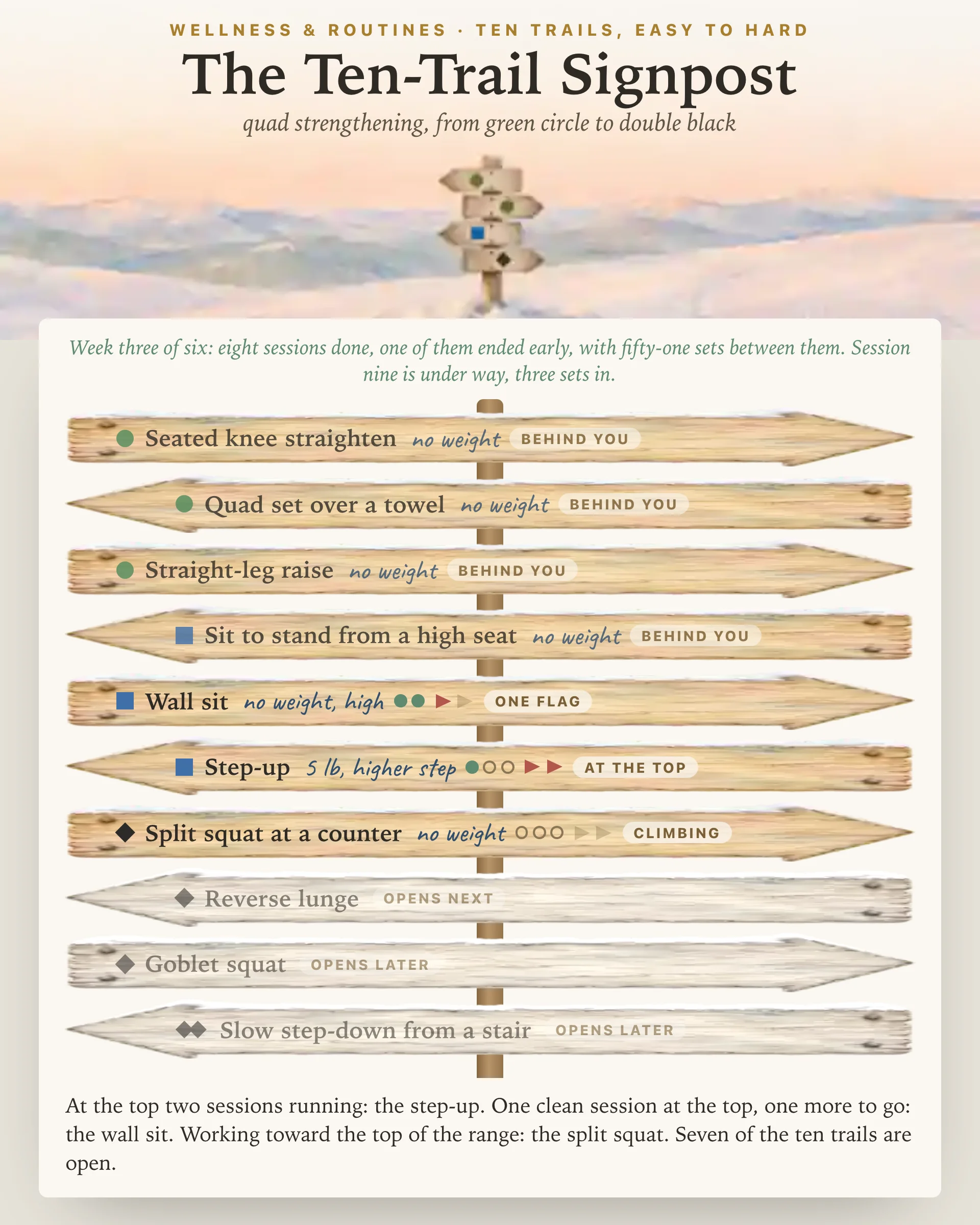
The quadriceps are the four muscles along the front of your thigh, and they straighten the knee: they get you out of a low seat, up the stairs and back down a step without a jolt. Quad strengthening exercises run from tightening the thigh while you sit to lowering your whole weight off a stair on one leg. The hard part is starting at the right one and knowing when to move on, so this page grades ten of them on one wooden trail sign, the way ski trails are marked: green circles, blue squares, black diamonds and one double black.
Check with a doctor or physical therapist first if you have had knee surgery or a joint replacement, a recent knee injury, a knee that is hot, red or swollen, or a heart or blood pressure condition. Keep a counter, chair or stair rail within reach for every standing trail.
The common rule of thumb for knees: a mild ache that has settled by the next morning is fine to work with. Sharp pain, new swelling or a knee that feels worse the next day means easing off, and a knee that locks or gives way is one to show a doctor.
The greens are done sitting or lying, the blues on both feet with something to hold, and the black diamonds shift weight onto one leg. The double black asks the thigh to control all of it while lengthening, just as the last stair down does.
Tap where you start: the greens from a chair or a bed, the blues if you can rise from a chair without your hands, the blacks if squats and lunges feel steady. You work three neighboring trails at a time, three sessions a week for six weeks, from six sets in about twenty minutes to ten in about thirty.
Each session opens with a knee check built on that rule. A worse knee means an easier session with nothing moving up; one that locked or gave way holds the session, your place kept.
The clock paces each rep after a five-second get-set, or times the wall sit second by second, on real time, so a phone that locks mid-set still counts true. A set you stop partway keeps only its finished reps, marked stopped early, and never counts toward moving up. Rests run a minute and are never logged, and any weight you add is penciled beside its trail.
A board earns a flag for each session in a row where every set reaches the top of its range, the session runs to its end and the knee was fine. Two flags on your hardest trail open the next one, and your easiest steps off. A set under the range suggests easing off, and you can always step down a trail.
The best evidence comes from knee osteoarthritis. A 2024 Cochrane review led by researchers at the University of Melbourne pooled 139 trials with 12,468 participants and found that land-based exercise probably improves pain and physical function right after a program, by roughly nine to thirteen points on a hundred-point scale (Lawford and colleagues, 2024). The authors judged those gains of uncertain clinical importance, most participants knew they were exercising, and no type of exercise beat another.
Many of those programs center on the quadriceps. A review of ten trials by physiotherapists in Istanbul found quadriceps strengthening reduced pain and improved function in most, with no single exercise clearly ahead (Kus and Yeldan, 2019), which is why this page grades moves by difficulty instead of crowning one.
Weak thighs also seem to come before knee trouble. A meta-analysis of eleven studies following 46,819 adults without knee osteoarthritis linked weaker knee extensors to higher odds of developing it (Øiestad and colleagues, 2022). The evidence was rated low quality, and a link like this does not prove that strengthening prevents anything. Quads are not the whole story either: across eight trials, adding hip strengthening to quadriceps work improved walking more than quadriceps work alone (Hislop and colleagues, 2020).
None of these studies tested this plan, and none promises a pain-free knee: expect real but modest benefits, over weeks.
The Three-Step Leg Routine gives seven leg moves three versions each, The Squat Orchard climbs five levels of one movement, The Sunflower Wall Sit Challenge builds a single hold over thirty days, and The Step-Up Hill spends six weeks on one step. This sign grades ten moves for the front of the thigh and walks you along them three at a time.
Open it on strength days, a rest day between, after five minutes of marching in place.
The best one is the hardest you can do with good control for eight to twelve slow reps. Reviews of quadriceps programs have not found one strengthening move clearly ahead of the others, so this page grades ten of them, from a seated knee straighten to a slow step-down from a stair, and moves you up one at a time.
Two or three days a week with a rest day in between suits most people. The plan here runs three sessions a week for six weeks, starting near twenty minutes with the warm-up and building to about thirty.
For knee osteoarthritis, exercise built around thigh strength is a standard part of care, and a large 2024 review found it probably eases pain and improves function a little right after a program. The gains are modest and it is not a cure. Ease off if a session leaves sharp pain or swelling the next day, and have a doctor look at a knee that locks or gives way.
The first three trails: straightening one knee from a chair and holding it, tightening the thigh over a rolled towel, and lifting a straight leg while lying on your back. They suit a first week back or a day the knees are sore.
When every set reaches the top of the range for two sessions in a row, with the knees feeling fine afterward. A set you had to stop does not count toward that, and one that falls under the range is a sign to ease off instead.
By the team behind Fabulous, the science-based self-care app used by over 30 million people.


