
The Overwhelm Recovery ProtocolWellness & Routines · ~5 min
About this template · Updated November 2026
A squat is the move you make every time you sit down and stand back up: rising from the couch, climbing out of a car, bending for a windfall apple. Squats for seniors are that same move done on purpose, slowly, with something solid to hold.
This page gives you five levels for a kitchen chair and the counter, a slow count, and a six-week plan that asks for more only when your sessions say you are ready.
Check in with your doctor or a physical therapist before you start if you have had a fall, spells of dizziness, a hip or knee replacement, a heart or blood pressure condition, or pain in your knees, hips or back. After a hip replacement, ask which seat height is right for you and never squat below it. Stop any squat that hurts.
Set up a sturdy chair with arms, its back against a wall so it cannot slide, the counter a short step away, and shoes that grip.
Each level takes away one piece of help.
Most people begin at level one; start higher only if eight slow reps there feel easy.
Every squat follows one rhythm: down for three, a moment low, up for two, then stand tall. Dropping into a chair hands the work to gravity; lowering yourself slowly makes your thighs and hips do it. In week six the low moment lasts two counts.
The count keeps real time even when your phone dims, and a set stopped early keeps only the squats you finished in full.
You squat three days a week with a rest day between. Each session opens with two minutes of marching in place at the counter and ten slow heel raises, and closes with a stretch for each thigh and calf.
The reps grow on schedule; the level grows only when you say so. After each session you choose easy, about right, hard to finish, or something hurt. Two easy sessions in a row at one level, every set finished, open the next level, and two hard ones suggest going back. A session that hurt brings a plain note: rest, and see a doctor or physical therapist if the pain stays.
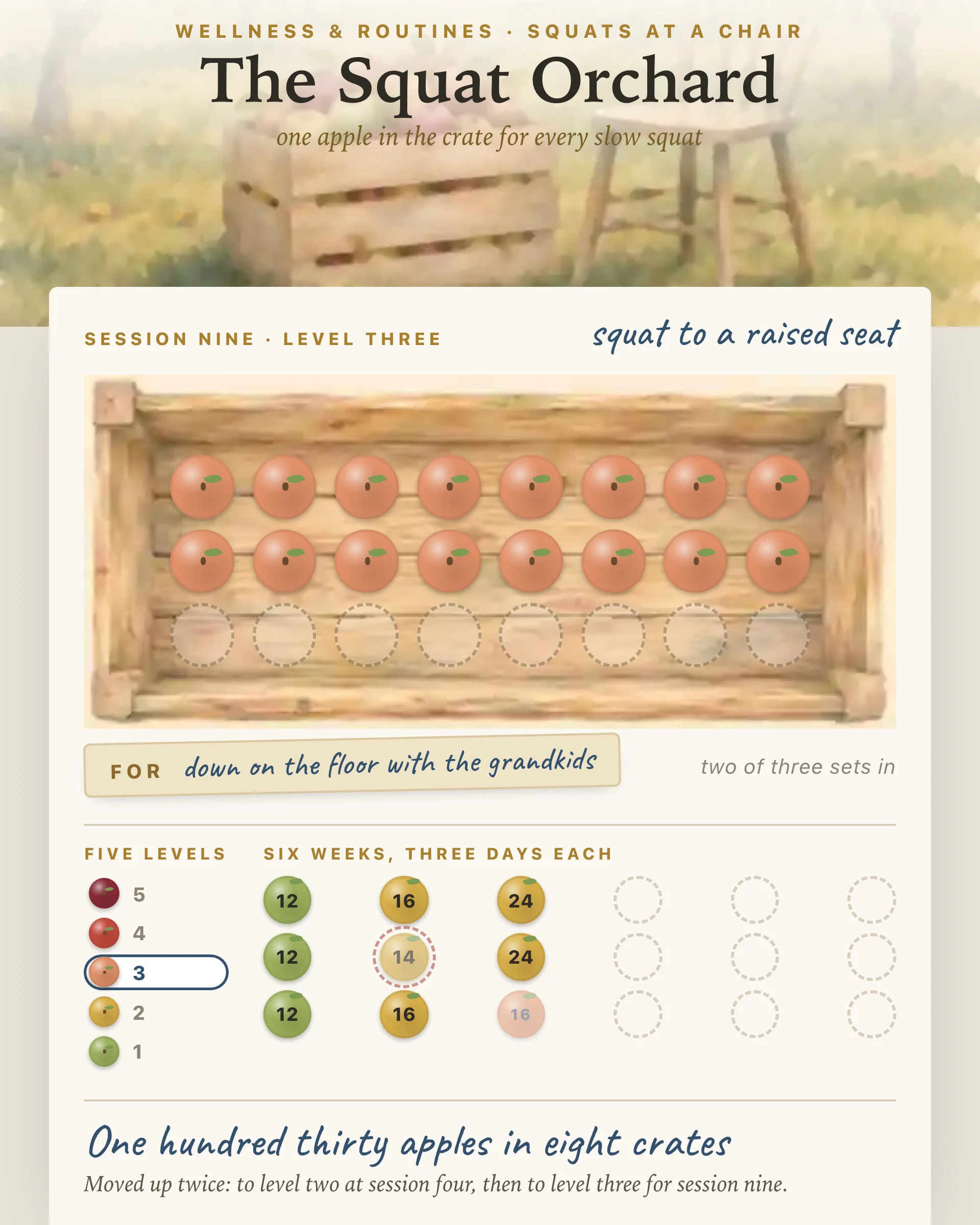
Each finished squat drops an apple into today's crate, colored by your level, from green at level one to deep red at five. Each set fills its own row, so a set stopped partway shows its gaps.
When you are done, you stack the crate on the cart: six weeks of three crates, each showing its apples and how ripe they were. A dashed crate had a set left unfinished. You can label your crate with what your legs are for, like getting down on the floor with the grandkids.
A Cochrane review of 121 trials in older adults found that progressive resistance training brought large gains in muscle strength and a moderate to large improvement in getting out of a chair, with a smaller gain in walking speed. Side effects were poorly recorded, which is why this page asks how each session felt.
The World Health Organization's 2020 guidelines advise strength work on two or more days a week and, past 65, balance and strength on three or more.
On falls, a review of 108 trials found that exercise lowered the rate of falls in older people living at home by about a quarter, mostly through balance and functional exercises, while strength training on its own had an uncertain effect. Squats help as one part of a routine that also trains balance.
If your knees complain, a 2024 review of exercise for knee osteoarthritis found that exercise likely improves function and may ease pain a little in the short run, though its authors called the size of those gains of uncertain clinical importance. No study has tested this exact ladder or the apple count.
Use it when low seats have started to take two tries. To see where you stand before week one and after week six, take the timed check in The Thirty-Second Chair. For a fuller routine that adds your arms and back, The Whole-House Strength Routine fits alongside this one. And once level five feels easy, The 30-Day Squat Challenge is a natural next step.
For most older adults a supported squat to a chair is among the gentler strength moves, because the seat sets the depth and your hands or the counter steady you. Ask a doctor or physical therapist first if you have fallen, get dizzy, have a replaced joint, or have pain in your knees, hips or back.
One or two sets of six to eight slow reps, two or three days a week with a rest day between, is a reasonable place to begin. This plan opens with two sets of six and grows to three sets of twelve over six weeks, and the level only climbs when your sessions say it is easy.
Not as a rule. A 2024 review of exercise for knee osteoarthritis found that it likely improves day-to-day function and may ease pain slightly in the short run. Squat only as deep as feels comfortable, keep your knees pointing the same way as your toes, and stop any squat that hurts.
Standing up from a chair with arms while you push down through your hands. From there each level removes a little help: no hands, a cushion you only touch, the bare seat, and finally your fingertips on the kitchen counter with no seat to touch.
No single move can promise that. A large review found that exercise programs built mostly on balance and everyday movements lowered the rate of falls in older people living at home, while strength work on its own had an uncertain effect. Squats belong inside a wider routine that includes balance practice.
By the team behind Fabulous, the science-based self-care app used by over 30 million people.


