
The Overwhelm Recovery ProtocolWellness & Routines · ~5 min
About this template · Updated November 2026
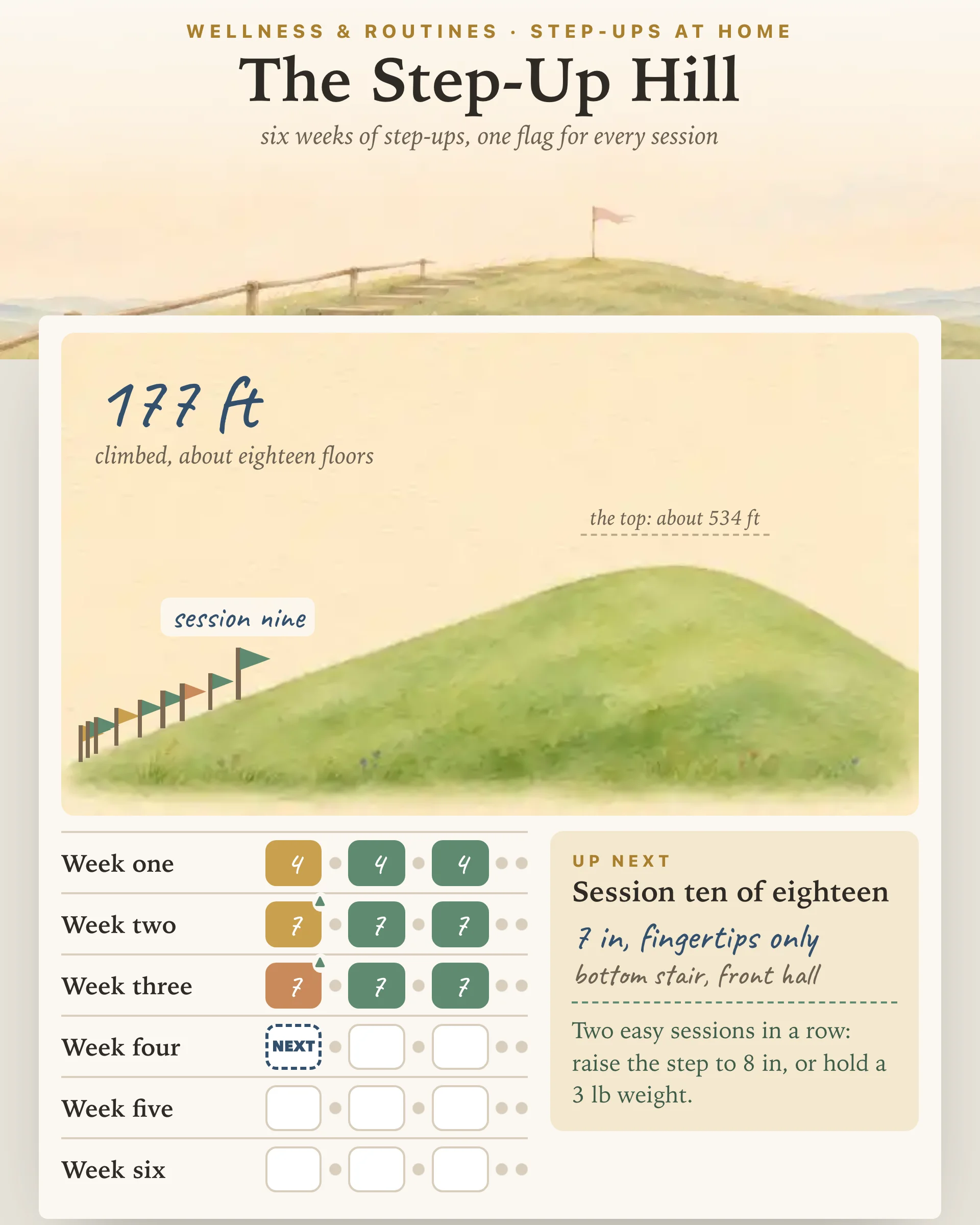
A step-up is the simplest strength move in your house: you climb onto one step with one leg, stand tall, and come back down under control. It is the work of the first stair of every flight and the curb at every crosswalk, done on purpose and counted.
This page turns that move into a six-week plan you can follow from the bottom stair. It starts low, keeps a hand on the rail, and asks for more only when your own sessions say you are ready.
The sheet asks for three checks before session one.
Add shoes with grip, the lights on and a clear floor behind you. A review of stair research found that stairways are a common place for falls, and falls there carry a disproportionate risk of death or severe injury.
You train three days a week with a rest day between sessions. Each session opens with a minute of marching in place and ten toe taps per foot on the step, then the sets, each leg leading in turn:
The plan grows the reps by itself. The height and your grip grow only when you say so. After each session you choose how it felt: easy, about right, hard to finish, or something hurt. Two easy sessions in a row on the same setup bring a cue to step up: raise the step a notch, with your hand back on the rail at the new height, or loosen your grip from rail to fingertips, and later to a light weight in the far hand. Two hard sessions bring the reverse. A session that hurt brings a plain note instead: rest it, and see a doctor or physical therapist if the pain stays or comes back.
Every step-up raises your body by the height of the step, so the sheet does the arithmetic for you. Three sets of ten with each leg on a seven-inch stair is sixty step-ups, or thirty-five feet of climbing. Each session plants a flag on a painted hill at the height you have climbed so far, and the top of the hill is what all six weeks would climb on the step you use now. Raise the step and the hill grows. A floor of stairs is about ten feet, so the sheet also counts your floors.
Below the hill, a six-week grid colors one square per session by how it felt, and a log keeps each session's height, grip, sets and reps.
A Cochrane review of 121 trials in older adults found that progressive resistance training brought large gains in strength, a moderate to large improvement in getting out of a chair and a smaller one in walking speed. Side effects such as joint pain were poorly recorded, one reason this sheet asks how each session felt. The World Health Organization's 2020 guidelines advise muscle-strengthening activity on two or more days a week for adults, and strength and balance work on three or more days for people over 65.
On step-ups themselves, a lab study of loaded variations found that the plain forward step-up drew the most activity from the gluteus maximus and the hamstrings. It tested fifteen trained women on an eighteen-inch box with heavy loads, so it says little about beginners on a low step. And no study here shows that step-ups alone prevent falls.
Use it when stairs have started to feel like work. If standing on a step is not comfortable yet, begin with the seated and holding-on moves in The Three-Step Leg Routine or the counter holds in The Balance Ladder. For a fuller routine, The Whole-House Strength Routine fits on the days between.
Talk with a doctor or physical therapist before you begin if you have had a fall, dizzy spells, a knee or hip replacement, a heart or blood pressure condition, or pain in your knees, hips or back. Stop any set that hurts, and keep a rail or wall within reach on every rep.
Put your whole foot on the step, lean slightly forward and press through that heel until you stand tall on top. Bring the other foot up beside it, then lower yourself slowly, second foot down first. Finish every rep of the set on that leg before you switch.
Mostly the front of the thigh and the buttock of the leading leg, with the hamstrings and calves helping out. In a lab study of loaded variations, the plain forward step-up drew the most activity from the gluteus maximus and the hamstrings.
Begin low, around four to seven inches, which is a low step or a typical bottom stair. Raise it one notch only after two sessions that felt easy, and stop well short of a height that brings your knee above your hip.
It can be if you use only the bottom stair, keep a hand on the banister, wear shoes that grip, turn the lights on and clear the floor behind you. Stairways are a common place for falls, so treat the rail as part of the exercise rather than an extra.
For leg strength, yes. A large review of progressive strength training in older adults found clear gains in strength and in rising from a chair, with smaller gains in walking speed. Step-ups put that idea to work at home by adding height or weight once a level gets easy.
By the team behind Fabulous, the science-based self-care app used by over 30 million people.


