
Leaves on a StreamEmotional Fitness · ~3 min
About this template · Updated September 2026
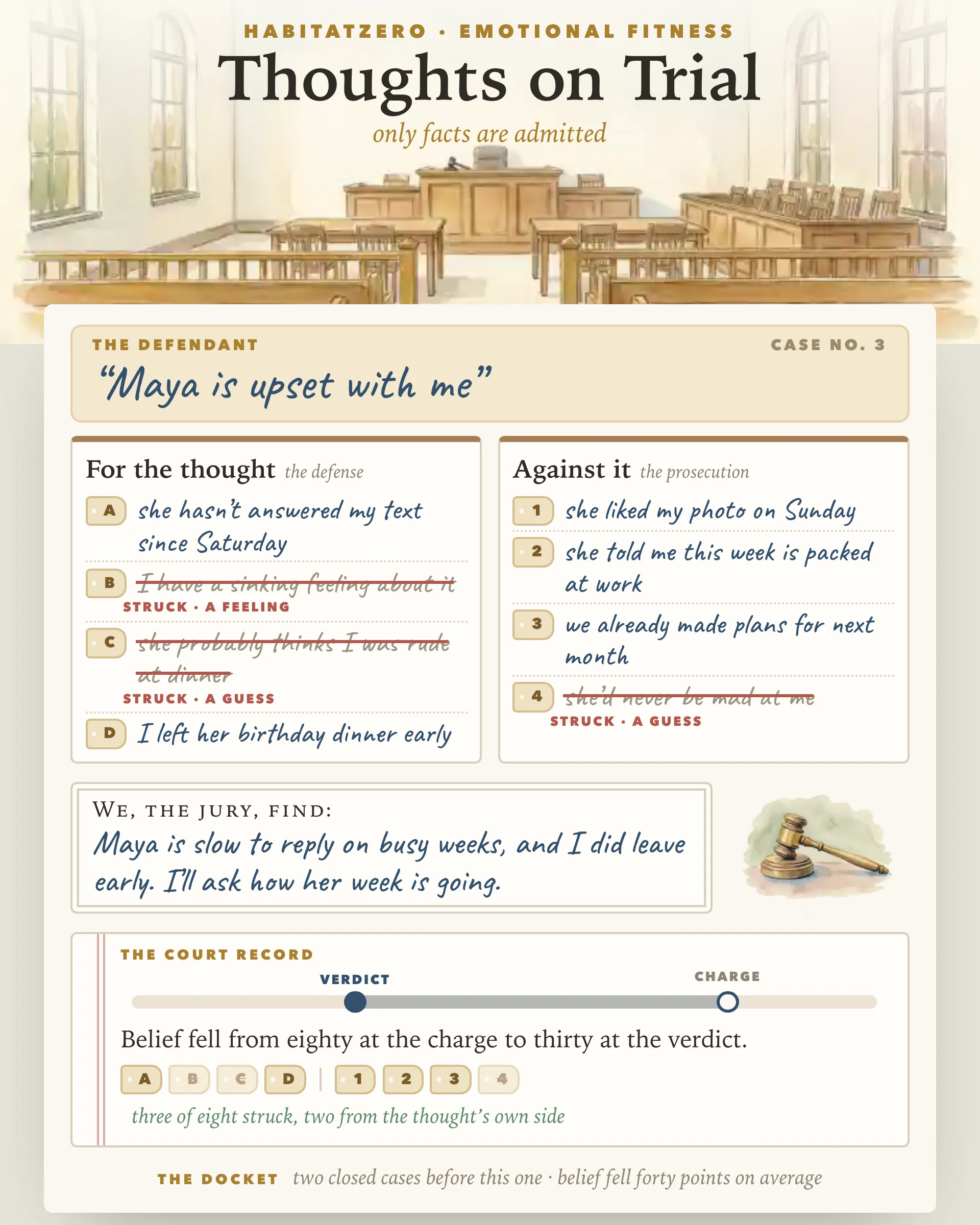
Putting a thought on trial is a cognitive behavioral therapy technique rather than one author's invention. Its engine is the evidence check at the center of Aaron T. Beck's cognitive therapy: in the Beck Institute's own summary of CBT, therapists help people identify distressing thoughts and evaluate how realistic those thoughts are. The courtroom framing turns up on many therapy worksheets, and the psychiatrist Irismar Reis de Oliveira built a structured treatment around it, Trial-Based Cognitive Therapy, whose signature exercise puts a person's deepest negative beliefs on trial. This sheet is an independent practice tool; neither Dr. de Oliveira nor the Beck Institute had a part in it or has endorsed it.
An anxious thought arrives sounding like a ruling that was handed down before anyone spoke. Maya is upset with me. I'm going to blow the interview. It skips the hearing. A trial puts the hearing back. The thought becomes the defendant: the defense lays out the facts that back it, and the prosecution the facts that cut against it. Worksheets online disagree about which lawyer does what, so this one labels its tables plainly; what matters is that both sides answer to one rule of evidence.
Real courts lean on one rule: admit what could be checked. A fact is something a camera could have recorded or another person could confirm. She hasn't answered my text since Saturday is a fact. I have a sinking feeling about it is a feeling, and she probably thinks I was rude is a guess about a mind you can't see into. Both get struck from the record, not because they don't matter, but because they tell you about you rather than about Maya.
Feelings are the sneakiest exhibits, because an anxious mind treats its own alarm as proof. In a 1995 study, Arnoud Arntz and colleagues asked people to rate the danger in short written scenarios. People with anxiety disorders judged a scenario more dangerous when it said the person in it felt anxious, even when the objective facts were held the same, while a comparison group without anxiety problems went by the facts alone. The paper's title puts the trap in one line: if I feel anxious, there must be danger. Striking feelings from the record is how a trial interrupts that loop.
The rule cuts both ways. She'd never be mad at me is a guess too, however soothing, so it gets struck from the prosecution's table as well. A fair trial is not positive thinking. It is fewer, better facts.
You write the thought word for word and rate how strongly you believe it, from zero to one hundred. Then you enter exhibits, lettered for the defense and numbered for the prosecution, six a side at most. When an exhibit sounds like a feeling or a guess, the page objects and you rule: sustain it and the exhibit is struck, or overrule it because it really is a fact. You can strike anything the page missed, too.
The closing arguments are assembled from admitted facts only, so a struck exhibit never gets argued. Then the jury, which is you, writes a verdict on the form: one sentence that fits every admitted fact on both tables. You rate the original thought a second time and return the verdict. The court record shows how far your belief moved and how much of the case was feeling or guessing rather than fact. Closed cases go on a docket, where you can see whether your thoughts keep resting on the same kind of non-evidence.
Weighing evidence on paper does shift belief. In a study of ninety-one volunteers, a single session with a thought record changed beliefs more than a control session did, though a behavioral experiment, which tests the belief in real life, changed them sooner and more broadly. So if your verdict leaves a question open, collect the missing fact: ask Maya how her week is going.
The courtroom format itself has early support. In a small randomized trial of thirty-six people with social anxiety disorder, patients treated with the trial-based thought record did at least as well as those given standard cognitive therapy techniques, and better on fear of negative evaluation; the authors call the result preliminary. That was treatment delivered by clinicians. This page is practice for everyday thoughts, not therapy, and it can't tell you whether anything is wrong.
Hold a trial when one thought keeps replaying and feels like the whole truth: after a tense exchange, before something you dread, or when silence starts to sound like a sentence being passed. The Thought Record Journal keeps a fuller record with emotions, and the Thinking-Trap Spotter names the pattern a struck exhibit belonged to. If arguing with a thought only makes it louder, Seeds on the Wind practices the opposite move, letting a thought pass without a trial.
If one thought keeps winning, or worry and low mood get in the way of your days, a CBT therapist can work through the case with you in depth. And if the thought on trial is about ending your life or hurting yourself, don't argue it alone: call or text 988 in the US, or call your local emergency number.
A CBT exercise that treats one anxious thought as a defendant in court. You hear evidence from both sides, admit only facts, and replace the thought with a verdict that fits everything the court heard. Worksheets disagree about which lawyer argues for the thought; on this one the defense speaks for it and the prosecution against it.
An exhibit is admissible when a camera could have recorded it or another person could confirm it, such as a text left unanswered since Saturday. A feeling reports your own alarm, and a guess reaches into someone else’s mind or into next week. Both are real experiences, yet neither proves anything, so both are struck, even the comforting ones.
Then the trial worked. Some anxious thoughts are partly right, and a fair verdict admits it and adds a next step, like asking a direct question or making a plan. When one thought keeps winning and wearing you down for weeks, take the case to a CBT therapist, who can work through it with you in depth.
No. Trial-Based Cognitive Therapy is a structured treatment developed by the psychiatrist Irismar Reis de Oliveira, and its trial works on deep core beliefs with a trained clinician. This page is an independent practice sheet for single everyday thoughts, with no affiliation to Dr. de Oliveira or the Beck Institute and no endorsement from either.
The page shows a finished case so you can see how a trial runs before you start. To hold your own trials and keep a docket of closed cases, personalize the worksheet in HabitatZero at no cost.
By the team behind Fabulous, the science-based self-care app used by over 30 million people.


