Leaves on a StreamEmotional Fitness · ~3 min
About this template · Updated July 2026
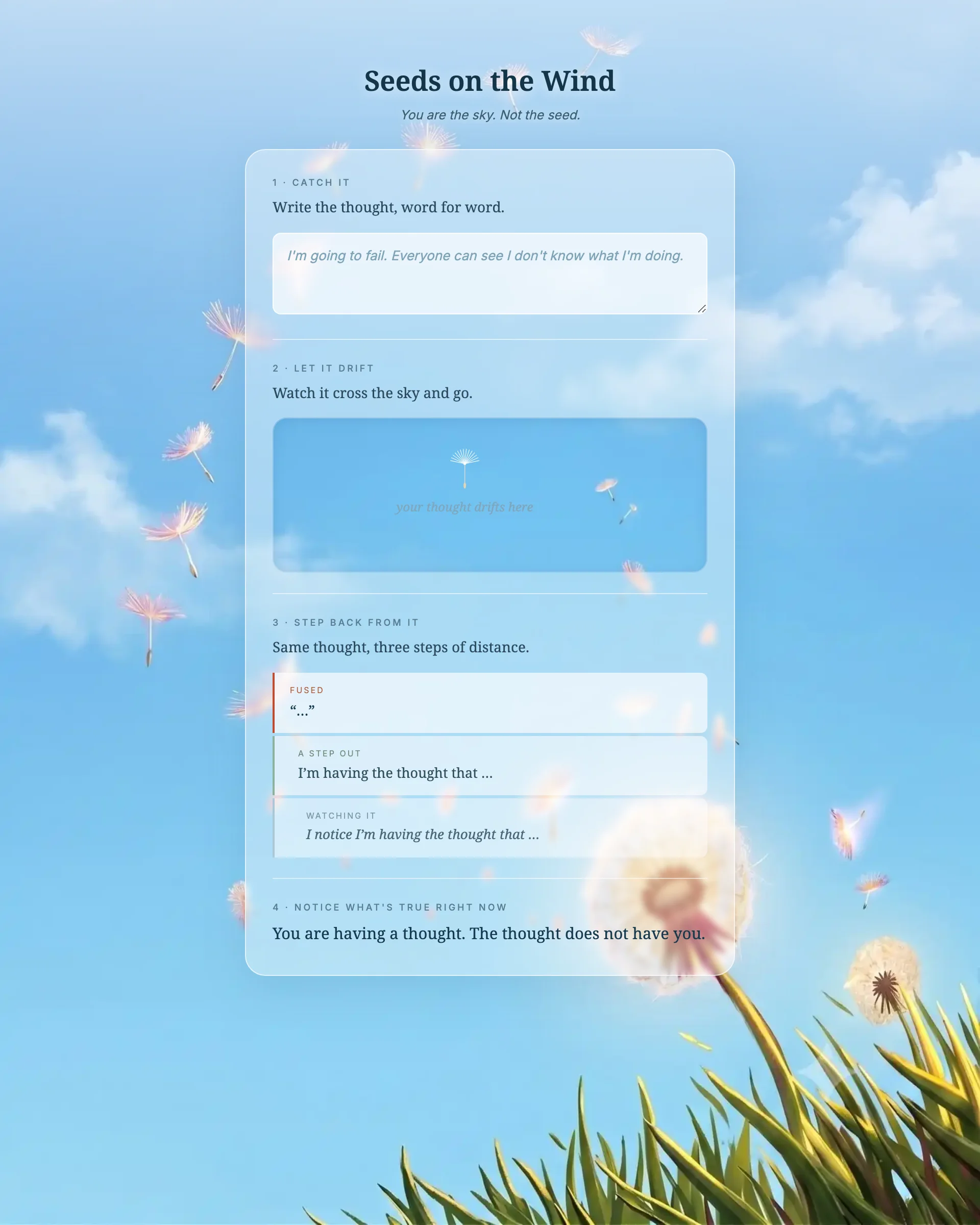
There is a category error at the bottom of most bad afternoons: a thought arrives — I'm going to fail. Everyone can see it. — and gets filed as a fact before anyone checks its papers. This exercise, built by Jazmin Quill as a single sky, practices the correction. You write the thought word for word, watch it drift across the sky like a seed on the wind, and read it back through three steps of distance. Nothing about the thought is argued with. Your seat just changes.
Write it word for word. Not a summary — the actual sentence your mind keeps saying. A thought written exactly becomes something you can look at instead of through, and that swap is the entire mechanism.
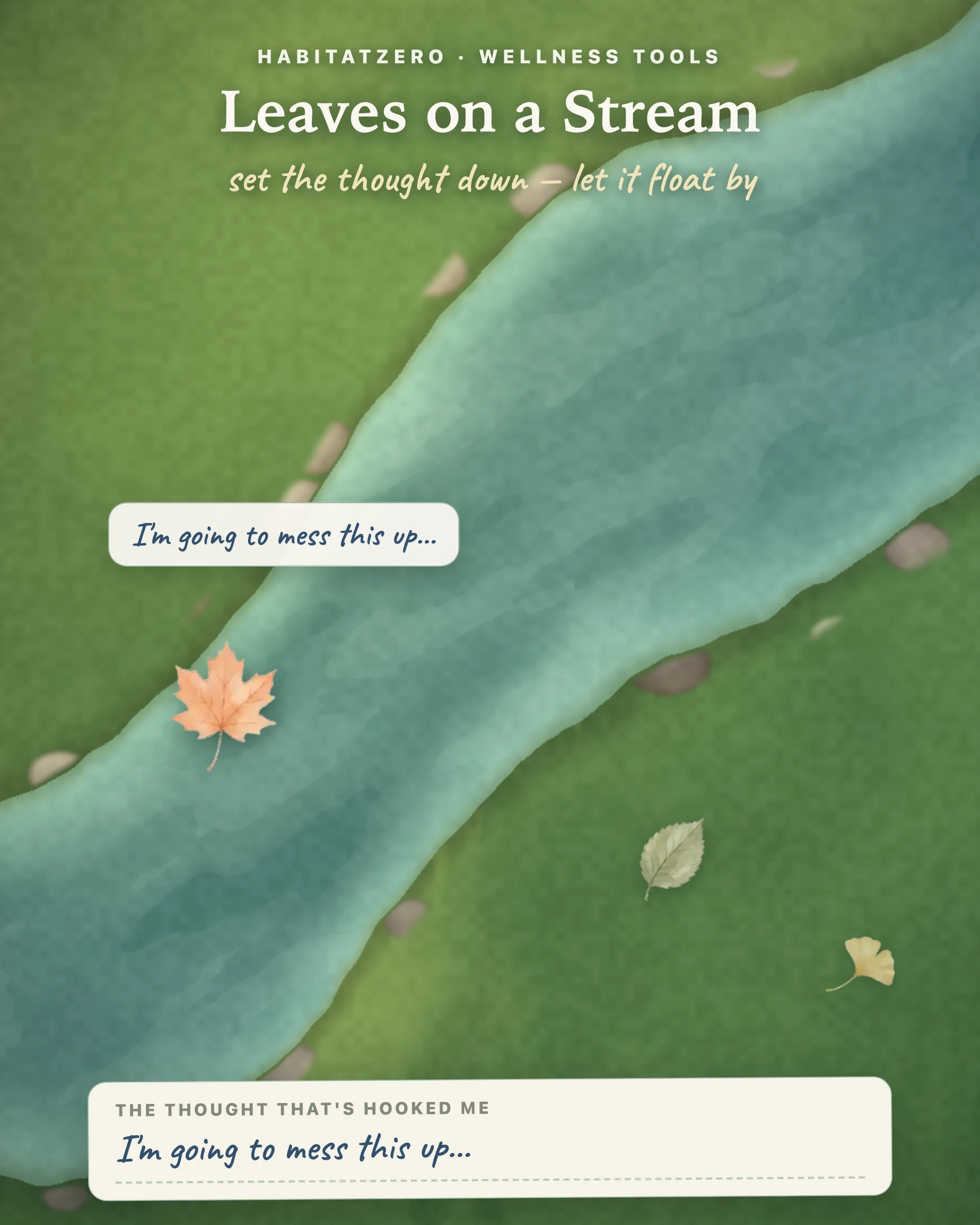
Watch it cross. Your sentence lifts off and drifts across the sky — present, visible, moving, in charge of nothing. The page's one line of instruction is also its thesis: you are the sky, not the seed.
Read the three rungs. The same thought at three distances: the sentence itself; I'm having the thought that…; I notice I'm having the thought that…. Read them slowly, in order. This is cognitive defusion — the core move of acceptance and commitment therapy (ACT), developed by Steven Hayes and colleagues — and the wording matters, which is why the page builds the rungs for you from your own sentence, down to keeping your capital I where it belongs.
Plainly told: ACT's claim is not that distancing makes bad thoughts go away, but that changing your relationship to thoughts changes what they can do to you — and the evidence backs the mechanism. A meta-analysis of ACT's clinical trials found the approach reliably effective across anxiety, depression, and stress problems, and component studies that tested defusion-style exercises on their own found the isolated move carries measurable benefit — the ladder works even outside the full therapy. The famous "passengers on the bus" image from Hayes' original ACT work teaches the same stance: thoughts ride along and make noise; you drive.
And the boundary, plainly too: this is a skill drill for ordinary sticky thinking, not a treatment. Thoughts that frighten you or run your days deserve a professional — who will likely teach you defusion, with a person in the room.
HabitatZero keeps two sky-adjacent practices, and they're siblings, not twins. Leaves on a stream is the letting go meditation — a continuous stream for whatever floats by, thought after thought, no writing required. Seeds on the Wind is the single sticky thought instrument: one sentence, written precisely, defused deliberately. Stream for volume, sky for the one that keeps landing. And when the thought that keeps landing deserves an argument on the merits, the reframing glasses are the tool that argues.
One sentence in your teeth. One sky to put it in. Write it, watch it cross, and notice who stayed.
Not that your thoughts are wrong — that they're events, not verdicts. A thought is something your mind produces, the way weather happens in a sky: real, sometimes accurate, often not, and never the same thing as the situation it describes. The practical problem is fusion — being so inside a thought that it reads as plain reality. This exercise practices the opposite move: putting enough distance around a thought to see it as a thought.
It's the classic defusion move from acceptance and commitment therapy, run word by word. 'I'll fail' is a verdict; 'I'm having the thought that I'll fail' is a report; 'I notice I'm having the thought that I'll fail' is a report with a witness. Each rung adds a few words and a few feet of distance. The thought loses no honesty on the way up the ladder — it just loses its grip.
The stance the sky picture teaches: attending to thoughts as passing objects rather than instructions. Research on acceptance and commitment methods — including a meta-analysis of clinical trials and component studies that tested defusion exercises like this one on their own — finds that this changed relationship to thoughts, not winning arguments with them, carries much of the benefit. Watching is a skill, and it's learnable in minutes a day.
A famous ACT image from Hayes and colleagues: you're the driver, and your thoughts are passengers — some loud, some rude, some shouting directions. You can stop the bus to argue with them, or you can keep driving where you were going while they talk. This page is the same lesson with quieter scenery: seeds cross the sky, the sky doesn't chase them, and you keep your hands on the wheel.
No — it's a skill drill for ordinary sticky thinking, borrowed honestly from methods that clinicians do use. If intrusive thoughts are frightening, relentless, or running your days, that deserves a professional rather than a webpage, and defusion will likely be part of what they teach you — with a person in the room, which matters.
By the team behind Fabulous, the science-based self-care app used by over 30 million people.