Leaves on a StreamEmotional Fitness · ~3 min
About this template · Updated July 2026
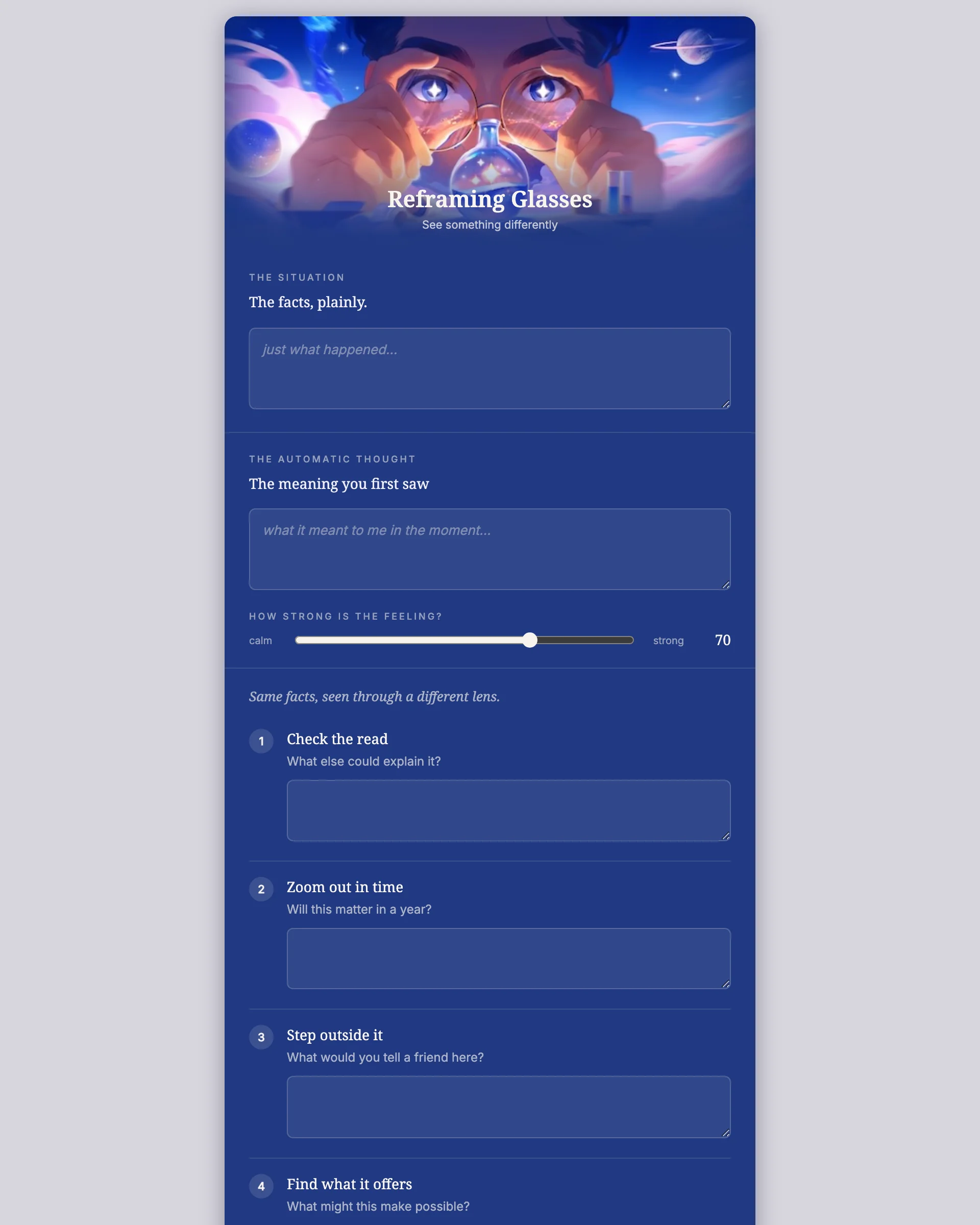
A loud thought arrives wearing the uniform of a fact. I've messed something up badly. She's furious. This always happens. Cognitive restructuring is the practiced move of stopping that thought at the door and checking its credentials — and this worksheet, built by Jazmin Quill as a single card called the Reframing Glasses, runs the whole check in about seven minutes: the facts, the automatic thought, four lenses, and the version you choose to carry out.
The situation. Just what happened, in camera-footage language — no adjectives doing secret work. Separating the event from its meaning is half the technique, because loud thoughts survive by keeping the two fused.
The automatic thought. The meaning you first saw, word for word, plus a slider: how strong is the feeling, calm to strong? Write the number down honestly. It has a job to do later.
Four lenses. Same facts, looked at through four questions in turn: what else could explain it (the alternative read), will this matter in a year (the zoom-out), what would you tell a friend here (the seat-swap), and what might this make possible (the offer). You don't need brilliant answers in all four boxes — one lens that genuinely shifts the picture is a good session.
The reframed thought, and the slider again. Not a forced positive — the reading that survives the lenses. Then re-rate the old feeling. It rarely falls to zero; watching it fall at all is the finding, in your own handwriting: the feeling tracks the interpretation, not the event.
This is the central move of cognitive therapy, and the lineage is worth stating plainly. Aaron Beck built the approach on the observation that automatic thoughts — fast, believable, often distorted interpretations — sit between events and moods, and that people can learn to catch and test them; his forty-year retrospective on cognitive therapy tells the story of that idea growing from clinical observation into one of psychology's most-validated methods. The accumulated trial evidence is why reviewers now describe cognitive behavioral methods as the current gold standard of psychotherapy — strong words, used in the literature itself.
The honest boundary, plainly too: a worksheet is a skill-builder, not care. If loud thoughts are running your days, a professional is the right next step — and this card makes good homework between sessions.
The Reframing Glasses work best on a single specific moment while it's still warm: the one-line reply you keep re-reading, the meeting that ended abruptly, the small mistake that ballooned into a verdict. Print it or fill it on screen; either way, finish the whole card — the re-rating at the end is not decoration, it's the receipt.
HabitatZero keeps its CBT-shaped tools deliberately specialized. The thought record journal is the longitudinal instrument — dated entries that catch recurring thoughts and weigh evidence across weeks. The Reframing Glasses are the acute instrument: one moment, four lenses, seven minutes, done. If the same thought keeps earning a card, that repetition is your cue to move it to the journal and watch the pattern instead.
Facts. Thought. Four lenses. The version you carry. Put the glasses on while the moment is still loud.
The core move of cognitive therapy: noticing an automatic thought — the instant meaning your mind assigns to an event — and examining it instead of obeying it. The technique goes back to Aaron Beck, who built cognitive therapy on the observation that it's rarely events themselves that sink a mood but the interpretations riding on them, and that interpretations can be checked. This worksheet is that check, run as a single card: facts, thought, four questions, revised thought.
Positive thinking replaces one unexamined thought with a nicer unexamined thought. Restructuring examines. The four lenses don't ask you to believe something sunnier — they ask what else could explain the facts, whether the stakes are as permanent as they feel, and what you'd say if a friend brought you the same story. Sometimes the honest answer after all four is 'the first read was right' — and then you've earned the worry instead of renting it.
Because the numbers are the evidence. A thought that started at eighty and reads at forty-five after the lenses just demonstrated — in your own handwriting — that the feeling tracks the interpretation, not the event. That's the finding cognitive therapy has half a century of research behind, and it lands differently when your own slider shows it.
Cognitive techniques are among the most-studied tools in psychology — reviews of the accumulated trials rank cognitive behavioral methods as the best-supported approach for everyday anxiety and low mood, which is why this format has survived fifty years essentially intact. Plainly said: a worksheet is a skill-builder, not care. If loud thoughts are running your days, a professional is the right next step, and this card will still be useful homework between sessions.
While the thought is still loud — same day beats next week. It's built for one specific moment: the email that landed wrong, the remark you keep replaying, the plan that collapsed into a verdict about you. If you find yourself filling one card per day about the same recurring thought, that pattern itself is worth noticing — recurring thoughts respond better to a journal that tracks them over time than to single cards.
By the team behind Fabulous, the science-based self-care app used by over 30 million people.