
The Overwhelm Recovery ProtocolWellness & Routines · ~5 min
About this template · Updated November 2026
Credit to the source first. Joseph Pilates put these exercises together in the first half of the twentieth century under the name Contrology, and Penelope Latey's The Pilates method: history and philosophy follows the method from his New York studio to the teachers who carried it on. The sampler on this page is an independent plan. It has no connection to his estate or to any studio or teaching body, and none of them has checked or approved it.
A pilates workout plan has to settle four things before your first session: which moves, in what order, how many days a week, and for how long. This one asks for two numbers, the days you can give it and how long you would like sessions to grow, and lays out six weeks from there.
The Pilates schedule here uses twelve exercises from the classic mat order: the hundred, the roll-up, single-leg circles, rolling like a ball, single-leg stretch, spine stretch, the saw, the swan, side kicks, teaser prep, swimming and the seal.
Every session opens with about a minute of settling on your back and breathing into the sides of your ribs. After that, each move gets an equal share of the time. If you choose sessions that grow to fifteen minutes, week one is eight minutes and week five reaches fifteen; at thirty, week one is twelve. Pick two, three, four or five days a week. Spread them out when you can; a session on any day counts toward its week. All you need is a mat or a folded blanket on clear floor, plus a towel to sit on.
Each move starts at its easier version: head down for the hundred and single-leg stretch, a half roll-back with your hands behind your thighs in place of the full roll-up, a folded towel under you for the seated moves. Open a move in the key and switch it to the full version once the easier one feels steady.
Some moves carry a note on when to leave them out. The roll-up, rolling like a ball, the seal, teaser prep, the saw and the rounding in spine stretch all bend the spine forward under load or roll on it. A UK consensus statement on exercise for people with osteoporosis recommends avoiding postures with a high degree of spinal flexion, and it encourages spinal extension work, the kind the swan and swimming give you. So each of those moves has a stand-in that keeps its time slot: a hip lift with a long back, a hands-and-knees reach, a side-lying clam or a tall sitting reach. If bending forward brings on back pain, the same stand-ins apply. If you live with osteoporosis, The Osteoporosis Exercise Pagoda builds eight weeks of strength, balance and posture work around what to leave out.
Check with a doctor or physical therapist before you start if you have osteoporosis or low bone density, a back or neck problem, a recent surgery or joint replacement, a heart or blood pressure condition, or if you are pregnant or recently gave birth. Stop any move that hurts, and come back to it in its easier form or not at all.
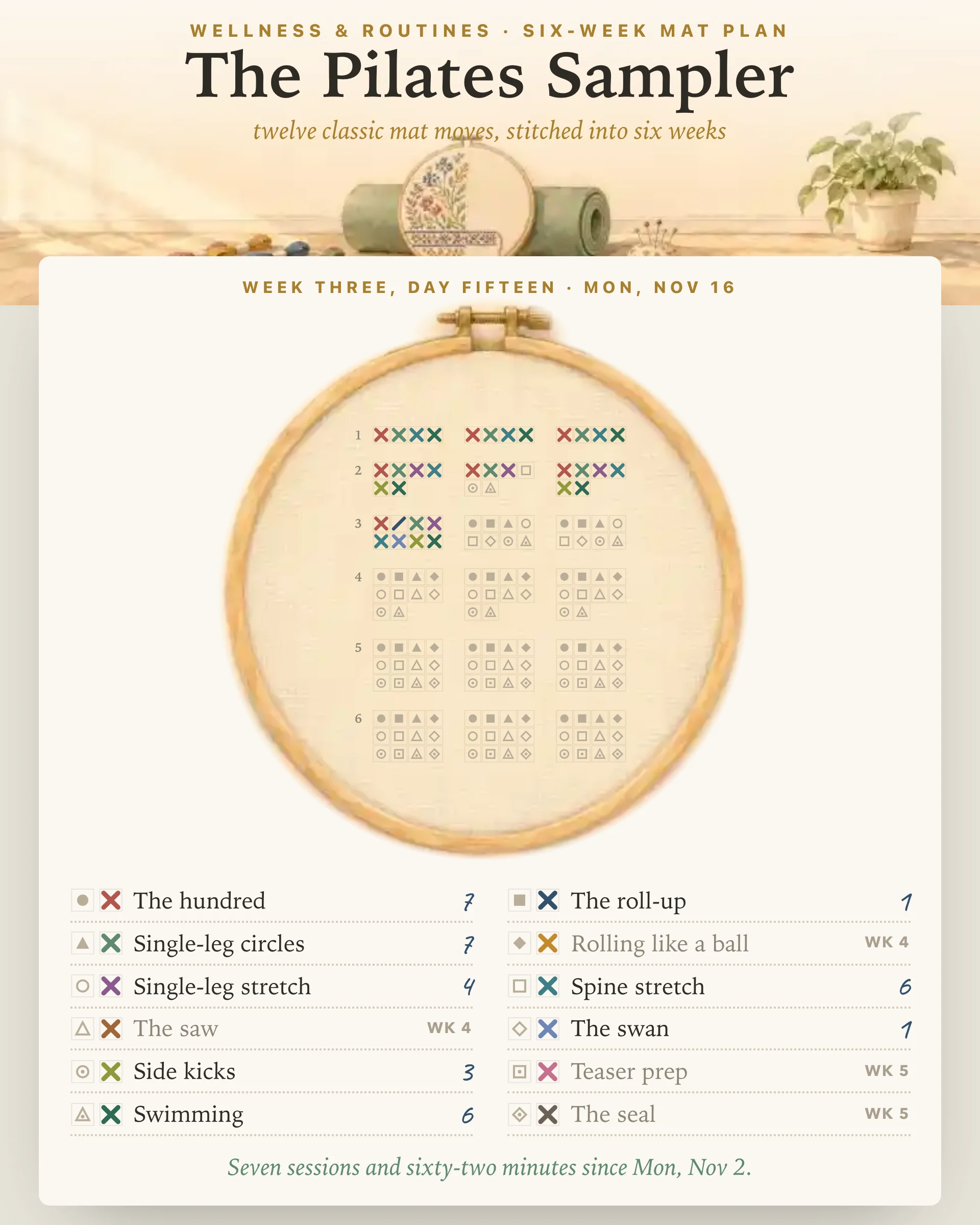
The page draws your six weeks as a cross-stitch chart inside an embroidery hoop: one row per week, one small block per session, one printed mark per move. Press begin and the player runs the session on a real clock, with the time left on each move, when to switch sides, and what comes next. A move adds a cross in its own thread only when its whole time runs out. Skip it or stop partway, and it stays a printed mark. A session you end early keeps its whole minutes, so ninety seconds counts as one minute and forty seconds counts as none. A pause stops the clock, and a phone that sleeps mid-session still keeps true time.
The deepest research on Pilates is about back pain. A Cochrane review of Pilates for low back pain found low to moderate quality evidence that it eases pain and disability compared with doing very little, but no clear sign that it beats other kinds of exercise. The World Health Organization's 2020 guidelines on physical activity recommend regular muscle-strengthening activity at every age, and slow mat work against your own body weight is one way to get some of it, next to walking or other aerobic activity.
The Beginner's Pilates Mat is a four-week introduction that adds eight moves on a fixed schedule. The twelve-card class deck deals a single class at the length you choose and punches it on a four-week card. This sampler takes the longer view: a six-week pilates plan sized to your days and minutes, with a plain note on every move about when to leave it out. If getting down to the floor is the hard part, The Pilates Ring starts in a chair.
Two or three days a week is a realistic start, and four or five suits people who want shorter gaps between sessions. The World Health Organization advises regular muscle-strengthening activity at every age, and mat work against your own body weight is one way to get it, alongside walking or other aerobic activity.
Week one has four moves: the hundred, single-leg circles, spine stretch and swimming. Two more join in each of weeks two to five, and week six runs all twelve in the classic order. Sessions grow by a few minutes each week until they reach the length you picked.
The ones that curl the spine forward under load or roll on it: the roll-up, rolling like a ball, the seal, teaser prep, the saw and the rounding in spine stretch. A UK consensus statement on exercise for osteoporosis advises avoiding postures with a lot of forward bending of the spine. Each of those moves has a stand-in here, such as a hip lift or a hands-and-knees reach. Ask your doctor or a physical therapist what suits you.
Most people find the moves feel more familiar within a few weeks, which is why this plan adds them slowly. A Cochrane review of Pilates for low back pain found some benefit compared with doing very little, but no clear edge over other exercise, so the plan worth following is the one you keep doing.
No. Joseph Pilates created these exercises, but this six-week sampler was put together independently, and no studio, teaching body or estate connected to him has seen or approved it.
By the team behind Fabulous, the science-based self-care app used by over 30 million people.


