
The Overwhelm Recovery ProtocolWellness & Routines · ~5 min
About this template · Updated November 2026
Credit goes first to Joseph Pilates, the German-born trainer who built the system he named Contrology and later taught it in New York. Penelope Latey's paper on the history and philosophy of the Pilates method follows how his ideas traveled after him. This ring is a separate, independent routine: it has no link to his estate, to any studio or to any teacher-training body, and none of them has reviewed or endorsed it.
Pilates for seniors keeps the heart of the method, slow movement led by the breath and a steady middle, and drops the parts that make many older adults hesitate, like getting down to a mat and up again over and over. Most of the work happens on a sturdy chair, then standing behind it with your hands on its back, then at a wall, and only at the very end lying down, on the bed if the floor is not an option.
The ten moves sit in one fixed order, from rib-cage breathing in the chair to a bridge on the bed. Each comes at three levels. Level one keeps you seated or close to it. Level two brings you up to stand with support. Level three asks a little more, such as pausing at the top of a leg lift or pressing away from a kitchen counter instead of the wall.
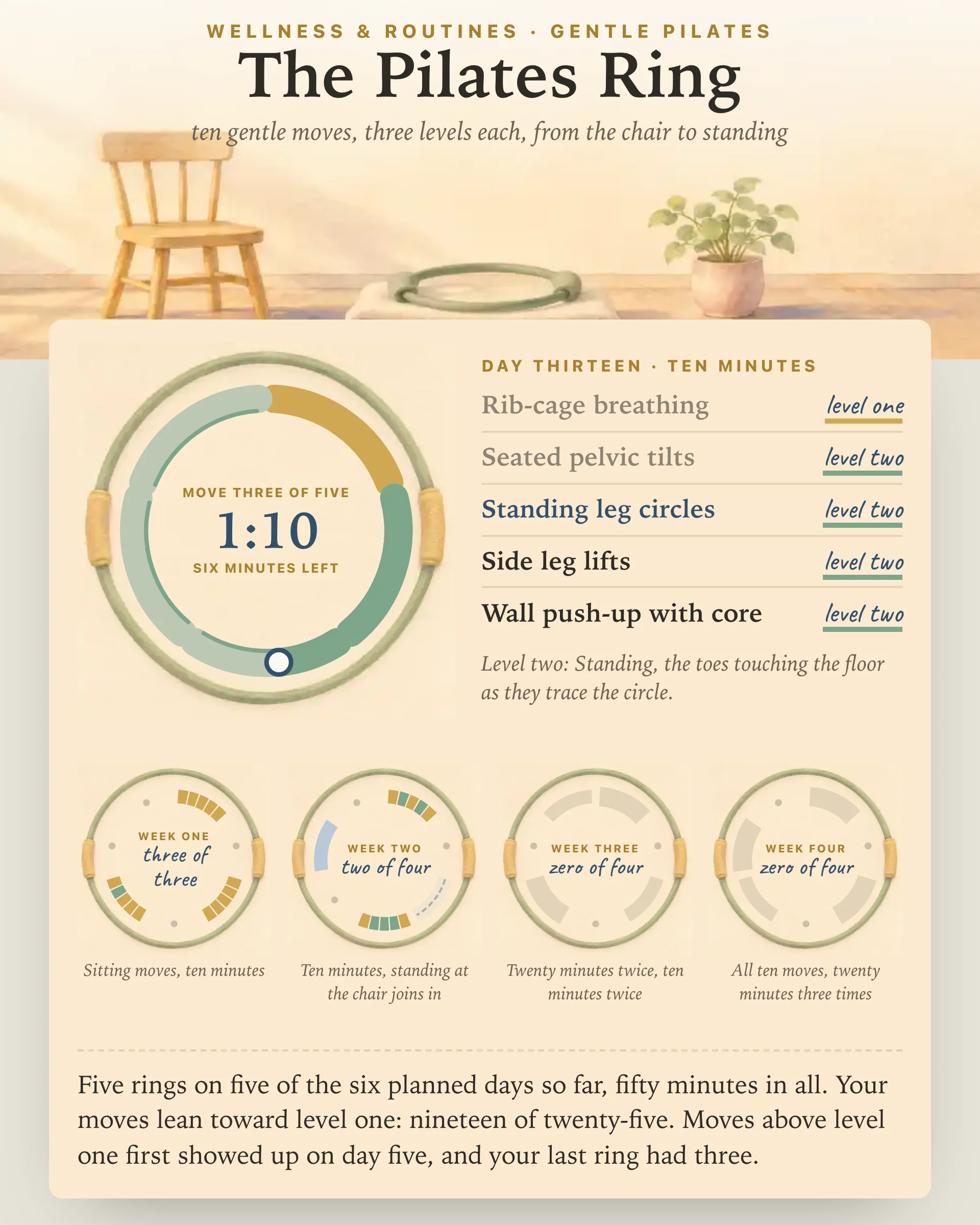
Pick ten or twenty minutes. A twenty-minute ring takes all ten moves, two minutes each; a ten-minute ring holds the five you choose, and turns down a sixth. Press start and the painted ring fills segment by segment, each in the color of the level you set, and tells you when to switch sides. The clock works from the time that has really passed, so a phone that locks mid-move loses you nothing, and a pause holds everything still.
When the ring finishes, or when you stop it after two minutes or more, the day joins its week ring as a small copy of the session, one stripe per move. Tap how it felt. If you pick "something hurt," the reading puts that first and asks you to rest and check with a professional. Over four weeks the stripes tend to drift from gold, level one, toward green and blue.
Week one is three ten-minute rings of sitting moves. Week two adds a fourth day and brings in standing at the chair. Week three mixes two twenty-minute rings with two ten-minute ones, and week four asks for three rings of twenty minutes and one of ten. Rest days belong to the plan. Miss a day and simply pick up with the next one.
A 2015 systematic review by Barker and colleagues found that Pilates improved balance in older adults compared with doing no exercise at all. The same authors found very little data on whether Pilates changes how often people actually fall, and they warned that the trials were small and may have overstated the benefit. A 2019 Cochrane review of exercise for preventing falls in older people living in the community gives firmer evidence that programs built around balance and functional exercise lower the rate of falls. Neither review tested this page, and no worksheet can promise you fewer falls, a straighter back or less pain. A ring can only help you show up and see your own pattern over a month.
Before you start, talk with a doctor or physical therapist if you have had a fall, dizzy spells, a joint replacement, a heart or blood pressure condition, osteoporosis, or pain that keeps returning. Stop any move that hurts. Keep a sturdy chair or a counter within reach for everything you do standing, and after the roll-down and the bridge, take your time: roll onto your side before you sit up, and sit for a breath before you stand. If you have been told to avoid bending forward or twisting under load, keep those two moves at level one or leave them off the ring.
Many women in their fifties and sixties come to Pilates for strength that is kind to the joints and for a better sense of posture and the deep belly muscles. The same ring serves you. Start where the plan starts, and raise a move by one level only after the current level has felt easy for two sessions in a row.
If you would rather stay seated for every move, The Chair Pilates Abacus keeps all of its work in the chair. If the floor is comfortable and you want the classic mat order, The Beginner's Pilates Mat introduces it one week at a time. When those mat moves feel easy, The Mat Pilates Class Deck deals a full class in the traditional order at fifteen, twenty or thirty minutes. And if the push-up against the wall becomes your favorite part, The Wall Push-Up Ladder builds on it rung by rung.
Open the ring three or four days a week at a time you can repeat, such as after breakfast, with your screen at eye level beside the chair.
It can suit many older adults because it is slow, led by the breath, and easy to scale down to a chair. A 2015 review found that Pilates improved balance compared with no exercise, though very little data exists on whether it changes how often people fall.
Yes. Most classic mat ideas, such as rocking the pelvis, curling the spine and lifting a leg with control, translate to a firm seat or to standing behind a chair. This routine starts seated and adds standing moves as the weeks go on, always with a hand on the chair back.
This plan asks for three sessions in the first week and four in each week after, ten or twenty minutes at a time, with rest days in between. Short, regular practice tends to be easier to keep up than one long weekly class.
Women in their fifties and beyond often look for exercise that is kind to the joints and works posture and the deep belly muscles, which Pilates does. If you have osteoporosis, ask your doctor or physical therapist which forward bends and twists suit you, and keep those moves at level one until you know.
No. It is an independent routine built from widely taught Pilates ideas, and no studio, certifying body or estate linked to Joseph Pilates has reviewed or approved it.
By the team behind Fabulous, the science-based self-care app used by over 30 million people.


