
The Overwhelm Recovery ProtocolWellness & Routines · ~5 min
About this template · Updated November 2026
Credit where it belongs. The exercises on these cards come from Joseph Pilates, who built a system he called Contrology in the early twentieth century and taught it in New York; Penelope Latey traces that path in The Pilates method: history and philosophy. The deck itself is an independent page. It has no tie to any studio, teacher-training school or certifying body, and none of them has looked it over.
Mat pilates is the version of the method you do on the floor, with nothing but a padded mat and your own weight. A good class has a shape, from waking the spine on your back to a playful roll at the end. Joseph Pilates set his mat work down as a fixed sequence, and teachers still follow it because each exercise readies the body for the next. This page keeps that order and lets you choose how much of it to do today.
The deck holds twelve classic exercises, always dealt in the same order:
A fifteen-minute class deals nine cards. Rolling like a ball, the saw and the seal sit out, so the other nine are never rushed. Twenty minutes brings the whole deck. Thirty minutes keeps all twelve and lengthens each set, though the hundred never goes past its ten breaths.
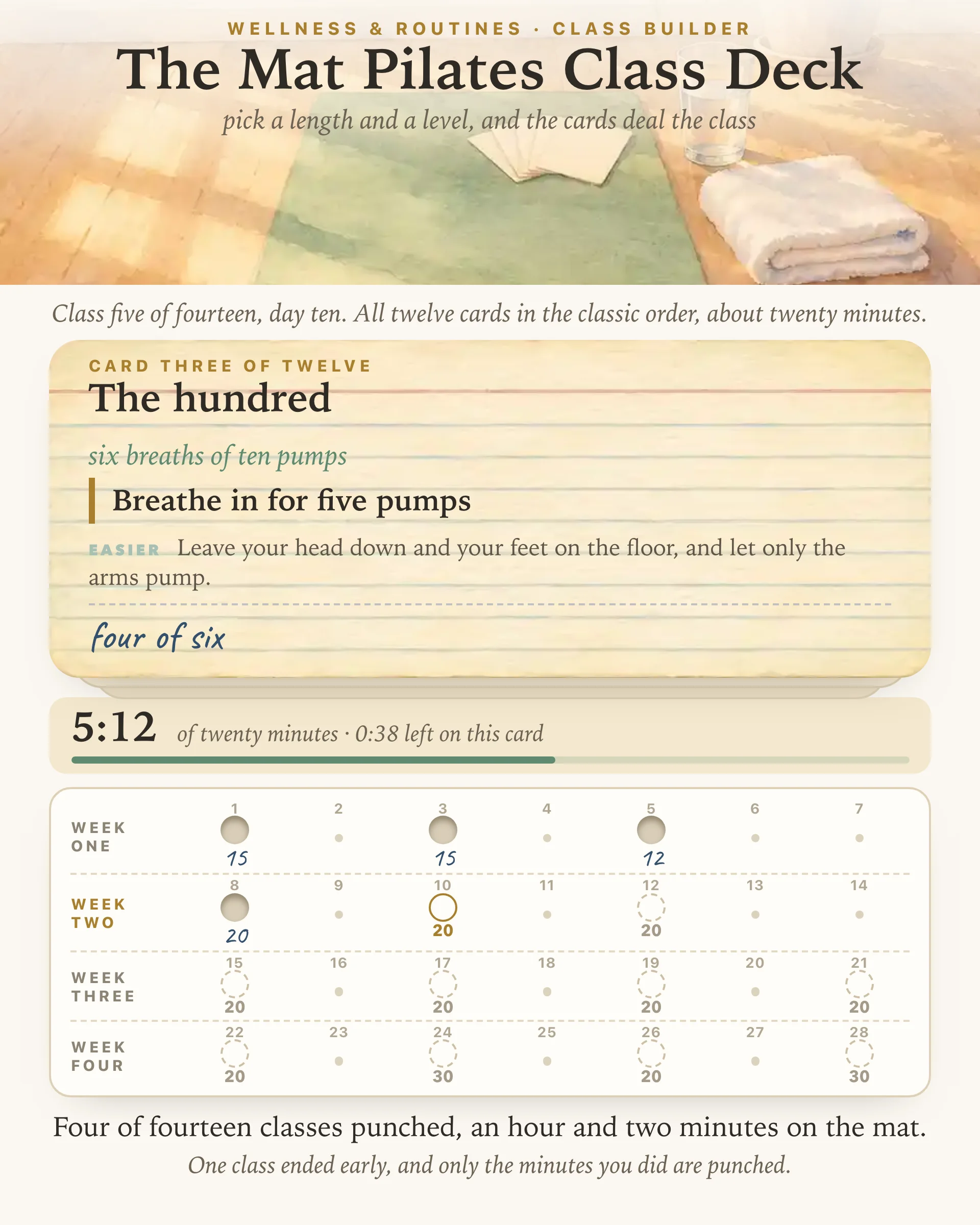
Tap a length and a level under the painting, and the deck deals itself. Each card shows the exercise, how many reps your level calls for, how to do it, short breathing cues, and an easier version for days when the full one asks too much. Flip through first, or tap any tab to read ahead.
Press start the class and a clock begins. Every card gets a share of the minutes worked out from its reps, so the hundred gets less time than the pelvic curl. When a card's time is up the deck moves on by itself. Tap count one for every rep you finish, and on two-sided exercises the counter switches you to the other leg or side halfway. If you finish a set early, flip to the next card yourself.
The clock keeps real time, measured from your start minus any pauses, so a phone that locks mid-class still shows the right minute. End early and only the minutes you did are recorded.
Then punch it. The card at the bottom has fourteen holes across four weeks, one for each class. A punched hole carries the minutes you did in handwriting, and the reading beneath it adds up your time on the mat, notes any class that ended early, and says what next week brings. A class done without the clock can be punched at the length you dealt, and a wrong punch comes back out with two taps.
That is fourteen classes and about four hours and forty minutes on the mat. Classes follow one another in sequence rather than calendar dates, so a missed Tuesday simply waits for Wednesday. The chip marked the plan shows each class's suggested length, and any other length is fine.
The method itself is well defined: a systematic review of 119 papers found it described as mind-body exercise focused on strength, core stability, flexibility, muscle control, posture and breathing, done on a mat or on equipment. For back pain, a Cochrane review found low to moderate quality evidence that it beats minimal intervention for pain and disability, but no conclusive evidence that it outdoes other kinds of exercise. In plain terms, it is a reasonable way to move, not a cure.
The World Health Organization's 2020 guidelines ask adults for muscle-strengthening activity on two or more days a week, alongside aerobic activity. A mat class works your trunk, hips and shoulders against your own weight, so it can cover some of that, though it is lighter than lifting and does not replace walking or other cardio.
Rolling like a ball, the seal, the roll-up and deep forward rounding bend the spine the most. If you have low bone density, a back or neck condition, a joint replacement, or a heart or blood pressure condition, or you are pregnant or recently gave birth, ask a doctor or physical therapist which cards suit you before your first class. Stop anything that hurts. The easier version on every card counts just as much.
If even fifteen minutes on the floor sounds like a lot, The Beginner's Pilates Mat introduces gentler versions of these moves one week at a time. For work with your feet pressed against a wall, try The 28-Day Wall Pilates Challenge. If getting down to the floor is the hard part, The Chair Pilates Abacus keeps every exercise seated.
It is the floor-based form of the method, done on a padded mat with your body weight as the only load. The exercises train trunk control, breathing, flexibility and steady movement of the arms and legs, without the spring machines a studio uses.
The traditional sequence warms the spine on your back first, with breathing, the pelvic curl and the hundred, then rolls, leg circles and abdominal work, then seated stretches and twists, work on your front and side, and a playful rolling finish. This deck keeps that order and drops cards for a short class rather than shuffling them.
Yes. A mat or a folded blanket on a carpet is enough, plus a towel to sit on or rest your head on. Clear room to lie down with your arms overhead, and keep a sturdy chair close if getting down to the floor and back up takes some help.
This plan starts with three fifteen-minute classes a week and builds to two thirty-minute classes by week four, with rest days in between. Shorter classes done often teach the order better than one long class you dread. Repeat a week if it felt like too much.
No. No studio, teacher-training school or certifying body wrote or reviewed these cards. They describe long-established mat exercises in plain words, and they cannot see your form the way an instructor in the room can.
By the team behind Fabulous, the science-based self-care app used by over 30 million people.


