
The Overwhelm Recovery ProtocolWellness & Routines · ~5 min
About this template · Updated November 2026
Every move on this branch comes down from the method Joseph Pilates built in the early twentieth century and called Contrology; Penelope Latey's history of the method traces how it spread. The branch is an independent worksheet. No studio, Pilates school or holder of his name wrote it, checked it or vouches for it.
Pilates for women over 40 is mostly the same mat work everyone does, fitted to a body with history. By your forties you may leak a little when you cough, have a back that flares now and then, or carry a bone density result your doctor mentioned. This page asks first, then shapes a twenty- to thirty-minute practice around your answers.
The session runs twelve moves in an order that gets you down to the mat once and keeps you there: the wall roll-down standing, then the pelvic curl, the hundred with your head down, the single-leg stretch with your head down, the bridge with a march, the spine twist, the side-lying leg series, the clam, the side plank on your knee, swimming on hands and knees, the cat stretch, and rest. Each has an easier version, a plain note on when to skip it, and a stand-in that takes its place on the clock.
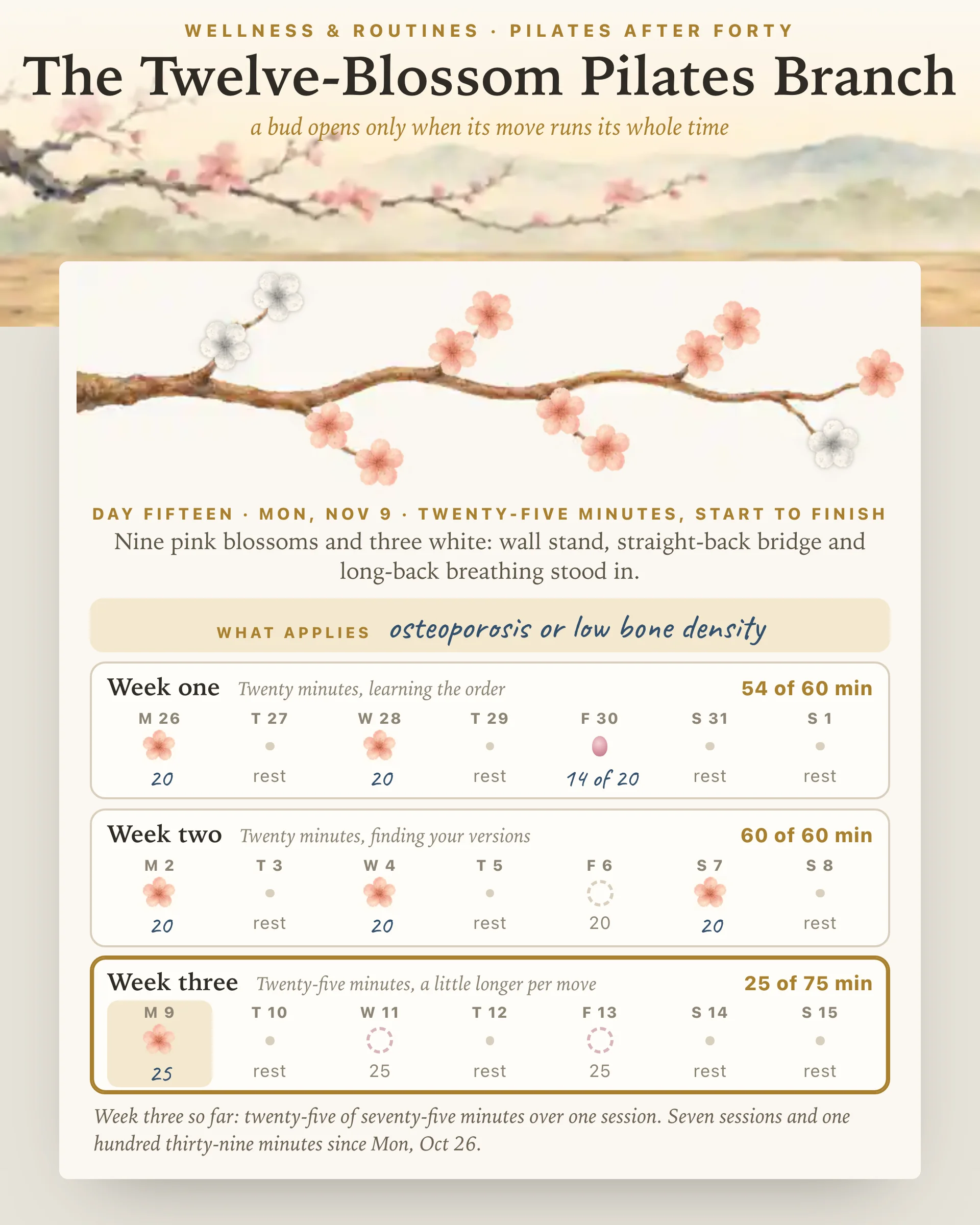
Three marks under the branch change the session for you.
Every stand-in keeps the slot of the move it replaces, so the session never gets shorter. You can also set any move by hand; keeping one your mark rules out brings a reminder to clear it with your doctor or physical therapist.
Press begin and the clock gives each move a twelfth of the session: one minute and forty seconds at twenty minutes, two minutes and five seconds at twenty-five, two and a half at thirty. The current move's bud swells as its time runs, and it opens only when the whole time has passed, pink for a move as written or easier, white for a stand-in. Skip a move and its bud stays closed. End early and only whole minutes go in the log.
The clock reads real time from your start, minus pauses, so a phone that locks mid-session still knows where you are, and skipped time never comes back. Further down, six weeks fill in three days at a time: twenty minutes for two weeks, twenty-five for two, then thirty.
A 2024 review pooled eleven randomized trials of Pilates in women past menopause. Pilates beat comparison groups on five of nine areas of quality of life, including physical functioning and bodily pain, but the certainty ran from very low to moderate. Programs of forty-eight sessions or more, and classes on equipment, helped in more of those areas than shorter programs and mat classes. The review measured everyday quality of life, not hot flashes or other menopause symptoms.
For bones, a review behind Canada's osteoporosis guidelines found only five studies with 143 people, nearly all women at higher fracture risk. Pilates may improve physical functioning and quality of life, with low certainty. Its effect on falls and bone density was uncertain, and no study reported on fractures or harms. Neither review shows that Pilates builds bone, prevents a fracture or eases menopause symptoms; read it as a steady way to move.
What this page adds is the skip notes and stand-ins. New to Pilates? The beginner's mat brings in moves one week at a time. The class deck deals the traditional sequence at a length you pick. For dumbbells and heavier loads, turn to the eight-week lifting board. If leaking is your main concern, the ten-string harp stays closer to a pelvic floor therapist's program.
Talk with your doctor or a physical therapist first if you have had a fracture, a fall or dizziness, a joint replacement, a heart or blood pressure condition, pain that keeps coming back, or a recent pregnancy. Stop any move that hurts, keep a wall or a sturdy chair within reach for getting down to the mat and up again, and take the stand-in on any day a move does not feel right.
It can be a steady, low-impact way to work on strength, control and flexibility as the years go on. In trials with women past menopause, Pilates improved several parts of everyday quality of life, such as physical functioning and bodily pain, with certainty from very low to moderate, and programs of forty-eight sessions or more helped in the most areas. Treat it as one good habit next to walking and heavier strength work.
Two or three sessions a week is a common rhythm, and this plan uses three: twenty minutes for two weeks, twenty-five for two, then thirty. The days between let new muscles recover, and a missed session can simply move to the next day.
A UK expert consensus advises avoiding loaded, repeated or end-of-range forward bending, which shows up in roll-downs, curl-ups and rounding the back. Here, the wall roll-down, the peel of the pelvic curl and the cat stretch swap to stand-ins with a long, straight back, while a smooth, comfortable twist stays in. Ask your doctor or physical therapist what suits you, above all after a fracture.
Often, with changes. Pelvic floor guidance lists the hundred and other strong belly work among the moves to leave out if you leak or feel heaviness, so those trade places with gentler stand-ins on this page. Back pain differs from person to person, so every move begins at its easier version and any move that sharpens your pain can swap out. A pelvic health or back specialist physical therapist can fit the plan to you.
No. The moves go back to Joseph Pilates, who is credited in the article, while the branch itself is an independent worksheet that no studio, Pilates school or holder of his name has made, checked or endorsed.
By the team behind Fabulous, the science-based self-care app used by over 30 million people.


