
The Overwhelm Recovery ProtocolWellness & Routines · ~5 min
About this template · Updated November 2026
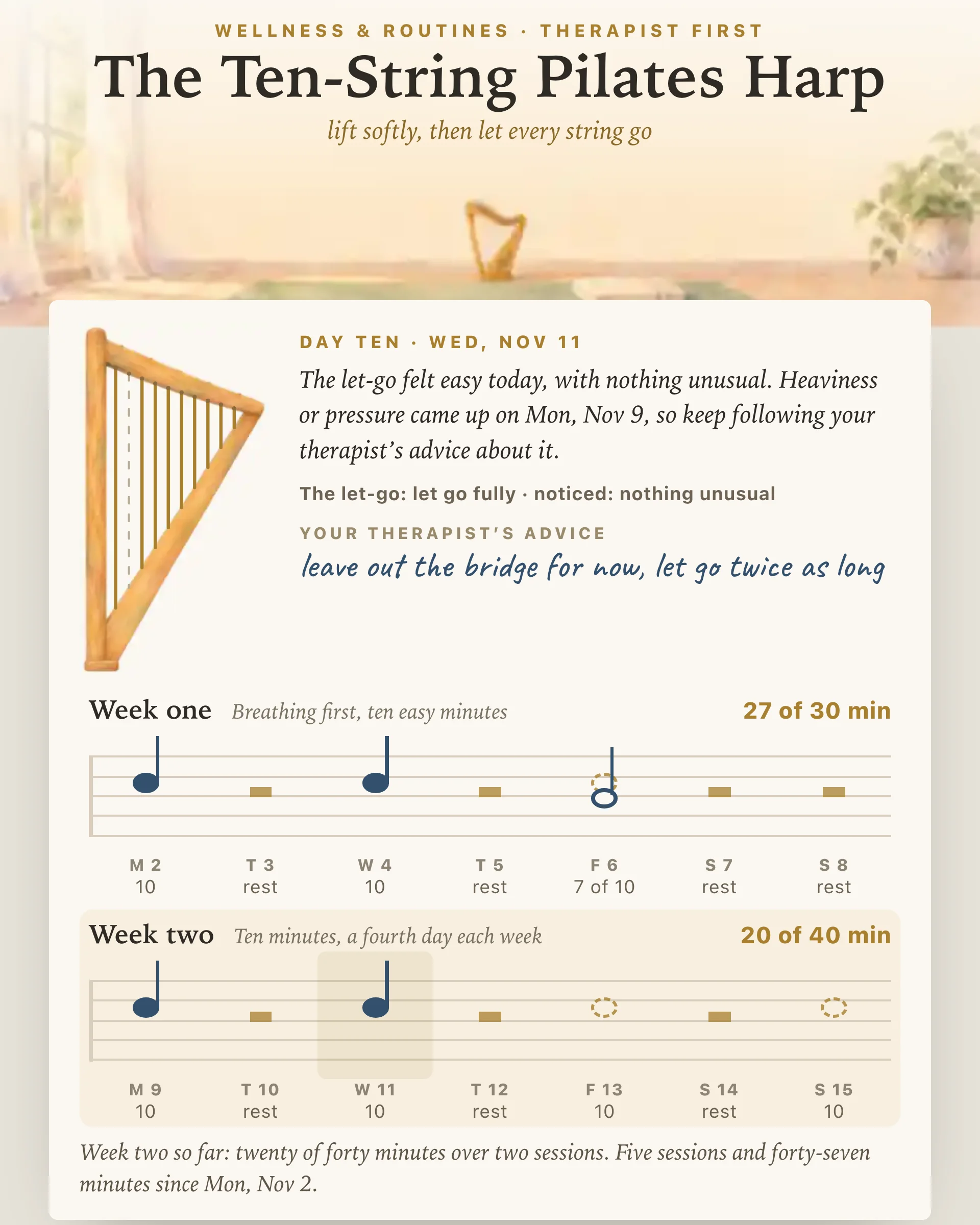
The moves below owe their roots to Joseph Pilates, the German-born trainer who called his method Contrology and brought it to New York in the 1920s; Penelope Latey traces where it went next in The Pilates method: history and philosophy. This harp is an independent page; no studio, estate or Pilates training body had a hand in it or reviewed it.
Pilates for the pelvic floor rests on two small things: a gentle lift of the muscles that close and support the bottom of your pelvis, timed to an out-breath, and a complete release afterward. Here, ten mat moves are the strings of a harp, a real-time timer paces each breath, and four weeks fill in like lines of music. It supports the advice of a pelvic floor physical therapist and never replaces it.
If you are pregnant, have given birth or had surgery in the last few months, or notice pelvic pain, leaking, or a feeling of heaviness or bulging down below, check with your pelvic floor physical therapist or doctor before you start. Some of those signs call for more relaxation work than strengthening. The same goes for a hip or knee replacement, a heart or blood pressure condition, or pain anywhere. Stop any move that hurts or brings on leaking or pressure.
Lie on your back with your knees bent. Breathe in and let your belly, ribs and pelvic floor widen and soften. Breathe out and gently draw the pelvic floor up and in, as if holding in gas, at about a third of your strongest effort. Then let it all go before the next breath. That release is the part people skip, yet relaxing fully is half of what these muscles do each day. If letting go feels hard, one tap makes each release twice as long as the lift.
The breathing opens each session. Then come pelvic tilt, bridge, heel slides, toe taps, clam, side-lying leg lift, cat-cow and bird dog, each with a lift on the out-breath, then child's pose and rest, where nothing lifts. Every move names its own warning sign: a belly that domes along the middle in toe taps, pressure down below in a bridge, sore wrists on hands and knees, dizziness when lying on your back. If your therapist rules a move out, tap leave it out. Its string goes dashed, and its seconds go to the breathing and the rest, never to another move.
Begin, and the timer runs the day's plan: ten minutes for two weeks, then twelve, then fifteen on two days of the last week. The clock reads real time from the moment you started, so a locked phone still knows where you are, and pauses never count. A string turns gold only when its whole move is done. Stop early and you keep your whole minutes, nothing more; skipped time stays out.
Afterward, two taps record how the let-go felt and whether pain, leaking or heaviness came up. The reading follows those marks in order: anything noticed comes first, with a nudge to tell your therapist; two hard let-goes in a row suggest a longer release; two whole, easy sessions are simply noted. A line above the moves keeps your therapist's advice in your own words.
The firmest evidence is for plain pelvic floor muscle training rather than Pilates. A Cochrane review of 31 trials with 1,817 women who had bladder leaking found that those given training were far more likely to report it cured or improved than women given no treatment (Dumoulin and colleagues, 2018). Most trials were small, ran under a year and tested supervised training, not mat classes.
For Pilates itself the picture is thinner. In one trial, 62 women with little or no pelvic floor trouble did 24 hour-long sessions with either a physical therapist or a Pilates instructor, and both groups gained about the same pelvic floor strength; the authors said this could not tell whether Pilates treats pelvic floor problems (Culligan and colleagues, 2010). A newer analysis of 14 trials with 797 women who leak when they cough or strain found Pilates and other alternative exercise, pooled with breathing, yoga and hip work, helped about as much as pelvic floor training and more than usual care (Hao and colleagues, 2025). Because those methods were pooled, it cannot say how Pilates does alone, and no trial so far has shown Pilates beating standard pelvic floor training. So every move here carries a deliberate lift, the piece with the most research behind it.
None of this shows that Pilates cures leaking, mends a prolapse or changes sexual function. Treat these sessions as practice beside a therapist's program.
Use it three or four days a week, on a mat or rug, once your therapist or doctor agrees gentle exercise suits you. To find the muscles first and log plain squeezes, start with the pelvic floor exercise log. For a wider routine later, the beginner's Pilates mat and the gentle Pilates ring plan for older adults build on the same breathing.
It can be a gentle, approachable way to move, but its evidence is thinner than the evidence for plain pelvic floor muscle training. Small trials find Pilates helps about as much as standard training when the pelvic floor is deliberately worked during the moves, and none has shown it doing better. Treat it as a companion to your therapist’s program rather than a swap.
Moves done lying down or on hands and knees, paced by a slow out-breath, are a kind place to begin: pelvic tilts, small bridges, heel slides, clams, side-lying leg lifts, cat-cow and bird dog, with child’s pose and rest for letting go. Each move on this page says when to skip it, and your therapist may cross out others.
No exercise page can promise that. Supervised pelvic floor muscle training has the strongest research behind it for bladder leaking in women, and a pelvic floor physical therapist can check whether your muscles need more strength or more release. Use these sessions alongside that care, never instead of it.
Many people can, with changes, but ask your midwife, doctor or pelvic floor therapist first, especially in the weeks after a vaginal birth or a cesarean. Lying on the back leaves some pregnant people dizzy, so the moves offer side-lying swaps and any of them can be left out.
No. It is an independent worksheet of long-familiar mat moves, with Joseph Pilates credited in the article, and no studio, instructor school or holder of his name had any part in making or checking it.
By the team behind Fabulous, the science-based self-care app used by over 30 million people.


