
The Overwhelm Recovery ProtocolWellness & Routines · ~5 min
About this template · Updated November 2026
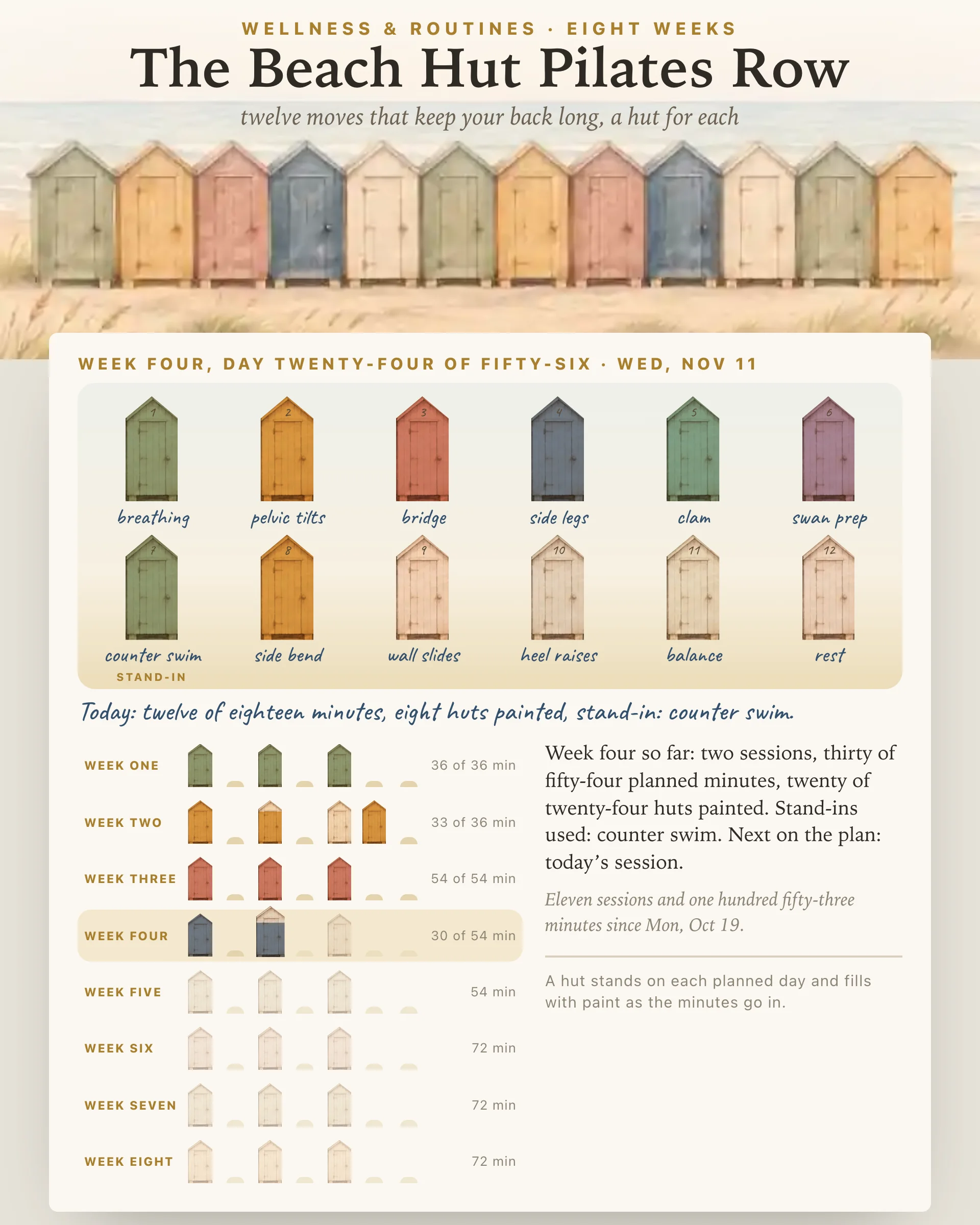
A scan that shows osteoporosis or osteopenia can make a Pilates class feel risky, because so many classic mat moves roll the back forward. This page keeps the slow breathing, steady middle and careful control, and drops the rest. Twelve moves keep your back long, each lives in its own beach hut, and eight weeks of sessions build into a season you can see.
Treat this row as support for your doctor's or physical therapist's care, never a replacement for it or for any medicine. Go over the twelve moves with one of them first, especially if you have broken a bone in your back, have back pain, or your upper back has started to round, and after a fall, dizzy spells, a joint replacement, or with a heart or blood pressure condition. Stop any move that hurts, keep a sturdy chair or the kitchen counter within reach whenever you stand, and call your doctor that same day about sudden, sharp back pain.
In 2022 twelve UK clinicians and researchers, with a wider panel of physical therapists and patient representatives, published a UK consensus statement on exercise for osteoporosis. It lists Pilates among activities for strength and balance, and suggests it for posture and pain, through teaching form and alignment. As a precaution it asks for alternatives to the roll-down and the curl-up, and for loaded or end-range forward bending to be avoided. Its rule is to think straight: upper back straight, neck in line, the bend coming from the hips. It calls smooth, comfortable twisting safe, and it stresses that a broken vertebra during this kind of activity is unlikely for most people with osteoporosis.
The session goes down to the mat once and back up once. On your back come breathing with a long back, pelvic tilts and a bridge raised as one straight piece; on your side, the side-lying leg series and the clam; then swan prep on your belly and swimming on hands and knees. Standing, with a chair, a wall and the counter, come a side bend, wall slides, heel raises and balance holds, and the row ends with rest in a chair.
Each hut says plainly what it leaves out: the roll-up, rolling like a ball, the saw, the teaser, the hundred's head and shoulder curl, and any forward bend with a weight in your hands. Because the saw twists hard as it reaches for the toes, deep twists stay out too, even though smooth twisting is called safe. Every move has a stand-in that runs in the same hut for the same time, such as a leg reach at the counter in place of the bridge, so a move your physical therapist rules out never shortens the session.
The player keeps real time and counts slow beats on each side, and a hut is painted only when its whole time runs. A stopped session keeps whole minutes, never rounded up, and paused or skipped time never counts. Weeks one and two ask for three twelve-minute sessions a week, a minute per move; weeks three to five give each move ninety seconds, and weeks six to eight two minutes. One tap afterward records how your back felt, and pain brings a plain note to rest and check in.
The fullest summary is a systematic review of Pilates in people at higher risk of fracture, written by a kinesiology team in Canada to inform the country's 2021 osteoporosis guideline. From more than seven thousand records it kept five studies with 143 people, 99 percent of them women. It rated the evidence that Pilates helps physical function and quality of life as low certainty, called the effect on falls and bone density uncertain, and found no data on fractures or harms.
A year-long trial came from a physical medicine and rehabilitation team at a university medical school in Turkey. Seventy women with osteoporosis, aged 45 to 65, were assigned at random to supervised Pilates twice a week or to back-extension exercises at home, and 60 finished. The Pilates group improved more in pain, walking distance, standing up from a chair and quality of life. The trial did not report bone density, and a supervised class is not the same as practicing alone.
Physical therapy researchers in Northern Cyprus and Ankara reported that 41 women with osteoporosis who did clinical Pilates gained some spine density while a comparison group lost some. Yet when researchers in Brazil pooled three trials of Pilates and bone density in women past menopause, they found no clear effect at the spine or hip, and only one trial was of sound quality. None was big enough or long enough to show fewer broken bones.
The Pilates Ring is a general routine for older adults that moves from the chair to standing, and The Chair Pilates Abacus stays seated throughout. Neither was built around thinning bones, and both include moves this row leaves out. The Osteoporosis Exercise Pagoda is the strength and balance plan for the same readers, with sit to stands and band rows: use it alongside this row for the strength work the UK group asks for. For yoga with the same care, The Espalier Pear keeps its poses at a wall.
It can be, when the moves keep your back long and never curl it forward. The 2022 UK consensus statement on exercise for osteoporosis lists Pilates among activities that build strength and balance, asks for alternatives to the roll-down and the curl-up as a precaution, and warns against loaded or end-range forward bending. Go over any routine with your doctor or physical therapist first, above all after a broken bone in your back.
Leave out moves that round the back forward or twist it hard: the roll-up, rolling like a ball, the saw, the teaser, the roll-over, and the head and shoulder curl of the hundred and the leg stretches. Bend at the hips rather than the back, and never fold forward with a weight in your hands. Every hut on this page names what it leaves out and offers a stand-in for the same time.
The research does not show that it can. One small trial in women with osteoporosis reported a rise in spine density after Pilates, but a meta-analysis of three trials found no clear effect at the spine or hip, and a review prepared for the 2021 Canadian osteoporosis guideline called the effect uncertain. Expect help with strength, posture and confidence in moving rather than with bone density.
This plan asks for three sessions a week for eight weeks, each with the same twelve moves: a minute per move in weeks one and two, ninety seconds in weeks three to five, and two minutes from week six. The UK consensus also asks for strength work on two or three days a week, so pair the row with a strength routine your physical therapist approves.
Osteopenia means bone density below average but not yet in the osteoporosis range, and the same advice to keep the back long applies. We found no Pilates trial built only for osteopenia, so this row treats both the same way. Ask your doctor or physical therapist whether you also need more strength or impact work.
By the team behind Fabulous, the science-based self-care app used by over 30 million people.


