
The Overwhelm Recovery ProtocolWellness & Routines · ~5 min
About this template · Updated November 2026
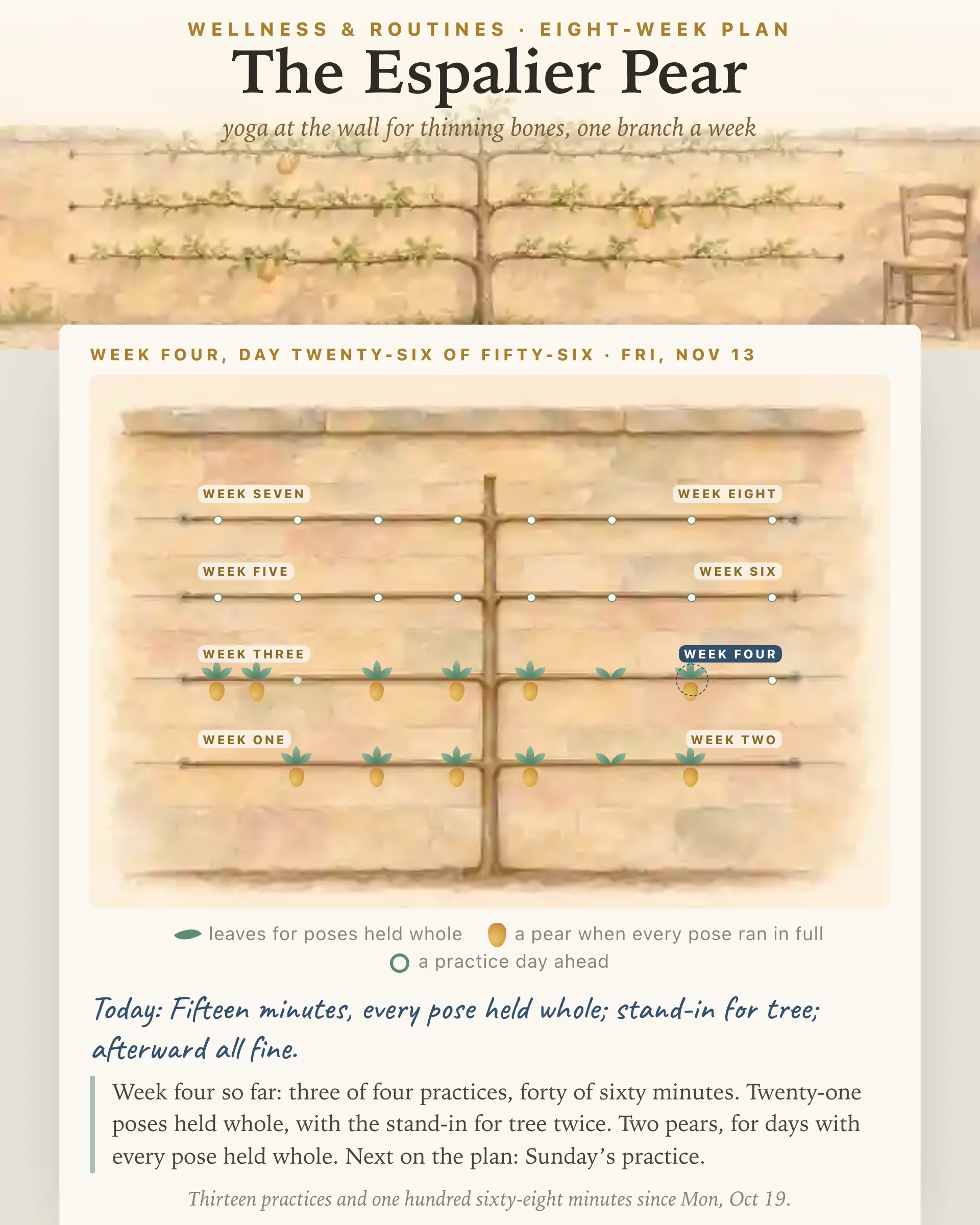
An espalier is a fruit tree trained against a sunny wall: one straight trunk, level arms tied to wires, shaped slowly and never forced. That is a fair picture of yoga for osteoporosis. This practice happens at a wall, a counter and a sturdy chair, keeps your back long, and grows over eight weeks, each week an arm of a painted pear tree that leafs out as you practice.
Treat this as support for your doctor's or physical therapist's care, never in place of that care or any medicine. Go over the poses with one of them first, above all after a broken bone in your spine, with back pain, or if your upper back has begun to curve forward, and also if you have fallen, had dizzy spells, a replaced joint, a heart or blood pressure condition, or pain that comes and goes. Come out of any pose that hurts, and keep a counter or a sturdy chair within arm's reach whenever you balance. Sudden, sharp back pain is a reason to call your doctor that day.
In 2022 a UK group of twelve clinicians and researchers, mostly physical therapists and rheumatologists, with a wider panel that included patient representatives, published a consensus statement on exercise for osteoporosis. Its rule for moving safely is to think straight: upper back straight, neck in line, bending at the hips, moving smoothly within a comfortable range. Sustained, repeated or end-range forward bending should be changed or avoided; twisting is called safe when smooth and comfortable. It encourages yoga without those deep bends, and reassures that most people with osteoporosis are unlikely to break a vertebra in these activities.
Ten poses come in four groups. Standing poses use the wall or counter: mountain, tree, warrior two, side angle with the forearm on the thigh, and chair pose lowering toward a real chair. Locust and sphinx, two small backbends on the belly, work the muscles that hold you upright. From week six, two balance poses join at the counter, and a supported rest closes every practice.
Each pose says plainly what to leave out. Side angle never takes the lower hand to the floor, since that folds the trunk forward and twists it. Chair pose stops before the chest tips toward the thighs. The whole practice skips forward folds, rounded-back moves such as roll-downs, deep twists, and loaded neck poses like plow and shoulder stand, and no pose asks you to hold your breath.
Every pose also has a stand-in that keeps its time, such as mountain in a chair or locust standing at the counter. Standing versions of the belly poses move ahead of the trip to the floor, so you get down to the mat once at most.
Press begin and the player leads you in real time, one side at a time, pacing slow breaths. A pose counts only when its whole time runs, and a practice you stop early keeps its whole minutes, never rounded up. Each pose done in full grows a leaf on that day's spur; a day with every pose in full ripens a pear. Weeks one and two ask for three twelve-minute practices, weeks three to five for four of fifteen minutes, and weeks six to eight for four of twenty.
A widely reported study followed 741 volunteers recruited online for a twelve-minute daily yoga routine; they averaged 68 when they joined. Of the 227 who practiced at least every other day, 202 were women and 83 percent had osteoporosis or osteopenia. Spine density rose in those who kept going, with no serious injuries reported. But there was no comparison group, practice was self-reported, fewer than a third kept it up, and the routine included twists this page leaves out. It cannot show that yoga prevents fractures.
A small trial in Turkey gave 32 women with osteoporosis twelve weeks of daily exercise and added two minutes of tree pose for one group. One-leg standing was better in the tree group at six weeks, while both groups improved on most other balance tests. Falls and fractures were not measured.
A systematic review written for Canada's osteoporosis guidelines found nine studies of yoga in adults over fifty at higher fracture risk, rated the evidence very low certainty, and found no effect on quality of life in the randomized trials.
The warnings come from case reports. A rehabilitation physician at a large US medical center described three healthy people with osteopenia who developed new back or neck pain, and in some a fracture, after yoga poses that bend the spine forward. A later series from the same center described nine people, eight of them women, median age 66, whose vertebrae fractured between one month and six years after they began yoga with forward bending. Such reports cannot say how often this happens, only which movements to keep out.
The Osteoporosis Exercise Pagoda is the strength companion for the same readers, with sit to stands, push-ups against the wall and band rows; alternate it with this practice. The Door Frame times standing balance poses, and The Woven Mat offers a general practice in chair, supported and mat versions. Neither was built around thinning bones, so start here if that is why you came.
It can be, when the poses keep your back long and your movements slow. A 2022 UK consensus on exercise for osteoporosis advises changing or avoiding sustained, repeated or end-range forward bending, and case reports tie deep forward folds in yoga to broken vertebrae. Standing poses at a wall, small backbends on the belly and supported balance work are a sensible place to begin, after a talk with your doctor or physical therapist.
Skip forward folds such as toe touches and seated forward bends, anything that rounds your spine such as roll-downs or curling up from the floor, twists taken as far as they go, and poses that load the neck such as plow, shoulder stand and headstand. This worksheet names the risky part of every pose it does include and offers a stand-in that takes the same time.
No trial has shown it. One long study of a twelve-minute daily routine reported spine density gains in the volunteers who kept going, but it had no comparison group and most people who joined were not in the final count. A review written for Canada's osteoporosis guidelines rated yoga research in people at risk of fracture as very low certainty. Think of yoga as practice for strength, balance and posture rather than as a bone treatment.
This plan asks for three practices a week in weeks one and two, then four a week through week eight, growing from twelve minutes to twenty. Since a pose counts only when its whole time runs, a short practice done with care is worth more than a long one rushed.
Osteopenia means bone density lower than average but not as low as osteoporosis, and the same caution about forward bending applies, since the published case reports include people with osteopenia. The poses and stand-ins here suit either diagnosis, and your doctor or physical therapist can tell you whether to add more.
By the team behind Fabulous, the science-based self-care app used by over 30 million people.


