
The Overwhelm Recovery ProtocolWellness & Routines · ~5 min
About this template · Updated November 2026
These moves come from the mat method Joseph Pilates built in the early twentieth century: slow, deliberate work with the breath leading and the trunk held still while the arms move. This page is an independent worksheet, made without any studio, instructor school or holder of his name, and none of them has reviewed or endorsed it.
A Pilates arm workout asks less of the weight and more of the control. You stand tall, keep your shoulders down and your wrists straight, breathe out on the effort, and move slowly enough that the last rep looks like the first. Light dumbbells, 1 to 3 lb, are the usual tools, many people start with empty hands, and a band works for four of the moves.
There are twelve moves. Six are standing: arm circles, chest expansion, hug-a-tree, a biceps curl with a long spine, side arm lifts and offering arms. Then a wall push-up series and a kneeling triceps press-back, and four on the floor: a push-up on the knees with Pilates breathing, a forearm plank, a side plank on the knee with a reach, and swimming arms lying face down. Each has three levels. For every push-up and plank, level one is the wall version, and it counts in full.
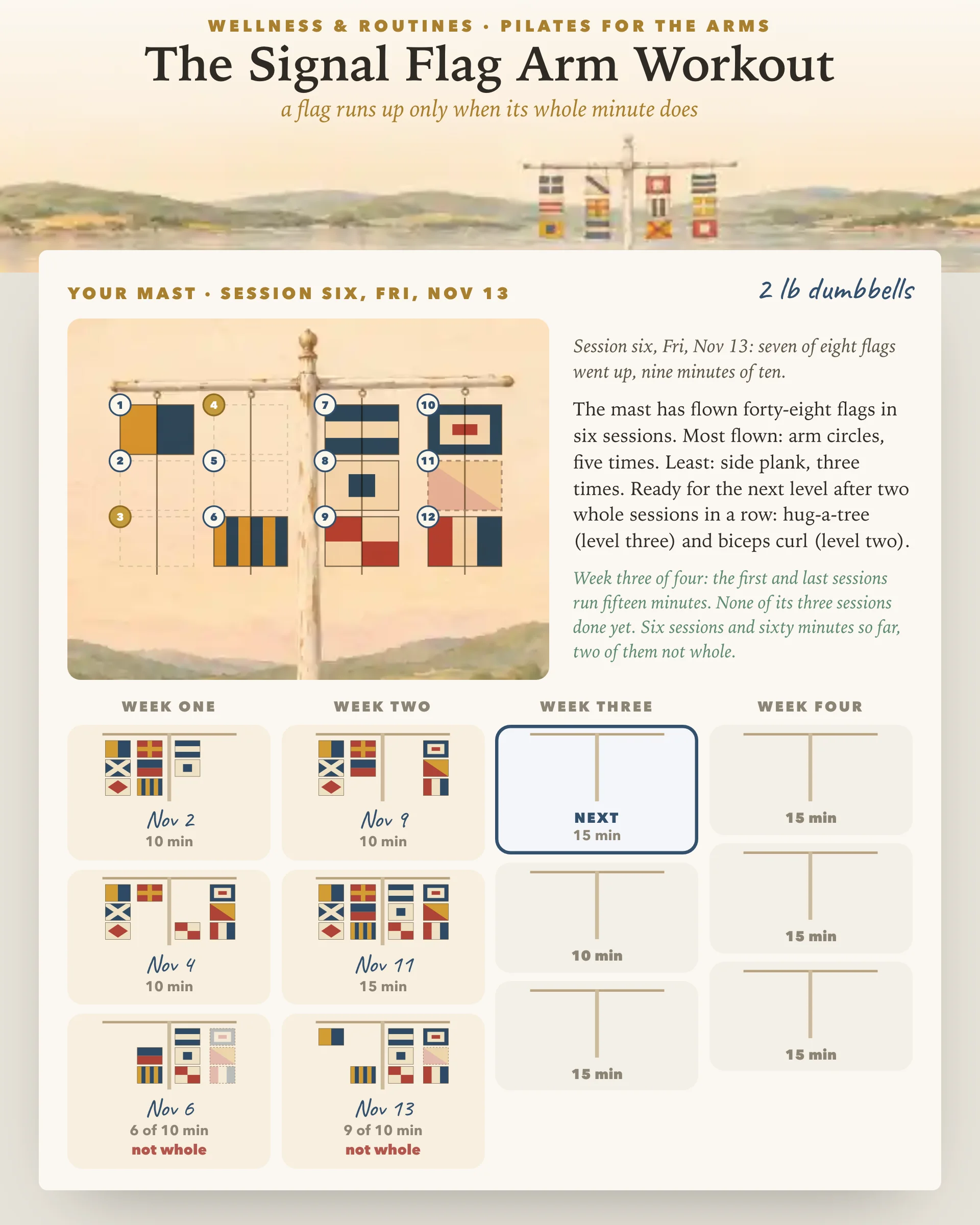
Each move owns a signal flag on a painted harbor mast. Ten minutes is a one-minute warm-up, eight one-minute moves and a one-minute cool-down; fifteen is a two-minute warm-up, all twelve moves and a one-minute cool-down. Each move's minute is ten seconds to get set and fifty seconds of slow work, or twenty-five seconds a side for side plank.
The clock runs on real time, so a locked phone keeps the true count, and pause holds it. A flag climbs while its minute runs and flies only once the whole minute has run. Skip a move or stop partway and its flag stays down; a session ended early keeps only its whole minutes, and skipped time never counts.
For ten minutes, the mast picks the eight moves flown least, or you tap your own in and out. What you hold, from hands only to a 1 to 5 lb pair, goes in the log with every session. When a move has run whole at its level in the two newest sessions that held it, with the same weights, its badge turns gold: ready for the next level. A session cut short breaks the row, and a move done at an easier level never counts toward going up.
The plan is twelve sessions over four weeks, three days a week. Week one runs ten minutes each time; in week two the middle session grows to fifteen; in week three the first and last run fifteen; in week four all three do.
The most direct trial is small: thirty older women were randomized to a Pilates program twice a week for twelve weeks or to a control group, and the Pilates group ended stronger at the elbow, with better scores on arm function tests. Within the Pilates group, though, of the two muscle groups tested only the elbow straighteners improved clearly from where they started. It was a small, short trial, and not a home routine.
A larger trial randomized 43 breast cancer survivors over 40, all on hormone therapy, to mat Pilates three times a week for 24 weeks, with harder levels and more repetitions added over time, or to a control group. Shoulder strength and upper body flexibility improved by twelve weeks. Those were hour-long sessions in one specific group, so they show a direction, not what fifteen minutes will do.
On the wall versions: in a force-plate study of 23 recreationally fit adults, push-ups from the knees or with the hands raised on a box carried a lighter load than regular push-ups. The wall itself was not tested, but it raises the hands higher still, which is why it sits at level one.
On light weights: a review of 21 studies found that light loads built muscle size about as well as heavy ones, while heavy loads did more for maximal strength. In those studies every set went to the point where one more rep was impossible. A Pilates minute rarely goes there, so treat this as practice in control and endurance, not a heavy strength program. None of these trials shows that arm work slims the upper arm; where fat goes depends on your whole routine of eating, sleep and movement.
Talk to a doctor or physical therapist before your first session if you have shoulder, neck or wrist pain, a recent injury or surgery, including breast or shoulder surgery, osteoporosis, or a heart or blood pressure condition. Breathe through every hold rather than bracing, and stop any move that hurts.
The Arm Toning Workout gives six moves with sets and reps you rate by feel, and The Eight-Arm Dumbbell Workout logs every dumbbell set with a rest timer. The Pilates Ring Squeezebox paces each squeeze of a soft ring. For a month of bodyweight arm work built from a day-one test, try The 30-Day Arm Challenge. This page sits between them: Pilates arm work in timed minutes, at three levels, with or without weights.
It is slow arm work in the Pilates style: a tall spine, shoulders down from the ears, the breath leading each rep, and light weights or none. Classic moves include arm circles, chest expansion, the hug-a-tree and a biceps curl done standing tall.
Yes. Every move here works with empty hands, and five of the twelve use only your own weight. Add a 1 or 2 lb pair, or a band, once the moves feel steady, and keep the same pair for a while so a move's progress can show.
No exercise takes fat off one spot. These moves can make the muscles of the arms and shoulders stronger and steadier, and how the upper arm looks over time depends on your whole routine of eating, sleep and movement.
Three days a week with a rest day between suits most beginners, which is what the four-week plan here follows. Ten minutes is enough to start, growing to fifteen by the last week.
No. It is an independent worksheet that borrows from the mat method Joseph Pilates developed, and no Pilates studio or teacher training body made or approved it.
By the team behind Fabulous, the science-based self-care app used by over 30 million people.


